The 'Invisible Qualifications' Checklist: What Is Your Real-World Experience Worth?
Map your daily management work to Diploma of Business competency units with this practical RPL checklist. See whether your experience qualifies.

Your Career Has a Qualification Hidden Inside It
You have the experience. Fifteen years of managing teams, controlling budgets, navigating compliance, and keeping operations running. You know this work inside and out. But on paper — in the systems that decide who gets promoted, who gets shortlisted, who gets through the university admissions portal — none of it counts. Not yet.
That is the invisible qualifications problem. Your competence is real. Your track record is genuine. But formal systems are built to read credentials, not careers. Recognition of Prior Learning (RPL) is the process that bridges that gap — it assesses your existing skills and experience against the requirements of a nationally recognised qualification, so that what you already know can be formally acknowledged.
This checklist is a translation tool. It maps the daily activities of experienced managers and business professionals to the competency units of the Diploma of Business (BSB50120) — a nationally recognised AQF Level 5 qualification. Work through it honestly. By the end, you will have a clearer picture of what your experience is worth in formal terms.
What Is the Diploma of Business — and Why Does It Matter?
The Diploma of Business (BSB50120) is a nationally recognised qualification on the Australian Qualifications Framework at Level 5. It covers financial management, people leadership, operational planning, business communication, and risk management — the core disciplines of anyone who has managed a team or run a business function.
Why does it matter beyond the credential itself? A Diploma of Business can open the door to advanced standing at university — meaning that some universities may accept it as a basis for entry into postgraduate programmes, potentially without requiring a completed undergraduate degree first. This is not a guarantee, and entry requirements vary by institution. But for experienced professionals who have been told they need to complete a three-year bachelor's degree before they can study at postgraduate level, the Diploma of Business is often the qualification that changes the conversation.
The Diploma of Business (BSB50120) is listed on the national training register with a current usage recommendation, confirming it is the active qualification code.
For a detailed explanation of how a Diploma of Business can open postgraduate university entry, see our article on the degree leapfrog pathway.
How to Use This Checklist
This is not a formal assessment. It is a self-audit tool to help you identify which of your daily activities map to Diploma of Business competency units. Work through each section and note which items apply to your current or recent role. The more items you recognise, the stronger your potential evidence base for an RPL application.
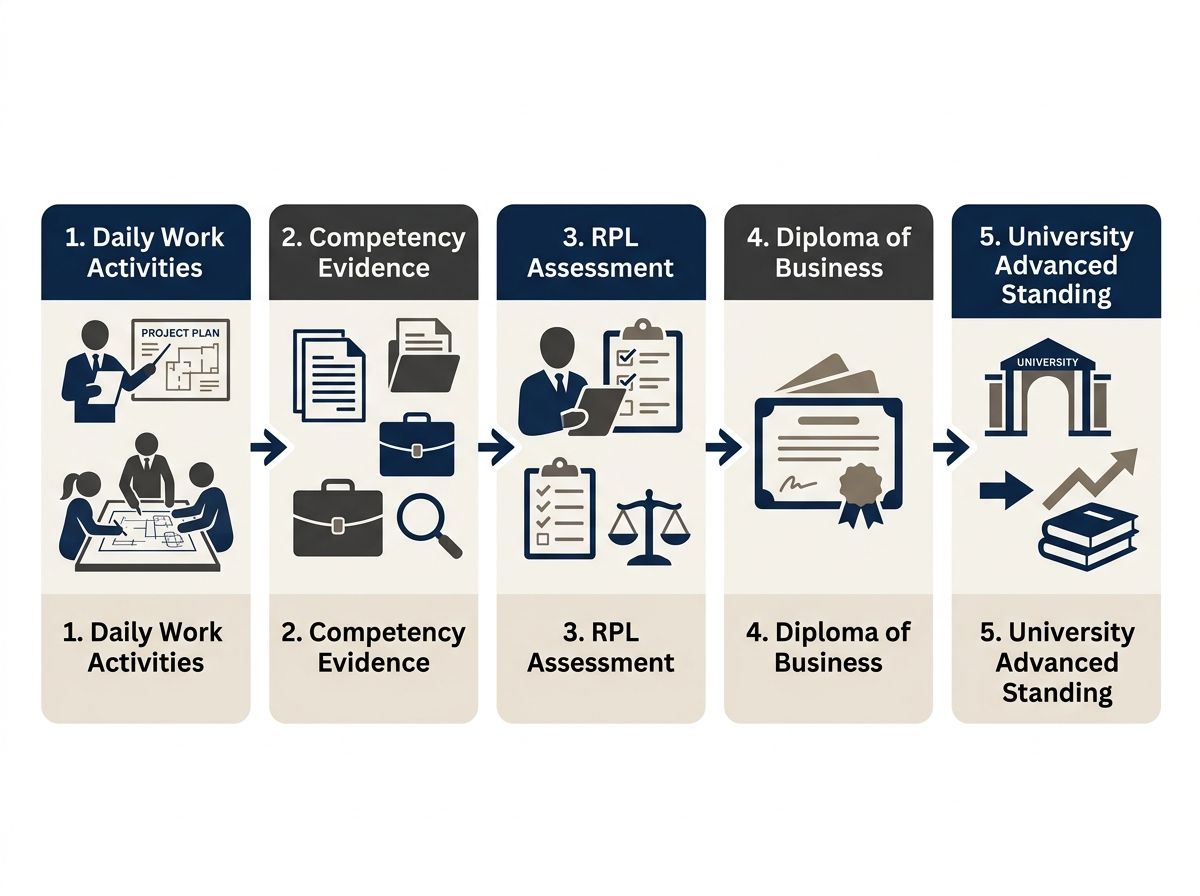
One important clarification: a qualified assessor from a registered training organisation (RTO) determines what counts as evidence and whether your experience meets the required standard. This checklist helps you prepare for that conversation — it does not replace it, and ticking boxes here does not mean a qualification is assured. RPL is a rigorous assessment process. What this checklist does is help you see what you already have.
Section 1: Financial Management and Budgeting
Many experienced managers handle financial responsibilities every day without thinking of them as formal competency evidence. If the following activities describe your work, your financial management experience may map to units within the Diploma of Business covering budget management and financial planning.
- You prepare, monitor, or report on a departmental or operational budget
- You track expenditure against budget and identify variances
- You approve or recommend spending within a defined authority level
- You forecast resource requirements for upcoming periods
- You prepare financial reports or summaries for management or stakeholders
- You manage cost control measures and identify savings opportunities
- You allocate resources — staff, equipment, or funds — across competing priorities
If most of these apply to your role, your financial management experience is likely relevant to the Diploma of Business. The specific units your assessor will evaluate depend on the elective stream of your qualification — confirm the exact units with your RTO.
Section 2: People Management and Team Leadership
This is often where experienced managers have the strongest evidence — and where the invisibility is most frustrating. You have had the difficult conversation with an underperforming team member. You have written the performance improvement plan. You have managed the roster through a staffing crisis. These are not just management tasks — they are formal competency evidence.
- You supervise, manage, or lead a team of two or more people
- You conduct performance reviews or appraisals
- You address underperformance or manage disciplinary processes
- You onboard, mentor, or develop team members
- You manage leave, rosters, or workforce planning
- You resolve workplace conflicts or interpersonal issues
- You set team objectives and monitor progress against them
- You provide feedback — formal or informal — to direct reports
- You have recruited, interviewed, or selected staff
People management is at the core of the Diploma of Business. If you lead a team — even informally — this section likely represents your strongest evidence area.
Section 3: Operational Planning and Project Coordination
Many experienced managers do not think of themselves as project managers — they think of themselves as people who get things done. But planning the office relocation, coordinating the system upgrade across three departments, managing the seasonal staffing surge — these are project management and operational planning activities. They just were not called that at the time.
- You plan and schedule work activities for yourself or your team
- You coordinate tasks or resources across multiple people or departments
- You have managed a project from initiation through to completion
- You develop or implement operational plans or work procedures
- You monitor progress against targets and adjust plans when needed
- You identify and resolve operational problems or bottlenecks
- You have implemented a process improvement or change initiative
- You manage competing priorities and deadlines across multiple workstreams
Section 4: Communication, Stakeholder Management, and Reporting
That presentation you gave last month? That is evidence. The supplier negotiation you led? That is evidence too. Professional communication and stakeholder management are formal competency areas within the Diploma of Business — and most experienced managers have been doing this work for years without recognising it as such.
- You write reports, briefings, or recommendations for management or stakeholders
- You present information to groups — internally or externally
- You manage relationships with clients, suppliers, or external partners
- You communicate policy changes, decisions, or updates to your team
- You represent your organisation or department in meetings or negotiations
- You adapt your communication style for different audiences — from frontline staff to senior executives
- You handle complaints, escalations, or sensitive communications
Section 5: Risk, Compliance, and Continuous Improvement
If you work in healthcare, community services, education, or any regulated industry, this section will feel immediately familiar. Managing workplace health and safety, ensuring regulatory compliance, and identifying operational risks are not just administrative tasks — they are formal risk management competencies that map directly to the Diploma of Business.
- You manage workplace health and safety obligations for your team or area
- You ensure your team or department operates within regulatory or policy requirements
- You identify, assess, or document operational risks
- You have investigated an incident, near-miss, or complaint
- You maintain compliance records, registers, or documentation
- You have implemented or contributed to a quality improvement initiative
- You monitor and review procedures to ensure they remain fit for purpose
- You report on compliance or risk matters to management
Reading Your Results: What Your Ticks Actually Mean
There is no pass mark here. This checklist is a starting point, not a verdict. But here is a practical guide to interpreting what you found.
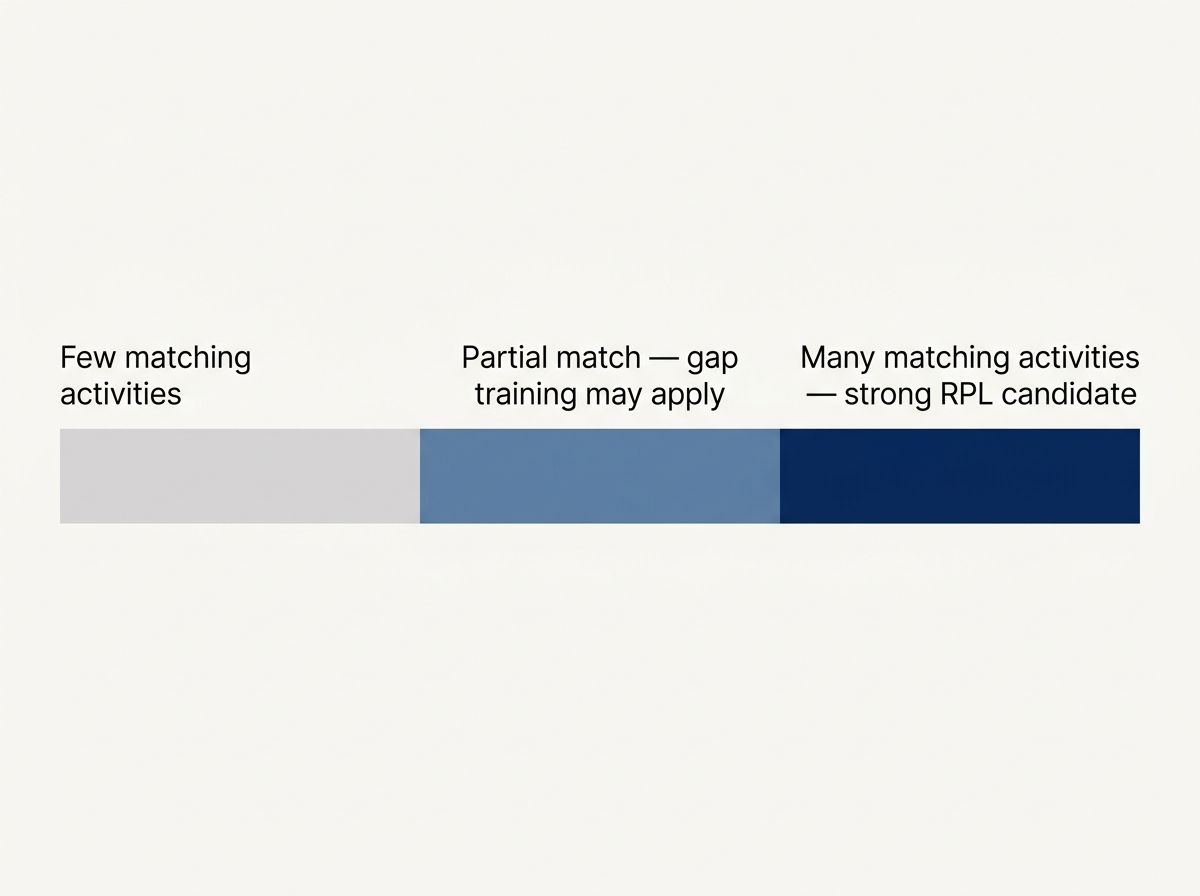
If you ticked most items across three or more sections, your experience likely maps well to the core competency areas of the Diploma of Business. This suggests you may have a strong evidence base for an RPL application — though only a qualified assessor from a registered training organisation can determine what counts and whether it meets the required standard.
If you ticked items in some sections but not others, that is also useful information. RPL assessments sometimes identify areas where a candidate's experience is strong in most units but thin in one or two. In those cases, gap training may be required to address the shortfall. Gap training requirements and any associated costs vary by RTO and qualification — always confirm the arrangements with the specific RTO before proceeding.
If very few items applied across all sections, RPL for the Diploma of Business may not be the right pathway at this stage — and that is honest, useful information too. RPL is a rigorous assessment process, and it works best when the experience is genuinely there.
The Churchill Education blog provides useful context on how the BSB50120 qualification replaced earlier Diploma of Business codes, including why some previous versions were deemed not equivalent.
From Invisible to Recognised: Your Next Step
You have done the audit. You can see what you have. The question now is what it counts toward — and that is a question worth answering before you commit to anything.
The Diploma of Business (BSB50120) is a nationally recognised qualification that reflects the real work of experienced managers. For many people, it is also the qualification that opens the door to university advanced standing — the pathway that turns years of professional experience into formal academic credit. Whether that pathway is right for you depends on your specific experience, your goals, and an honest assessment of your evidence.
That is exactly what a Free Skills Review is for. It is a no-obligation conversation — genuinely free, with no commitment to proceed — where we look honestly at what your experience is likely to support and what the process would involve. Your skills speak. We help them be heard.
To understand how a Diploma of Business can open the door to university advanced standing, visit our Fast Track University page.
Ready to Get Recognised?
Start with a free skills review to find out if RPL is right for you.