How Universities Score Your Career: The Unspoken Rules of Postgraduate Admissions
University admissions systems are built to read degrees — not careers. Here's the insider logic behind how professional experience is evaluated for MBA entry in Australia.

The admissions system wasn't built for you
You have spent fifteen, twenty, perhaps twenty-five years building something real. You have managed teams, driven strategy, navigated crises, and delivered results that degree-holders half your age are still learning to attempt. And now you are considering postgraduate study — an MBA, a Graduate Certificate, a Masters — and you are discovering something quietly frustrating: the system does not know what to do with you.
This is not a judgment on your capability. It is an architectural reality. University admissions departments are set up to process a single currency: academic qualifications. When a professional with twenty years of management experience applies without a recognised degree, the system encounters something it was not designed to handle efficiently. Understanding why this happens — and what you can do about it — is the first step toward changing your outcome.
What admissions officers actually look for (and why your CV isn't enough)
Admissions systems are built around standardised academic currencies. A qualification with a national code, an Australian Qualifications Framework level, and a registered awarding body behind it is something the system can process automatically. It maps to a known position in a known hierarchy. A transcript can be verified. A grade point average can be compared. These inputs are legible to the machine.
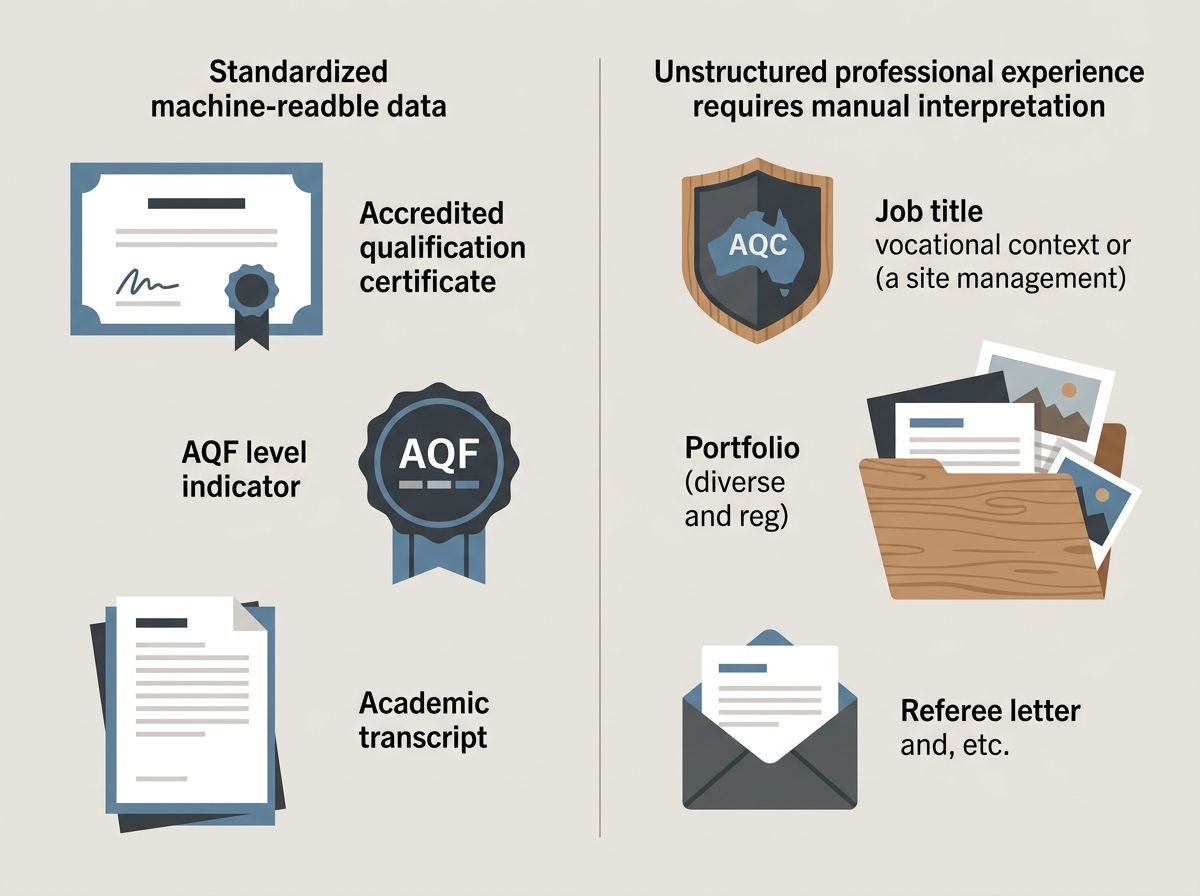
Professional experience — even decades of it — arrives in a different format. A job title is not a qualification. Years of service are not a transcript. A portfolio of achievements requires human interpretation, institutional judgement, and a willingness to make a subjective call. That is not impossible, but it is slower, less consistent, and less predictable than processing a standardised credential.
This is the quiet indignity that many experienced managers encounter — and it has a name. We explored it in detail in our article on why decades of management experience can be invisible to formal systems.
The assumption is that your experience speaks for itself. The reality is that the system cannot read your experience in its current form. That gap — between what you have done and what the system can process — is what this article is about.
The AQF: Australia's hidden scoring grid
Here is the framework most applicants never see. The Australian Qualifications Framework — the AQF — is the national policy that assigns levels to every regulated qualification in Australia, from Certificate I through to Doctoral Degree. It is the scoring grid that university admissions systems are built around. And most people applying to postgraduate programmes have never heard of it.
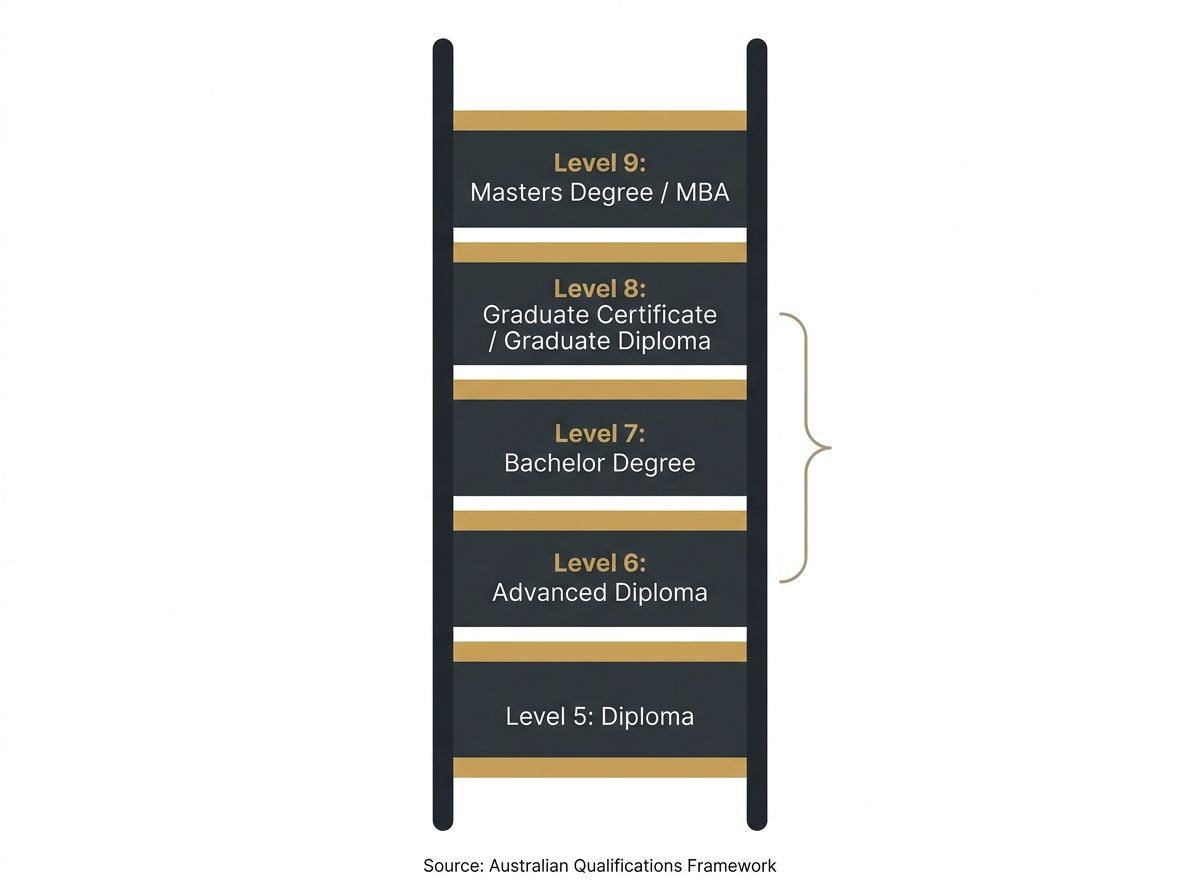
The AQF runs from Level 1 to Level 10. For postgraduate applicants, the relevant levels are these: Level 5 is a Diploma. Level 6 is an Advanced Diploma or Associate Degree. Level 7 is a Bachelor Degree. Level 8 is a Graduate Certificate, Graduate Diploma, or Bachelor Honours Degree. Level 9 is a Masters Degree — including the MBA. Level 10 is a Doctoral Degree.
These levels are publicly documented by the Tertiary Education Quality and Standards Agency (TEQSA), which regulates higher education providers in Australia and maps each qualification type to its AQF level.
When a university assesses a postgraduate application, the AQF level of the applicant's prior qualification is one of the first things it checks. A Bachelor Degree at Level 7 is the standard entry point for most postgraduate programmes. A Graduate Certificate at Level 8 may satisfy entry to a Masters. The system is designed to read these levels automatically. What it is not designed to read automatically is a career.
Why a VET qualification is a machine-readable credential
This is where the insight becomes practical. An accredited VET qualification — such as an Advanced Diploma of Business at AQF Level 6 — is a standardised credential. It has a national training package code, an AQF level, and a Registered Training Organisation (RTO) behind it. It is listed on the national register at training.gov.au. It is machine-readable in exactly the way a professional portfolio is not.
The Advanced Diploma sits at AQF Level 6. According to the AQF, qualifications at this level are available in both higher education and vocational education and training — making them a genuine bridge between the two sectors.
This is the core insight: your experience does not change when you secure a VET qualification. What changes is the format. The same capability that was invisible to the admissions system — because it existed as lived experience — becomes legible when it is assessed and recognised as an accredited qualification. The system can now read it. It has a level. It has a code. It maps to a known position in the AQF hierarchy.
We explored the specific pathway this creates — including how an RPL certificate can serve as direct advanced entry into postgraduate study — in our article on the AQF leapfrog pathway.
Advanced standing: the credit system most applicants don't know exists
Beyond entry, there is a second mechanism that most applicants never ask about: advanced standing. This is the formal process by which universities grant course credit for prior learning — reducing the total study required to complete a postgraduate qualification.
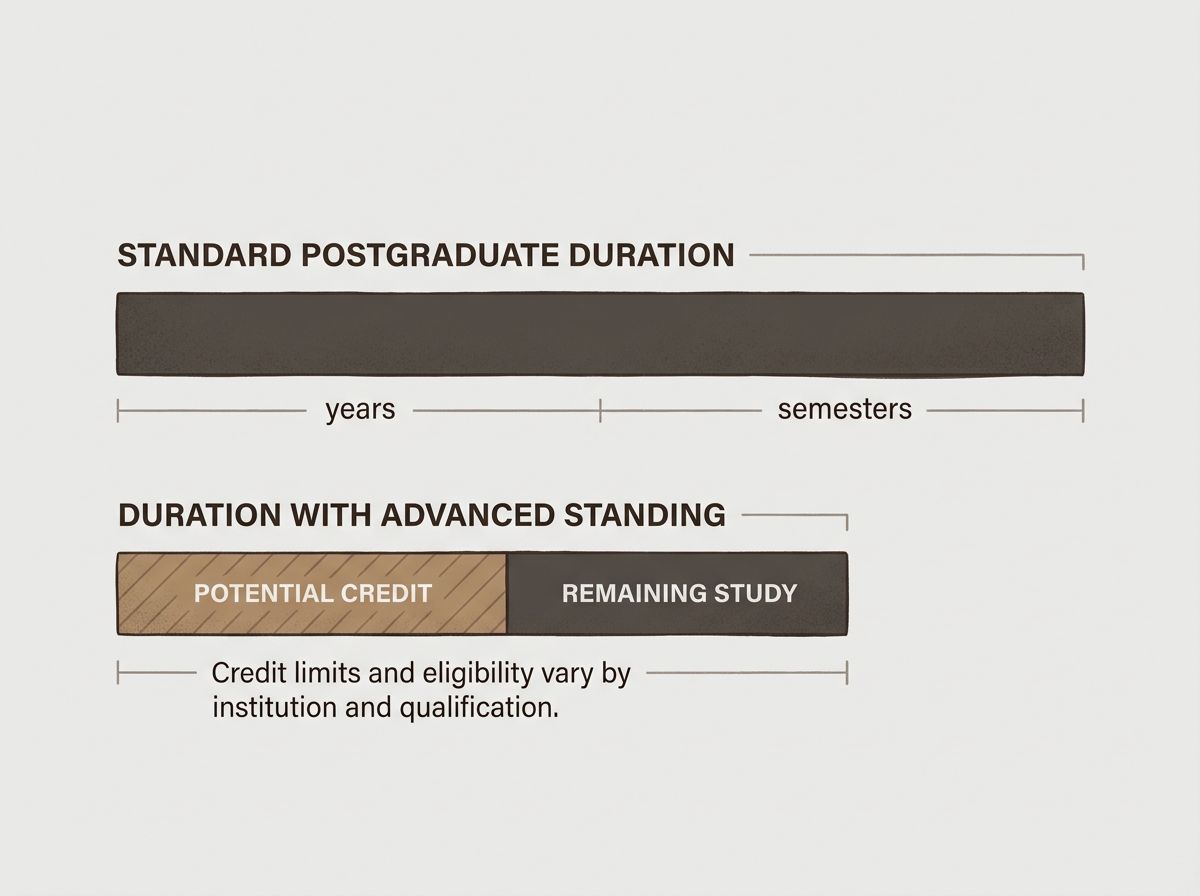
Under the Australian higher education regulatory framework, credit is defined as a recognition of equivalence in content and learning outcomes between different types of learning and qualifications. Credit can reduce the amount of learning required to achieve a qualification. It may be granted through credit transfer, articulation, RPL, or advanced standing.
TEQSA's guidance confirms that providers must have publicly accessible policies and arrangements for RPL and granting credit — so if you are considering a postgraduate programme, you can and should ask the institution directly about their advanced standing arrangements for applicants with VET qualifications.
The amount of credit available varies by institution and programme. Some universities publish specific credit schedules for VET qualifications; others assess on a case-by-case basis. The key point is that this mechanism exists — and most applicants never ask about it because they do not know it does. If you hold an Advanced Diploma at AQF Level 6 and are applying to a postgraduate programme, the question worth asking is: does this institution offer advanced standing for my qualification?
The manual review problem: why professional portfolios stall
When a professional applies to a postgraduate programme without a recognised qualification, the admissions team must conduct a manual review. This is not a flaw in the system — it is a logical consequence of how the system was designed. Systems built to process standardised inputs encounter friction when handling non-standard inputs. A portfolio requires human judgement. Human judgement introduces variability. Variability means longer timelines and less predictable outcomes.
TEQSA's guidance on credit and RPL acknowledges that any process for approving an RPL request should be grounded in evidence and academic judgement about equivalence of learning — and that providers' RPL policies should consider whether granting credit may disadvantage the student in achieving expected learning outcomes and maintaining the integrity of the qualification.
This is not a criticism of universities. It is a description of how careful, rigorous assessment works. The point is that a standardised VET qualification at the right AQF level bypasses this bottleneck entirely. It does not require a manual review of your career. It arrives in a format the system already knows how to process.
What this means for experienced professionals considering postgraduate study
The practical implication is this: if you have significant professional experience and are considering an MBA or postgraduate qualification, the pathway is not to submit a portfolio and hope. The pathway is to first secure a VET qualification that speaks the admissions system's language — and then apply with a credential the system can process.
This is the right sequence. Not because it is a shortcut. Not because it bypasses legitimate assessment. But because it matches how the system actually works. The AQF is the scoring grid. VET qualifications are machine-readable credentials. Advanced standing is a mechanism that rewards prior learning. RPL is the process that converts your experience into the credential that unlocks all of this.
One of the key objectives of the AQF is to facilitate pathways to, and through, formal qualifications. The framework was designed with this in mind. The pathway exists. Most people just do not know where to find the door.
If you are unsure whether this pathway applies to your specific situation — including whether your overseas qualifications or work history might qualify — our self-check guide walks through the key criteria honestly.
How RPL It guides the translation
RPL It specialises in guiding experienced professionals through the Recognition of Prior Learning process — helping them document their experience as evidence, navigate the assessment pathway, and secure the VET qualification that positions them for postgraduate entry or advanced standing.
The assessment itself is conducted by a qualified assessor from a Registered Training Organisation. RPL It guides and supports the candidate throughout the process; the RTO conducts the assessment and issues the qualification. If gap training is identified during assessment, it is provided at no additional cost. The qualification is nationally recognised because the assessment is genuine.
Your experience is real. The question is whether it can be translated into the credential the system needs. That translation is what RPL It does.
The regulatory framework for this process — including the requirements for how credit and RPL are assessed in Australian higher education — is published by TEQSA and is publicly accessible.
You have the experience. The system just needs it in a different format. Find out whether yours qualifies — free, and with no obligation.
Ready to Get Recognised?
Start with a free skills review to find out if RPL is right for you.