Why ten years on the tools is no longer enough for plumbing supervisor roles
Ten years on the tools used to guarantee a supervisor role. Now employers assign plumbing supervisor jobs by qualification, not experience. Here is why.
By RPL it Australia7 min read

The old rule: Experience earns the supervisor role
You have the experience. That is not in doubt. Ten years on site, across residential, commercial, and infrastructure projects, means you have solved problems that no training textbook covers. You have diagnosed faults that left apprentices stuck. You have run crews, managed job timelines, and kept worksites moving when unexpected issues arose. In the Australian plumbing trade, that kind of practical track record used to speak for itself. The most experienced worker on site stepped into the supervisor role. That was how the industry operated.
For a long time, this approach worked well. Supervisory authority in Australian plumbing, as in most other trades, was built directly on demonstrated competence. The person who knew the most, who had seen the most, and who could be trusted to make the correct call under pressure ran the site. Experience was the real credential, and your work was the proof.
If that is the industry you grew up in, the shift that has occurred over the past several years will likely feel unfair. It is unfair. However, understanding why this change occurred, and what it means for your career, is key to staying ahead.
What changed: Compliance now decides who supervises
This is the reality that experienced plumbers face across Australia. Employers and main contractors now assign supervisory plumbing roles based on formal qualifications rather than your years of experience on site. The Certificate IV in Plumbing and Services (CPC40920) is now the specific credential that determines who gets these roles. It is often not about who has the most trade knowledge, but who holds the required qualification.
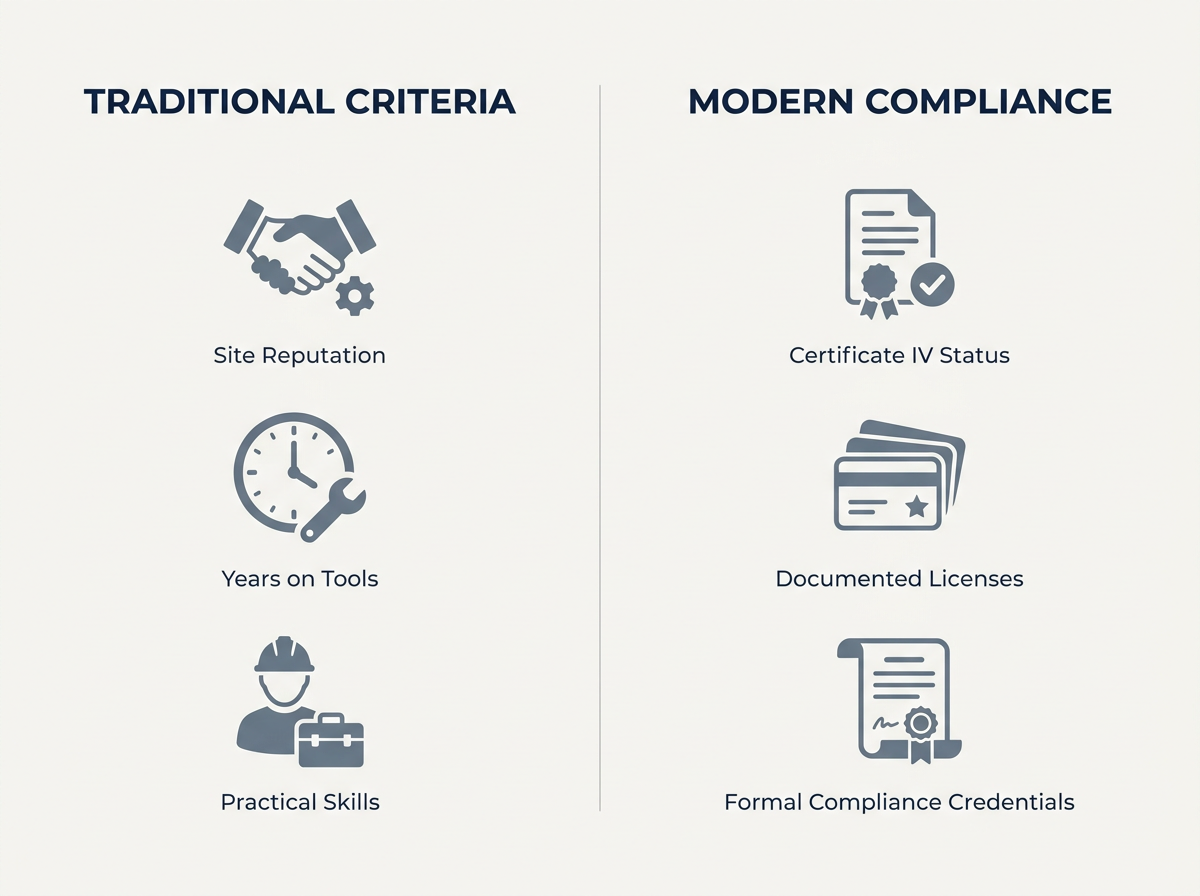
This shift is about compliance rather than competence. Main contractors on commercial and government projects now require documented proof that supervisors hold the correct qualifications. Insurance underwriters want to see that the person signing off on licensed work holds the qualification to back it up. Workplace health and safety regulations also create liability risks when personnel without formal qualifications are placed in supervisory roles.
As a result, the system cannot evaluate your experience directly. It only reads your formal qualifications. If your credentials stop at a Certificate III, the compliance framework places you below someone who holds a Certificate IV, even if that person has only half your time working on site.
The moment it becomes real
You have worked on site for ten years and know the trade better than anyone in your crew. Then the contract changes, the company wins a new government project, or the head contractor updates their subcontracting requirements. Suddenly, a new clause is introduced: all plumbing supervisors must hold a Certificate IV or an equivalent licence.
The role you have performed effectively and without incident is reallocated. This happens not because of a lack of skill, but because you cannot prove your expertise in the exact format the system requires. A colleague with less time on the tools but the right qualification is assigned the job. You might be moved to a different position, or told you need to get your ticket before the next project.
This is a real scenario that experienced plumbers across Australia face daily. The employer demands and compliance requirements are real, and the frustration of being evaluated by a system that does not recognize your practical site competence is entirely justified.
Why experience alone is now invisible to the system
It helps to understand how these systems operate. Licensing bodies, insurance underwriters, and head contractor procurement teams are not designed to assess your competence directly on site. They verify formal credentials. They do not ask if you can do the work; they ask if you hold the qualification that proves it.
This is how the system manages risk. When overseeing hundreds of subcontractors on a major construction project, managers cannot individually test every supervisor's practical knowledge. Instead, they verify credentials, check the regulatory boxes, and proceed. The Certificate IV is the specific box they need to check.
The compliance process tracks qualifications, not your personal competence. If your qualifications do not include the Certificate IV, your years of site experience remain unrecognized by the systems that control these job assignments.
Understanding this does not make it less frustrating, but it points to the solution. The issue is not your ability, but how that ability is documented. The Certificate IV provides the formal proof the system demands.
What the Certificate IV covers and why it is not starting from scratch
The Certificate IV in Plumbing and Services (CPC40920) is a nationally recognized qualification. It covers the supervisory, compliance, and technical tasks that experienced plumbing supervisors perform on site daily. This includes managing workplace health and safety on jobs, overseeing compliance with national codes and standards, coordinating crews and subcontractors, and managing the documentation required for licensed plumbing work.
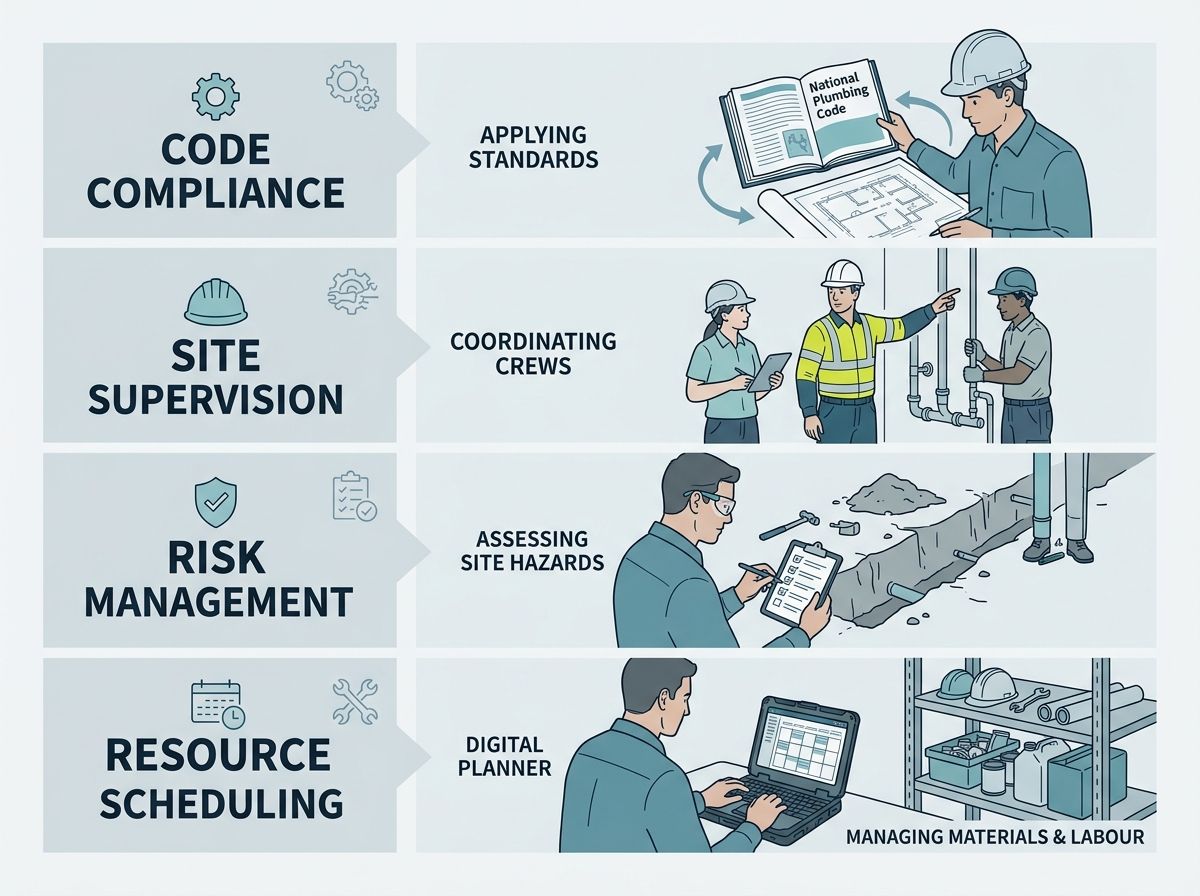
If you have been running jobs, even informally, you are already performing this work. The qualification does not teach you how to supervise; it formally recognizes that you already do.
- Managing compliance with the Plumbing Code of Australia and relevant Australian Standards, which you apply on every job
- Supervising and coordinating plumbing work on site, which you have done for years
- Identifying and managing workplace health and safety risks on plumbing projects as part of your daily practice
- Preparing and reviewing technical documentation for licensed plumbing work, covering the paperwork you already complete
This is not training designed for apprentices. It is an assessment process built to recognize the practical skills experienced plumbers already possess. The logical pathway for your situation is Recognition of Prior Learning (RPL), which avoids classroom study by focusing entirely on assessing your existing knowledge and site experience.
How RPL turns your site experience into a qualification
Recognition of Prior Learning (RPL) is a formal assessment pathway under the Australian Qualifications Framework. It is designed for tradespeople who have built skills through practical work experience rather than classroom study. For an experienced plumber, RPL allows your site history to serve as the evidence evaluated against the qualification requirements.
RPL is a formal assessment process, not a simplified shortcut. The assessor evaluates whether your current skills meet the national standards for the qualification. If they do, the qualification is awarded. If there are specific units where your documented work history does not fully cover the requirements, gap training is provided to address those areas. This training is a standard part of the process.
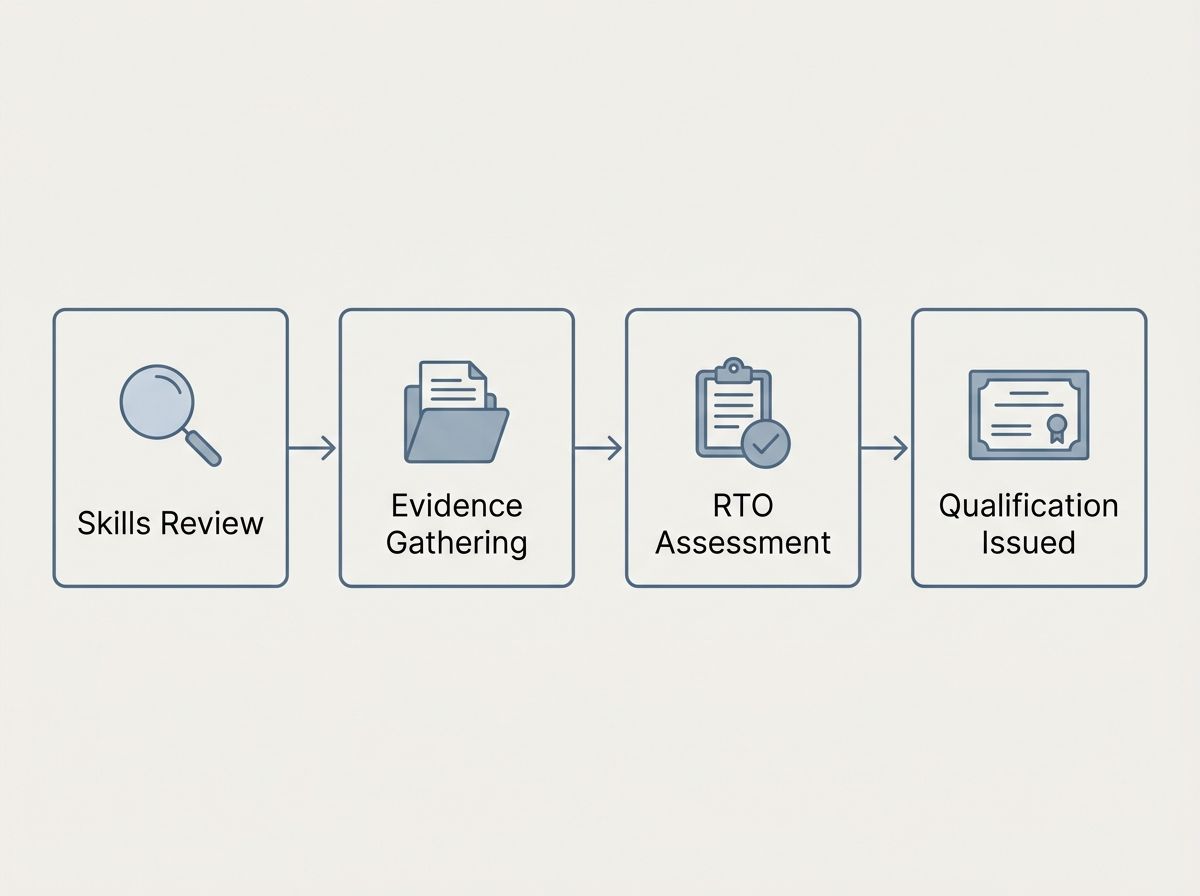
The RPL process typically involves these steps for an experienced plumber:
- A skills review to identify which qualification units your experience covers and any gaps that exist
- Gathering evidence of your practical experience, such as records of work, site documentation, employer statements, and project photographs
- An assessment by a qualified RTO assessor who reviews your evidence against the qualification requirements
- Gap training, if required, to address any specific skill areas not fully covered by your prior work
- The qualification is issued by the RTO upon successful completion of the assessment process
The assessment is conducted by a Registered Training Organisation (RTO), which issues the final qualification. RPL it helps you navigate the process, helping you understand what evidence is needed, how to compile it, and what to expect. The decision regarding your competency is made by the RTO assessor.
If going back to study has held you back, it is useful to see how the RPL pathway works in practice.
The first step costs nothing and commits you to nothing
At this stage, you are likely considering whether your experience is sufficient, whether the process is practical for you, and if this is the right time. These are the practical questions to ask.
The Free Skills Review is designed to answer these questions. It is a direct, no-obligation conversation about where your experience stands relative to the Certificate IV standards. This helps you determine if RPL is a viable pathway before making any commitment, ensuring you do not waste time or money.
These industry changes are structural and permanent. Compliance requirements will continue to dictate how supervisory plumbing roles are assigned. The main decision is ensuring your formal qualifications align with these standards to secure your place in the trade.
Your site experience and technical competence are established. The pathway to formal recognition is available when you choose to proceed.
Review the Certificate IV in Plumbing and Services (CPC40920) qualification details to see the complete scope of units covered.
General information only, current at the date shown. Licensing rules change, so check the current requirements with the relevant regulator before you rely on them. RPL it Australia is a student support service, not a Registered Training Organisation; qualifications are assessed and issued by our partner RTOs.