Trained in Fashion Overseas? What Transfers to an Australian Certificate IV
Overseas fashion training does not automatically count in Australia. Learn which skills transfer to the Certificate IV in Apparel and Fashion through RPL.
By RPL it Australia6 min read

Your training was real. The Australian system just doesn't know it yet.
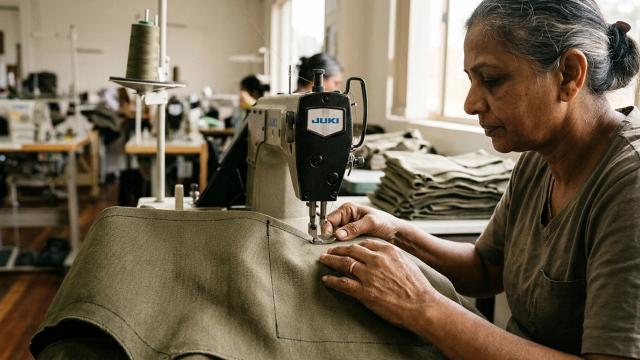
You have the experience. Years of it. Pattern-making, garment construction, production supervision, and quality control are skills you built through formal training and on real production floors, not in an Australian classroom. You arrived here knowing your craft. Then you discovered that none of it automatically counts.
This is a recognition gap, not a skills gap. Your expertise is real. The Australian qualification system simply has no way to see it yet. Your training was highly adequate, but it arrived in a form the system does not automatically recognise.
There is a formal pathway designed to bridge this recognition gap.
What the Certificate IV in Apparel and Fashion actually covers
The Certificate IV in Apparel and Fashion (MST40222) is a nationally recognised qualification that assesses competency at a senior production and supervisory level in the apparel and fashion industry. It sits above the Certificate III and covers the daily work that experienced fashion professionals, rather than beginners, actually perform.
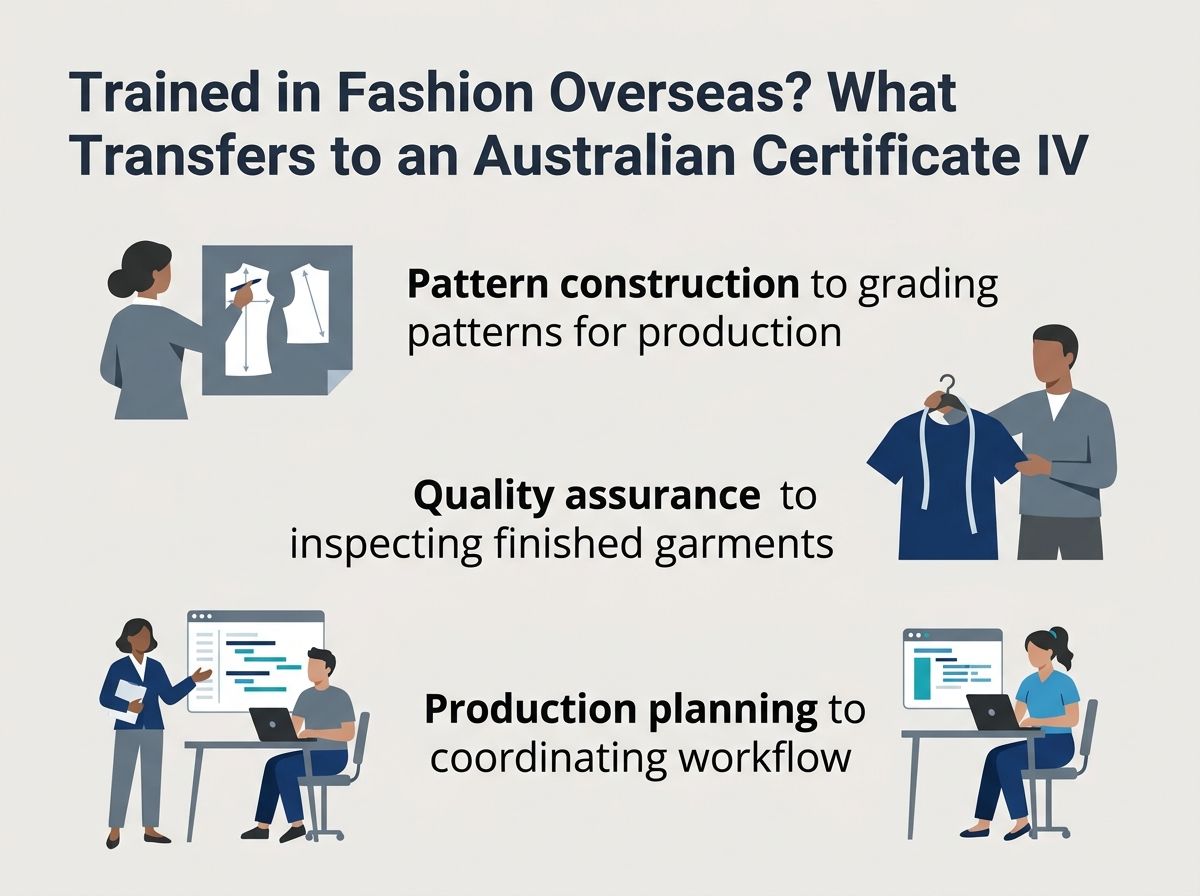
The qualification includes several core competency areas:
- Interpreting and applying design specifications for garment construction
- Constructing and grading patterns for production runs
- Supervising and coordinating garment production processes
- Applying quality assurance procedures to finished garments and production outputs
- Planning and managing production workflows
- Working with textiles, materials, and construction techniques at a professional level
- Understanding and applying workplace health and safety requirements in a production environment
If you have spent years doing this work in a factory, a design studio, a production house, or your own atelier, these competencies may already be part of your daily practice. The Certificate IV does not require you to learn new skills. Instead, it asks you to demonstrate the skills you already have.
What overseas training typically transfers, and what may need attention
This is where honest guidance matters. Not everything transfers automatically, and any pathway that tells you otherwise is not being straight with you. However, a great deal commonly does, and understanding this distinction is the first step toward a realistic assessment.
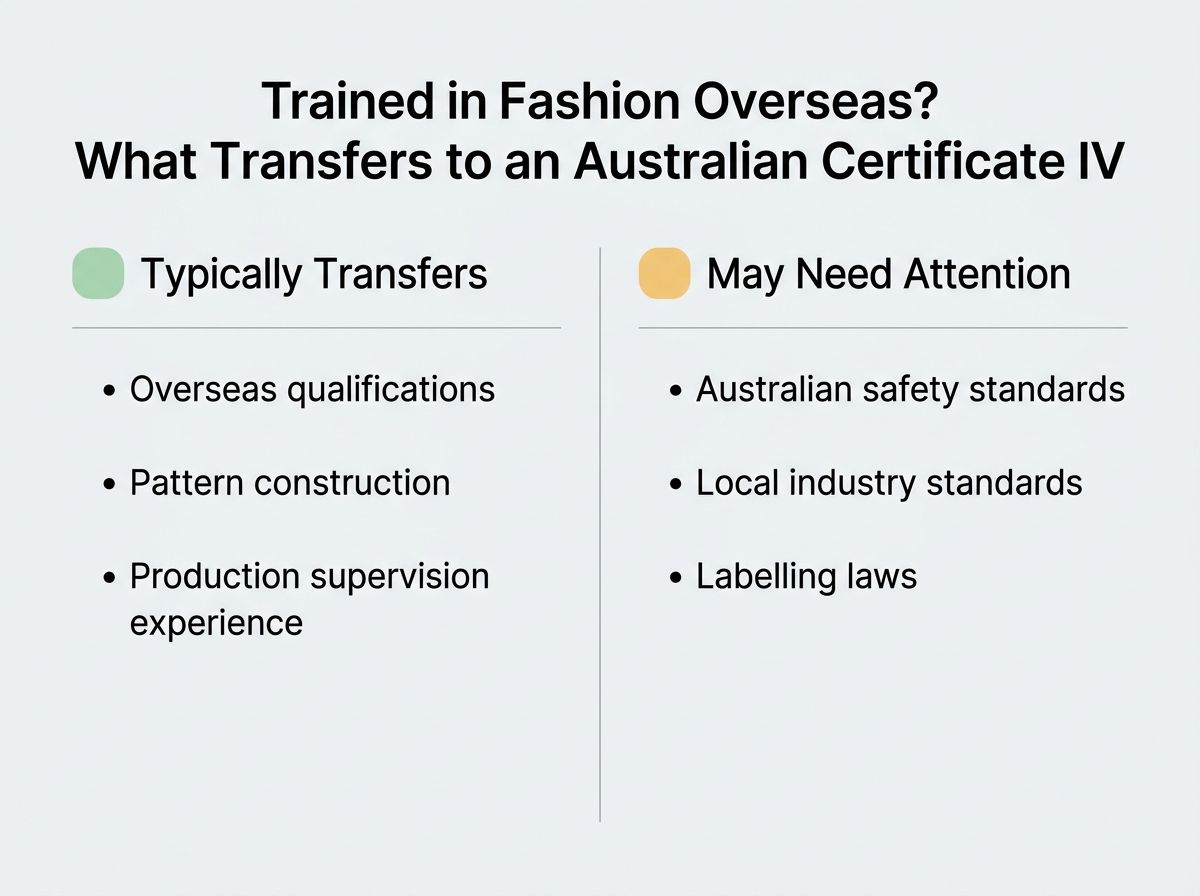
Overseas fashion training and work experience that commonly aligns with Certificate IV competencies includes:
- Formal fashion or textile design qualifications from recognised institutions in India, China, Southeast Asia, Europe, or other regions that covered pattern construction, garment assembly, and production techniques
- Production floor experience in garment manufacturing, including supervisory or quality control roles
- Design studio work involving the translation of design concepts into production-ready specifications
- Experience managing or coordinating production workflows, including scheduling, materials sourcing, and output quality
- Hands-on construction work across a range of garment types, fabrics, and production methods
Certain aspects may require additional attention, not as barriers to recognition, but as details to plan for:
- Australian-specific workplace health and safety requirements for garment production environments, which may differ from those in the country where you trained
- Familiarity with Australian industry standards and labelling requirements, which carry local specifics
- Any competency areas where your overseas training focused on different production methods or garment categories than those assessed in the MST40222 qualification
Where gaps are identified during a formal RPL assessment, gap training is provided as part of the process. Rather than stopping, you simply complete the step that fills in whatever competencies the assessment finds missing.
To see the types of evidence overseas-trained apparel workers can use to support an RPL application, read our guide on what counts as evidence for apparel and textiles RPL.
How RPL works for overseas-trained fashion professionals
Recognition of Prior Learning (RPL) is the formal process through which your existing skills and experience are assessed against the competency standards of an Australian qualification. It is not a shortcut. It is a rigorous, evidence-based assessment pathway that results in a nationally recognised qualification once competency is demonstrated.
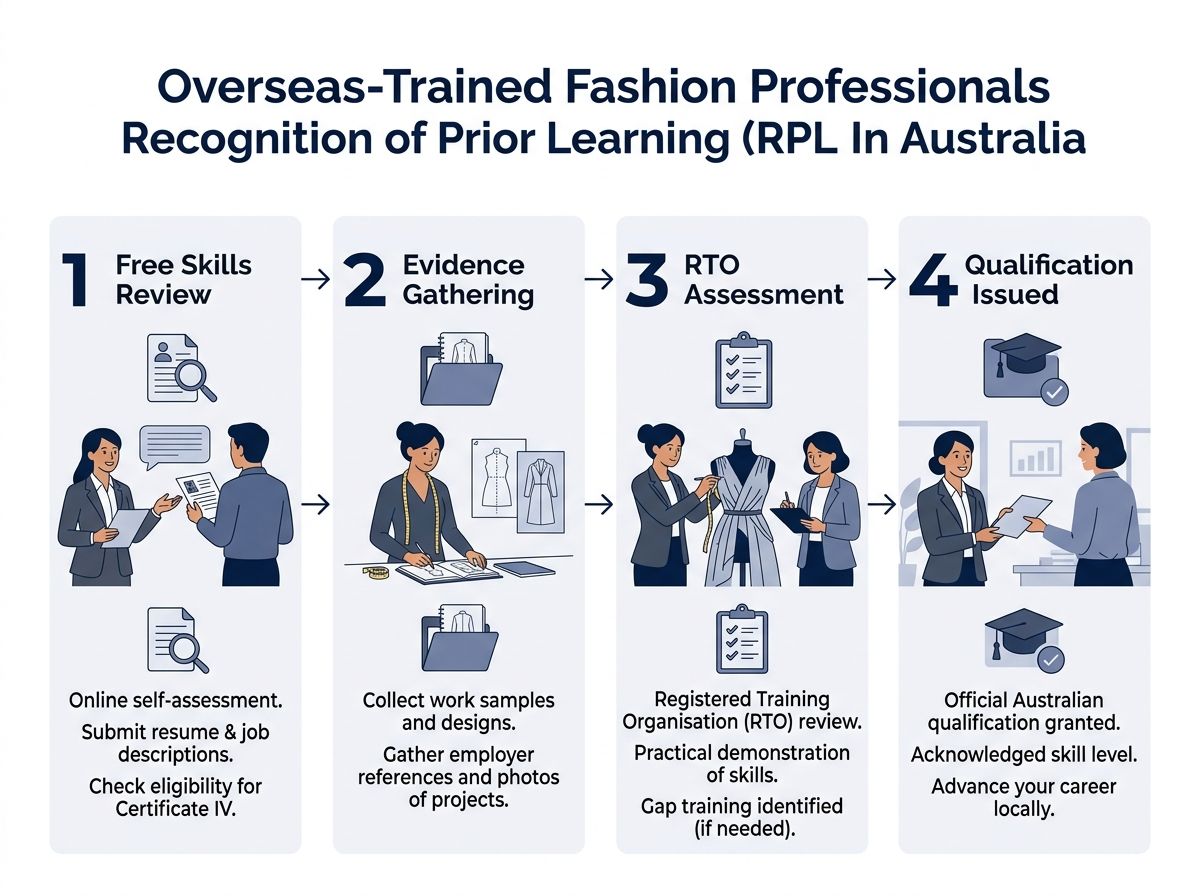
For overseas-trained fashion professionals, the RPL process generally follows these steps:
- A skills review is conducted to evaluate your background, training, and work history, giving you an honest picture of how your experience maps to the Certificate IV competencies
- You receive guidance on gathering evidence, which may include a portfolio of your work, employer references, letters from supervisors, production records, photographs of garments you have constructed or supervised, and documentation of your overseas qualifications
- A qualified assessor from a registered training organisation (RTO) reviews your evidence against the MST40222 competency standards
- Where competency is demonstrated, the RTO issues the qualification. Where gaps are identified, gap training is provided at no additional cost before the qualification is awarded
RPL it guides you through this process. The assessment itself is conducted by a qualified assessor from a registered RTO, as they are the authority that determines competency and issues the qualification. Our role is to make the pathway clear, helping you understand what evidence to gather, how to present it, and what to expect at each stage.
Your experience is valuable evidence, and the RPL process is how that evidence is formally assessed.
To understand how overseas garment experience is used as RPL evidence in practice, read our guide on overseas pattern-making and sewing experience.
The first step costs nothing and commits you to nothing
The most common reason people with genuine overseas fashion training do not pursue Australian recognition is uncertainty. They often do not know if their background is sufficient, where they should start, or whether they want to invest time in an assessment process without knowing the outcome.
A Free Skills Review is designed to resolve that uncertainty honestly, before any commitment is made. It is a no-cost, no-obligation conversation about your background and how it maps to the Certificate IV in Apparel and Fashion. If your experience aligns well, you will know. If there are gaps, you will also know, and you will understand exactly what is required to address them.
The decision to proceed is entirely yours.
What happens after the skills review
If your skills review indicates that your overseas training and work experience align with the Certificate IV in Apparel and Fashion, the next step is gathering evidence. You will be guided through what to collect and how to present your portfolio, references, production records, and overseas qualification documents.
That evidence goes to a qualified assessor at a registered RTO. They review it against the MST40222 competency standards. Where competency is demonstrated, the qualification is issued, granting you a nationally recognised Australian Certificate IV in Apparel and Fashion. Where gaps are found, gap training fills those needs before the qualification is awarded.
The qualification is nationally recognised because the assessment is thorough and genuine. That rigor is what makes the certificate valuable.
Your overseas training is real. The recognition gap is real too, but it is entirely navigable. The pathway exists, and the first step is finding out whether it applies to your experience.
To learn more about what fashion and textiles RPL assessors look for from overseas-trained professionals, read our guide on what evidence fashion and textiles RPL assessors look for.
General information only, current at the date shown. Licensing rules change, so check the current requirements with the relevant regulator before you rely on them. RPL it Australia is a student support service, not a Registered Training Organisation; qualifications are assessed and issued by our partner RTOs.