What counts as evidence for fashion and textiles RPL when you trained overseas
Overseas-trained in fashion or textiles? See exactly what evidence (portfolios, production records, and references) counts for RPL in Australia.
By RPL it Australia9 min read

Your fashion and textiles experience is real, but proving it on Australian terms is the challenge
You have the experience. Years of it. Pattern-making, garment construction, textile production, and design work: these are skills built through real work in real studios and factories. Back home, that experience spoke for itself. Here, it can feel invisible.
This is not because your skills are missing, but because your evidence is currently in a format that Australian assessors cannot easily verify.
Overseas-trained fashion and textiles professionals face specific documentation challenges. Your work history might be recorded in another language. Your former employer may no longer operate. Your portfolio may sit on an old hard drive or belong to a closed studio. Your qualifications might have been issued by an institution unknown to Australian assessors.
None of this means you cannot get recognition for your experience. It simply means you need to understand what Australian RPL assessors look for, and how to present your existing materials to meet their standards.
This article is a practical guide to gathering that evidence. It focuses on the Diploma of Apparel, Fashion and Textiles (MST50122), a qualification covering design, production management, and commercial operations in the industry. If you work at this level, the evidence you need is different from what a Certificate III applicant provides. We will review each type of evidence, explain what makes it useful, and outline its limitations.
If your overseas experience is primarily in design and production management, the companion article on overseas fashion design and production management experience explains the broader recognition framework.
What RPL assessors look for at the diploma level
RPL does not require you to prove you attended a course. Instead, it requires you to show you can perform the competencies covered by the qualification, regardless of where or how you learned them.
At the Certificate III level, assessors look for hands-on production skills such as garment construction, textile handling, machine operation, and quality checking. At the Diploma level, the requirements shift. The Diploma of Apparel, Fashion and Textiles (MST50122) covers competencies in design development, production planning, coordination, quality management, supplier communication, and business operations.
This distinction directly affects your evidence. A portfolio of finished garments shows production skill, but it does not prove that you managed production schedules, negotiated with suppliers, or made design decisions that balanced commercial and aesthetic needs. Diploma-level evidence must demonstrate both hands-on execution and management.
Assessors use several methods to evaluate your skills, including reviewing your portfolio, checking employment records, conducting structured technical interviews about your work history, and occasionally asking for a written self-assessment. The focus of each method varies by Registered Training Organisation (RTO), so you should confirm the exact process with your chosen provider.
The primary question assessors need to answer is whether your demonstrated experience covers the competency standards of the qualification. Your goal is to provide evidence that answers this question clearly, specifically, and honestly.
Design portfolios: what counts and what does not
A design portfolio is effective RPL evidence when it documents your design process rather than just the final product. Completed garments are useful, but the planning and developmental work behind those garments is far more valuable to an assessor.
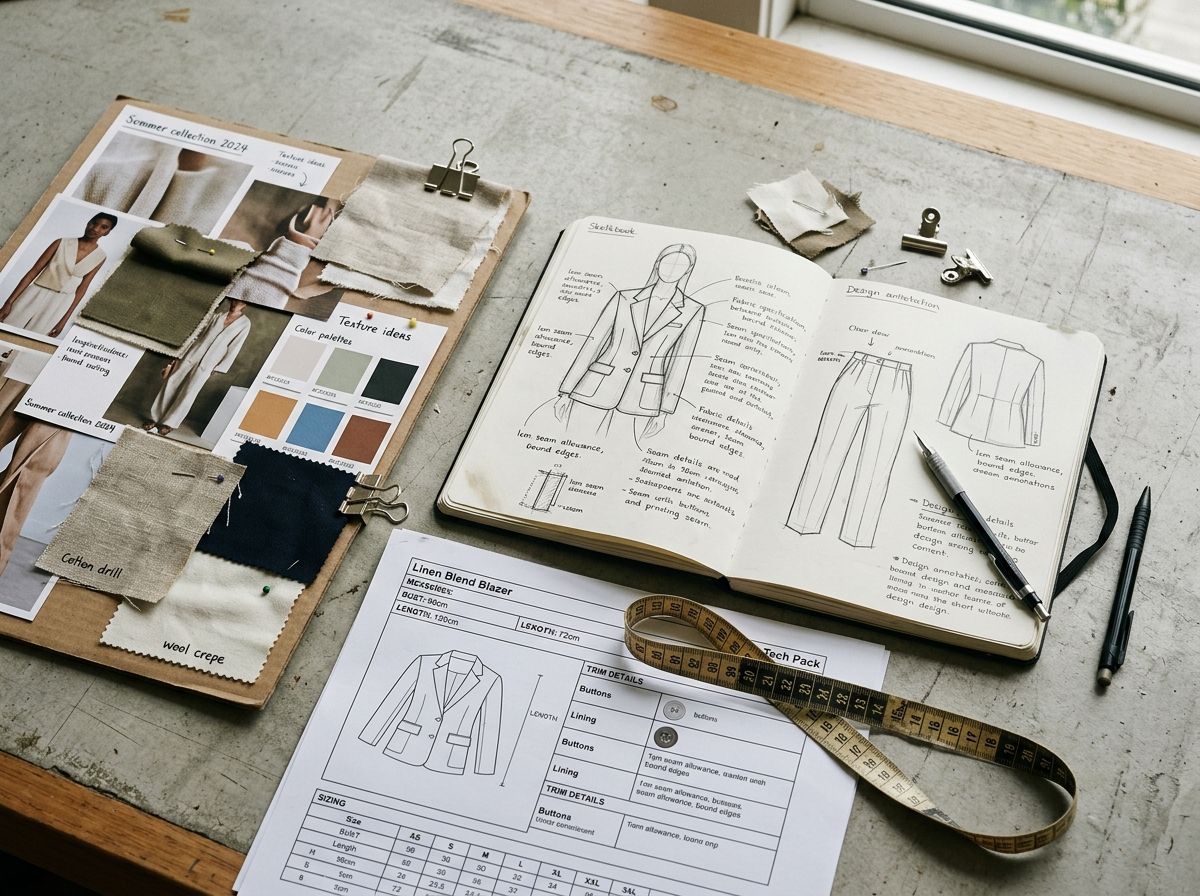
Portfolio evidence that carries weight in a diploma assessment includes:
- Design sketches and technical drawings showing how a garment or textile product was developed
- Mood boards, concept development materials, and trend research demonstrating your creative process
- Technical specifications, pattern documentation, and construction notes showing how you prepared designs for manufacturing
- Photographs of finished work with details of the client brief, project constraints, and final application
- Written documentation of client or brand briefs you resolved during your career
A portfolio consisting only of photos of finished work has limited value for a diploma-level assessment. It shows outcomes but hides the process. Assessors must see your decision-making regarding construction, materials, fit, and aesthetics, rather than just your ability to execute someone else's plan.
Regarding file formats: acceptance of digital portfolios depends on the RTO. Many assessors review digital submissions such as PDF portfolios, professional website links, or curated image folders. Others may request physical samples or printed sheets for specific units. Confirm these formatting preferences with your RTO before compiling your files.
Assessors do not discount overseas design work simply because it was completed outside Australia. The key factor is whether the work proves you possess the required skills, regardless of geography or client identity.
For a broader overview of evidence types relevant to apparel and textiles RPL, the article on evidence for apparel and textiles RPL covers the Certificate III context and provides useful baseline information.
Production records and work history: turning employment into evidence
Overseas employment records are acceptable RPL evidence. Their usefulness depends entirely on specificity: the more clearly they detail your day-to-day duties, the more weight they carry with assessors.
Practical production and employment records include:
- Job descriptions and employment contracts detailing your specific roles and daily tasks
- Production schedules, run sheets, and planning spreadsheets you created or managed
- Quality control reports, inspection logs, and product compliance documents
- Supplier emails, purchase orders, and material sourcing logs
- Internal messages showing you coordinated work across manufacturing teams or vendors
- Payslips, bank records, or official tax documents confirming your employment dates
Non-English documents are eligible for review, but translation rules vary between training organisations. Some RTOs accept certified translations, while others have strict guidelines about who can perform the translation. Before paying for translation services, ask your RTO about their specific policy. Do not assume you must have a NAATI-certified translation, but avoid using informal or unverified translations.
If your records no longer exist, you are not alone. This is common for overseas-trained professionals whose previous employers have closed or cleared old archives. When original paperwork is unavailable, a statutory declaration (a formal written statement witnessed under oath) is often accepted as supporting evidence. While it does not fully replace primary records, it can strengthen your file. Check with your RTO to see which templates they accept and what details you must include.
Be upfront about documentation gaps. An application that clearly notes missing records and explains why they are missing is more credible than one that exaggerates the available paperwork.
Employer references and third-party reports: who can verify your skills
Third-party verification is highly valued by assessors because it comes from an independent source. A detailed reference from a former employer or manager can confirm skills that are hard to show through files alone, such as communication style, professional judgment, and performance under pressure.
Valid third-party referees include current or former employers, immediate supervisors, senior colleagues who monitored your tasks, clients who commissioned your designs, or industry peers familiar with your work. The essential requirement is that they can describe your actual duties, rather than just confirming your employment.
A strong reference letter for your RPL portfolio should include:
- The referee's full name, current job title, and professional relationship to you
- The dates and workplace setting of your employment
- Specific descriptions of your day-to-day tasks instead of general praise
- Observed skills and responsibilities explained in clear, plain language
- Direct contact details so the assessor can verify the details if necessary
Requesting references from overseas colleagues who do not know the Australian vocational system can feel difficult. Explain what you need clearly and simply. They do not need to understand the formal training framework: they only need to describe your practical work. Sending them a brief template or bulleted list of your past tasks can make the process easier for everyone.
References from clients, such as fashion brands, retail buyers, or independent designers who commissioned your work, are acceptable third-party evidence, provided they explain your professional involvement rather than just confirming a financial transaction.
Qualifications and certificates from overseas: how to use them
Your overseas qualification shows you completed formal study, while your work history shows you can apply those skills in industry. Both carry value, but they serve different purposes in your RPL application.
Overseas qualifications are not automatically equivalent to Australian credentials. You cannot use them as a direct substitute for showing hands-on skills. However, they provide useful background information by showing the formal training structure that underpins your work experience.
If your overseas course covered topics that match the units in the Diploma of Apparel, Fashion and Textiles (MST50122), highlight this in your application. While this does not guarantee immediate credit, it helps the assessor understand your training background.
Non-English documents, including academic certificates, transcripts, and course outlines, must usually be translated before submission. Verify the exact translation rules with your RTO before spending money on these services.
RPL and overseas qualification assessment are entirely separate processes. RPL measures your practical experience against specific units of competency. Qualification recognition, which is often needed for visa applications or professional registrations, is handled by different authorities. If your visa pathway requires a formal skills assessment, you must manage that process independently. Since visa rules change frequently, consult a registered migration agent for advice on immigration requirements.
If your overseas experience includes pattern-making and garment construction at the production level, the article on overseas pattern-making and sewing experience explains how to translate those specific skills into formal RPL evidence.
Self-assessment: does your evidence align with the diploma?
Before you start an RPL application, review your current records. The Diploma of Apparel, Fashion and Textiles requires a broader range of skills than entry-level manufacturing roles. These questions will help you see if your evidence matches the required units, and where you might need to find extra documentation.
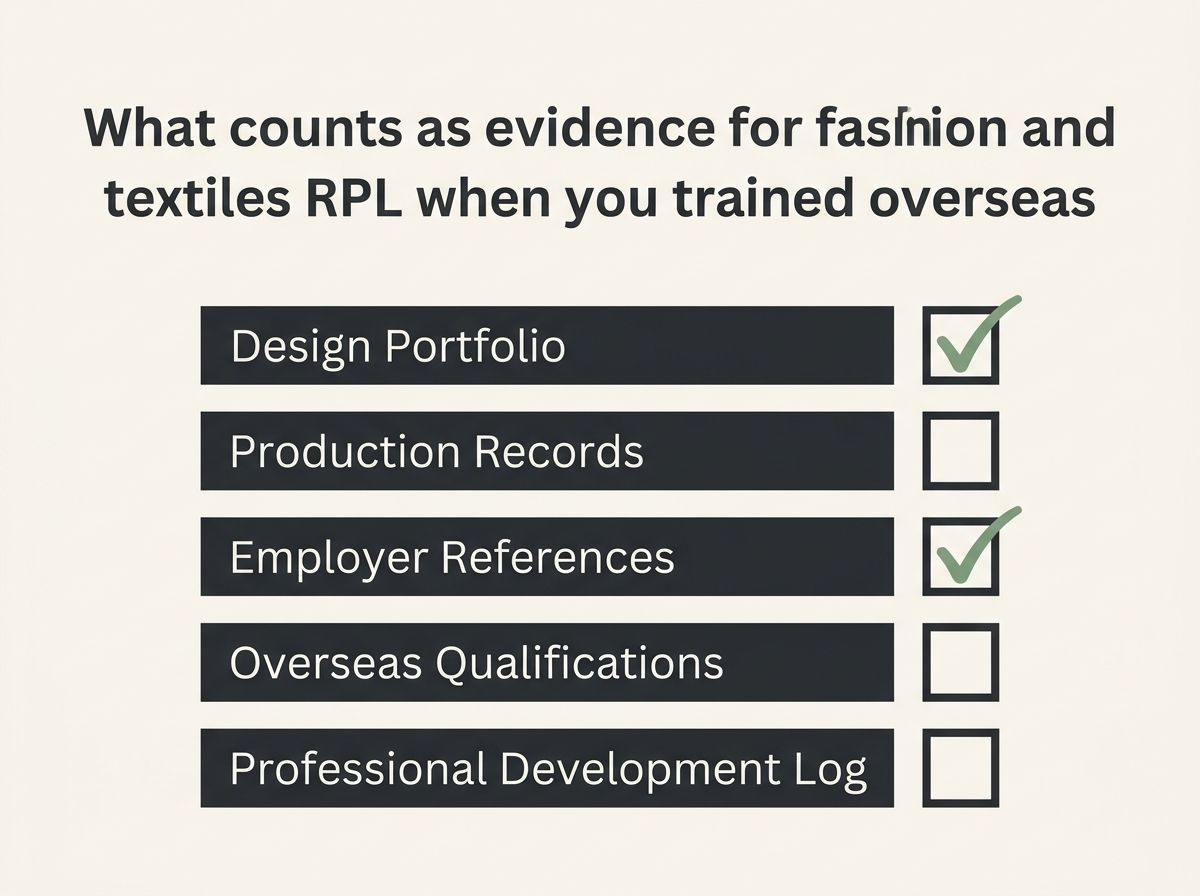
Review your files against these questions:
- Can I show my design process using sketches, technical specifications, or conceptual work instead of only finished garments?
- Do I have documentation for manufacturing coordination, including production schedules, spreadsheets, or supplier emails?
- Can I prove my involvement in quality control through inspection checklists, testing logs, or quality standards?
- Do I have evidence of client interactions, such as responding to commercial design briefs or managing brand accounts?
- Can I verify the timeline of my career in the fashion industry, even if some of my past employer files are missing?
- Are there colleagues or managers who can confirm my daily responsibilities in a formal reference or interview?
If you can answer yes to most of these points, your overseas background is likely sufficient to support an RPL application for the Diploma. If several areas look weak, you can either look for more evidence or consider a different qualification level that matches your records more closely.
This review is not meant to turn you away. It is designed to help you begin the recognition process with a clear understanding of your file and any areas that need attention.
How the free skills review works
You have the skills. The task now is to determine whether your current documentation is enough to satisfy the requirements of a formal application.
A Free Skills Review with RPL it is a practical first step. It is a conversation with no obligation to proceed, focusing on your background, your portfolio, and whether the Diploma of Apparel, Fashion and Textiles is the right pathway for your goals. It is not an assessment or an enrollment contract, but a straightforward evaluation of your files.
If your evidence is solid, you will get a clear path forward. If you have gaps in your paperwork, we will identify them so you can address them before spending time or money on a formal application.
You can find more information about the Diploma of Apparel, Fashion and Textiles and the RPL process on the qualification page.
Getting your experience recognised should not mean starting your training from scratch. Your skills have value, and we help you present them clearly to Australian assessors.
General information only, current at the date shown. Licensing rules change, so check the current requirements with the relevant regulator before you rely on them. RPL it Australia is a student support service, not a Registered Training Organisation; qualifications are assessed and issued by our partner RTOs.