The Horticulture Qualification Pathway Built Specifically for Career-Changers
Spent years in professional horticulture but assumed you had to study from scratch? Learn how RPL recognizes your existing trade skills.
By RPL it Australia6 min read

The pattern nobody warns you about when you transition into horticulture
You have the experience. You know how to read a soil profile, manage an irrigation system, identify a pest problem before it spreads, and interpret a client's brief into a finished landscape. You have done this work professionally and repeatedly for years.
Then you attempt to move into a role that requires a formal horticulture qualification, or you enquire about study. The formal system looks back at you as if you have never handled a plant in your life.
This is a common experience. It is a consistent pattern with three distinct stages that most career-changers in horticulture experience, usually without anyone identifying what is happening or explaining that an alternative route exists.
Stage one: building skills without the certificate
The first stage is the one you have already lived. You accumulated practical horticultural knowledge as a professional rather than a hobbyist. Perhaps you spent years as a landscape gardener managing residential and commercial sites, or worked in nursery operations learning propagation, plant health, and stock management. Perhaps you managed parks and gardens for a local council, or worked on a commercial farm where horticulture was the primary business.
Your daily tasks were highly practical. You pruned and shaped established trees, selected plant species appropriate to soil and climate conditions, and applied fertilisers. You regularly diagnosed pest and disease problems, managed irrigation schedules, communicated with clients about design goals, and supervised other team members on site.
These are not peripheral skills; they are the exact competencies that national qualifications evaluate. This knowledge is real, developed through years of practical work instead of classroom theory. This distinction, based on where your skills were learned rather than whether you possess them, is what typically creates the initial barrier.
Stage two: the system treats you like a beginner
The second stage is the disconnect. You apply for a role that requires a Certificate III in Horticulture, or you contact a training provider to ask about study options. The response you receive from employers or enrolment officers is almost always calibrated to someone who is starting with zero experience.
The employer focuses on the absence of a certificate rather than your actual capability. The training provider offers you a standard enrolment pathway that starts from day one. Nobody asks what you already know or what you have done. The formal system relies on a single question: do you hold the qualification? When the answer is no, you are treated as a beginner.
This is the point that defines the pattern. It does not reflect your actual trade capability. Instead, it is a structural feature of how standard training systems are set up, and how rarely they clearly explain the alternative pathways that exist within them.
Stage three: assuming there is no other way
The third stage is the conclusion most people naturally reach: that the only options are to enrol in full-time study or abandon the idea of formal qualification entirely. You assume you must either start from the beginning or remain in your current position without recognition.
This conclusion is entirely understandable, but in most cases, it is incorrect.
There is a formal pathway within Australia's national training system built specifically for people who have developed professional competence outside the classroom. It is called Recognition of Prior Learning (RPL). In the horticulture sector, this option is rarely highlighted when career-changers need to hear about it most.
This pathway is a formal assessment process recognised under the Australian Qualifications Framework. Through RPL, experienced workers have their existing skills assessed against national qualification standards, allowing you to bypass redundant training for things you already know how to do.
How the horticulture qualification pathway works in practice
Recognition of Prior Learning is a formal assessment pathway. It is not an effortless shortcut, as you must demonstrate your professional competence through evidence. However, it does not require you to sit in a classroom learning concepts you already practice every day on the job.
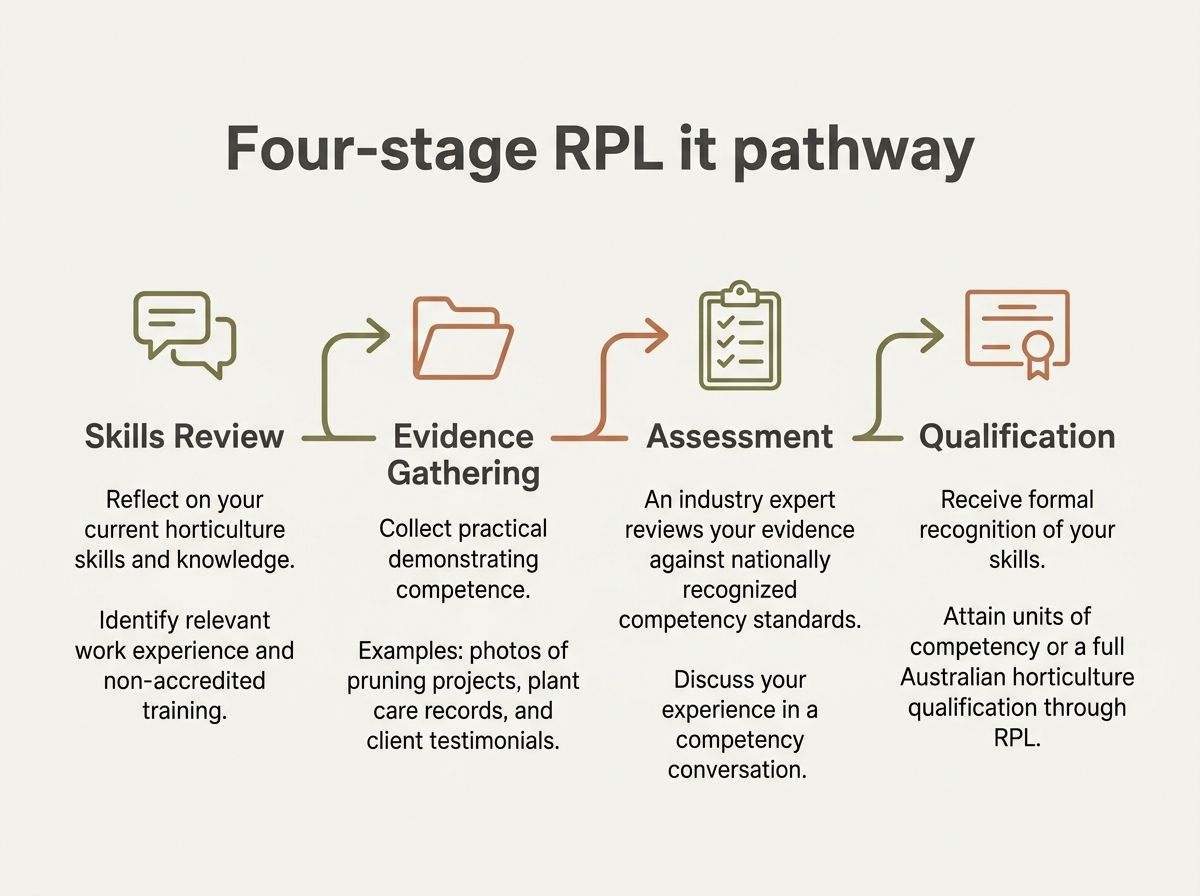
In practice, the RPL process for a horticulture qualification is highly structured. A qualified assessor from a registered training organisation (RTO) reviews your practical experience against national competency standards. You provide documentation showing you can perform these tasks to the industry standard. The assessor determines if this evidence meets the requirements, and if it does, the qualification is issued. If there are any gaps, targeted training is arranged, usually at no extra cost.
The qualifications available through RPL cover diverse professional backgrounds. The Certificate III in Horticulture (AHC30722) is designed for workers with broad plant and land management experience. The Certificate III in Landscape Construction (AHC30921) suits those who build outdoor spaces. The Certificate III in Parks and Gardens (AHC31024) applies to public land management, while the Certificate III in Nursery Operations (AHC31124) is for those with commercial nursery experience. These are the identical, nationally recognised qualifications issued to students who complete classroom study.
What type of horticulture experience counts toward RPL
Honest guidance requires identifying what typically meets the standards and what does not. RPL assessors evaluate professional competency rather than general familiarity with gardening. This distinction is critical to the process.

Experience that generally meets RPL competency thresholds includes professional gardening and grounds maintenance in commercial or residential contexts, landscape construction, and nursery operations like propagation and plant health management. It also includes parks and gardens management for local councils, farm-based production, commercial irrigation, pest management, and horticultural leadership roles.
Experience that is less likely to meet these standards on its own includes domestic or hobby gardening, even if extensive. The competency standards are calibrated to professional industry practice, focusing on the scale, consistency, and accountability of commercial work. A weekend vegetable garden, while impressive, does not demonstrate the operational depth of years of professional landscape management.
This is not a judgment on the value of hobbyist knowledge, but an honest description of how RPL assessment functions. If your experience is professional, the pathway is worth exploring. If it is primarily hobbyist, an honest skills review will clarify this and help identify a training pathway that fits your situation.
The evidence that assessors typically review includes employer references, statutory declarations from clients, photographs of completed work, logbooks, and records of prior training. Because specific evidence requirements depend on the qualification and the RTO, a skills review is the clearest way to understand what applies to your background.
How to take the next step and break the pattern
The pattern breaks when you discover that the choice between re-enrolling or giving up is a false binary. The RPL pathway is a formal, nationally recognised option designed for workers who have built their professional competence through years on the job rather than in a classroom.
The starting point is not an enrolment form but a skills review, which is a straightforward conversation about your background to determine if RPL fits your situation. This discussion occurs before you make any commitment, giving you clear facts rather than a sales pitch.
Your practical skills have real value. Finding out whether they meet the standards for formal recognition is a practical step, and you deserve a direct, honest assessment from an expert rather than a standard enrolment processor.
General information only, current at the date shown. Licensing rules change, so check the current requirements with the relevant regulator before you rely on them. RPL it Australia is a student support service, not a Registered Training Organisation; qualifications are assessed and issued by our partner RTOs.