The biggest myth about moving from finance admin to mortgage broker
Think you must quit work and study full-time for your Cert IV in Finance? Finance admin professionals may already have the evidence they need.

The myth that keeps finance professionals stuck
An unspoken belief circulates through finance support teams across Australia. It suggests that to become a registered mortgage broker, you must quit your job, enrol in a course, spend months in classroom sessions, and only then earn your certificate. Until that happens, you stay where you are.
This is an understandable view. The Certificate IV in Finance and Mortgage Broking is a formal qualification. In most people's experience, formal qualifications require formal study. The logic seems sound.
But this logic is wrong for many finance admin professionals. Every single working day, these experienced workers are already performing the practical duties this qualification evaluates.
This article is not about finding a shortcut. There are no shortcuts in a regulated industry. Instead, it explains a genuine alternative pathway, Recognition of Prior Learning, which allows experienced finance professionals to prove what they already know rather than re-learning it in a classroom.
The distinction is important. For busy professionals who cannot step away from work for months, this pathway is a practical solution.
What the Certificate IV in Finance and Mortgage Broking actually assesses
Before examining this myth, it helps to understand what the qualification measures. The Certificate IV in Finance and Mortgage Broking (qualification code FNS40821) is the nationally recognised standard for the mortgage broking profession in Australia. Because it is a competency-based qualification, it assesses whether you can demonstrate specific skills and knowledge, rather than whether you have simply completed a course.
The units in this qualification cover several core areas: preparing loan applications and supporting documents, assessing client financial positions and borrowing capacity, understanding credit advice compliance obligations, communicating with lenders on behalf of clients, and presenting loan options that meet client needs and disclosure requirements.
These are not abstract academic concepts. They are daily operational tasks. For many people working in finance administration, loan processing, or broker support, these activities already fill their working week.
The qualification is assessed by a Registered Training Organisation (RTO). The RTO's assessor determines competency. Importantly, this competency can be demonstrated through evidence of real work, rather than just completing a classroom course.
What finance admin professionals actually do every day
This is where the myth falls apart. Consider these standard tasks, which regularly appear in finance admin, loan processing, and broker support job descriptions across Australia.
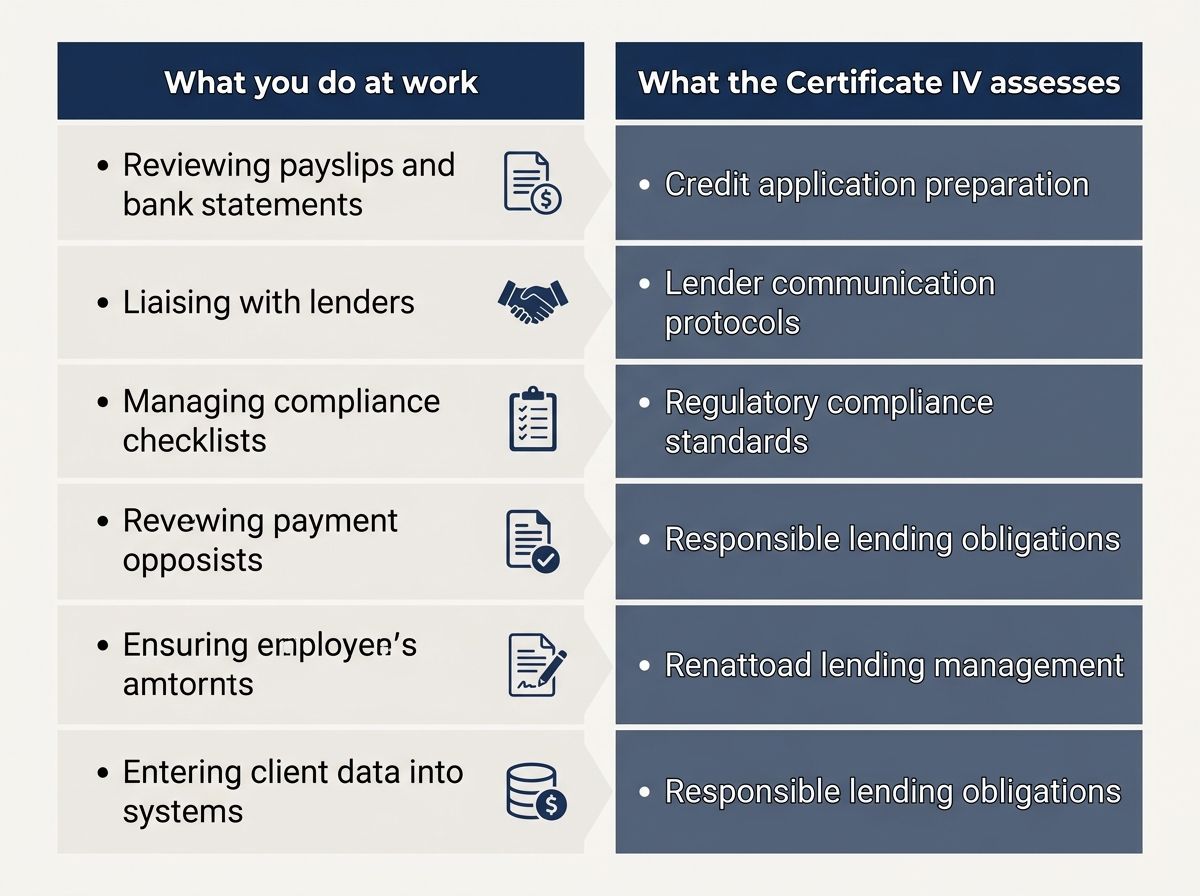
When you prepare a loan file by gathering payslips, bank statements, identification documents, and liability schedules, you organize and verify the financial data that underpins a credit application. This is not simple administrative background work; it is a core competency assessed by the Cert IV.
When you check a client's income and expenses against a lender's serviceability calculator, you assess borrowing capacity. When you follow up with a lender on outstanding conditions, request a valuation, clarify a policy question, or chase a credit decision, you are liaising with credit providers on behalf of a client. When you review a compliance checklist before a file goes to settlement, you apply your understanding of credit legislation and responsible lending obligations.
When you explain to a client why their application has been conditionally approved and outline the documents they need to provide next, you communicate credit information in a way that meets formal disclosure requirements.
- Preparing loan application files and supporting documents shows evidence of credit application preparation.
- Checking serviceability against lender calculators shows evidence of financial position assessment.
- Liaising with lenders on conditions, valuations, and credit decisions shows evidence of lender communication.
- Reviewing compliance checklists and responsible lending documents shows evidence of regulatory and compliance knowledge.
- Explaining application outcomes and next steps to clients shows evidence of client communication and disclosure.
These tasks are not peripheral administrative chores. They are the core operational components that the Certificate IV in Finance and Mortgage Broking is designed to assess. If this list matches your typical working week, your daily experience directly aligns with the qualification.
Why the 'full-time study' belief persists, and why it does not apply to you
This myth persists because most people encounter the Certificate IV through traditional training providers who advertise classroom delivery, online modules, and structured timetables. While this is one legitimate pathway to the qualification, it is not the only option available.
Recognition of Prior Learning (RPL) is a formal assessment pathway within the Australian vocational education system. It allows candidates to have their existing skills, knowledge, and practical experience assessed against the units of a qualification. If the evidence demonstrates competency, the RTO awards the qualification. If gaps are found, targeted gap training is provided to address them.
The key distinction is simple: RPL does not make you study topics you already understand. Instead, it asks you to prove that you already possess these skills. For someone who has spent years preparing loan files, managing compliance, and liaising with lenders, this proof comes from real daily work rather than a textbook.
This does not mean RPL is an easy shortcut or bypasses genuine assessment. Assessors apply the same strict standards regardless of the pathway you choose. The difference lies in the source of your evidence: you use your actual work history and daily practice instead of coursework and exams. While some candidates show strong evidence across all units, others might have gaps in specific areas, especially if their previous roles were highly specialised. Any identified gaps can be addressed through targeted training as part of the overall process.
The question is not how to avoid assessment, but whether your existing experience provides the evidence that the assessment requires.
What RPL actually looks like for a finance admin professional
The RPL process for the Certificate IV in Finance and Mortgage Broking is structured and fully guided. It is not a matter of simply emailing a CV and waiting for a result. This is what the process typically involves.
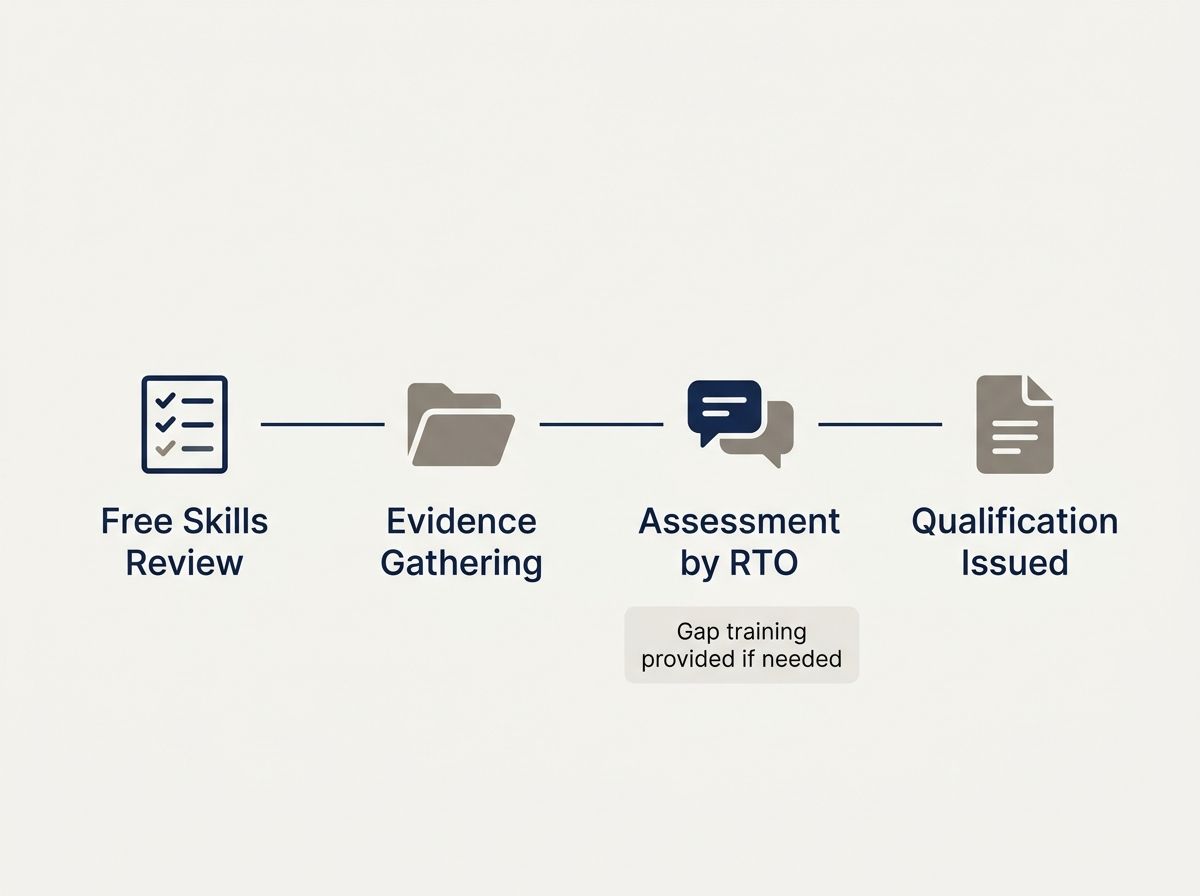
The process begins with a skills review, which is an honest evaluation of whether your experience supports an RPL application. This initial assessment confirms your suitability before you make any commitment. A thorough review will show you clearly whether your background is strong, where gaps might exist, and exactly what evidence you need to gather.
If the skills review indicates suitability, you move on to gathering evidence. For a finance admin professional, this means compiling real work samples: loan files you have put together, compliance checklists you have completed, lender emails you have managed, and records of client contact. You may also include a written statement of your work experience and a reference from a supervisor who can confirm your daily responsibilities.
The RTO assessor then reviews your evidence against the units of competency. In many cases, this includes a structured professional conversation. During this discussion, you explain your work practices, describe how you handle common scenarios, and show your understanding of the regulatory framework. This is a professional dialogue about your daily work, not an exam.
When your evidence demonstrates competency, the RTO issues the qualification. If there are any gaps, training is provided to address them. The resulting qualification is nationally recognised because the assessment process is rigorous and genuine.
RPL it guides candidates through this entire process. We help you identify what evidence to collect, how to organize it, and what to expect along the way. The assessment is conducted by the RTO's qualified assessor. We do not award the qualification ourselves; instead, we guide you toward the recognition your practical experience deserves.
Who this pathway is and is not for
Honest suitability advice is important. RPL for this qualification is designed for professionals with hands-on, daily experience in roles like finance administration, loan processing, mortgage broker support, or lending operations. The broader your practical experience, the more likely you are to support a successful RPL application.
Specifically, candidates who regularly prepare loan files, assess client financial positions, liaise with lenders, manage compliance, and discuss credit details with clients are usually in a strong position. Those whose experience covers several of these areas, rather than a single narrow function, are generally the best candidates.
RPL is not suitable for someone with no background in the finance sector, or for those in purely administrative roles with no exposure to credit processes. The qualification assesses specific operational competencies. If you do not have evidence of these tasks in your work history, RPL is not the right option. A good skills review will identify this clearly before you spend time or money.
We prefer to direct you to the correct training pathway rather than enrol you in an unsuitable option. That honesty is central to how we work.
The first step: A free skills review
If you have read this far, some parts of this article likely match your situation. You might recognize your daily work in these competencies, or perhaps you have delayed your transition to broking because full-time study is not practical. You may simply want to find out if your experience is sufficient.
A Free Skills Review is an honest, no-obligation way to evaluate your options. It is not a sales call. Instead, it is a practical assessment of your background against the requirements of the Certificate IV. You will get a clear, realistic answer about your suitability from people who value direct feedback.
Your skills are valuable. We help you present them clearly.
Ready to Get Recognised?
Start with a free skills review to find out if RPL is right for you.