The Lending Ceiling: Why Support Staff Are Passed Over for Broking Roles
Blocked from broking roles despite your lending experience? Learn how your support history maps to the Certificate IV in Finance and Mortgage Broking.

The pattern nobody talks about in lending
You have been in lending long enough to know how the industry works. You have processed applications, assessed serviceability, managed compliance checklists, and guided clients through documentation. You have watched new brokers arrive, sometimes fresh from a course, sometimes from entirely different industries, and step into roles that your own experience makes you more than ready for.
Yet the role did not go to you. It went to them, because they held the Certificate IV in Finance and Mortgage Broking, and you did not.
This is not a story about a single unfair hiring decision. It is a structural pattern that repeats across lending teams, brokerage firms, and aggregator groups throughout Australia. Capable, experienced support staff watch external candidates secure broking roles, not because those candidates know the industry better, but because Australian credit law requires a specific qualification before anyone can act as a credit representative.
This ceiling is made of compliance architecture, not glass, and it will not move on the strength of your practical experience alone.
If you have trained new hires who outrank you on paper, you are familiar with this dynamic.
Stage 1: Learning the industry from the inside
Lending support roles are not peripheral to mortgage broking. They are the core engine of the process.
Loan processors manage the documentation, verify income and liabilities, and ensure applications meet lender requirements before submission. Credit analysts assess serviceability, interpret policy, and identify risk factors that determine whether a deal will proceed. Broker assistants coordinate between clients, brokers, and lenders; they manage timelines, chase outstanding conditions, and keep complex transactions on track. Settlements officers handle the final stages of the loan journey, coordinating with solicitors, lenders, and clients to bring deals to completion.
Each of these roles builds deep, practical knowledge of the mortgage broking process. The people in them understand lender credit policies, responsible lending obligations, client needs analysis, and the compliance requirements that govern every loan application. They develop this knowledge not from a textbook, but from doing the work every day under real conditions.
This experience is real and substantive. It is directly relevant to the competencies assessed in the Certificate IV in Finance and Mortgage Broking, which covers areas including loan processing, credit assessment, compliance obligations, and client needs analysis.
The knowledge is there, but it is not in the format the regulator requires.
Stage 2: Encountering the compliance wall
When a lending support professional applies for a broking role, whether internally or at another firm, they meet the compliance wall.
Under Australian credit licensing requirements, anyone acting as a credit representative must hold, or be working toward, an approved qualification. The Certificate IV in Finance and Mortgage Broking (FNS40821) is the minimum qualification recognised for credit representatives in mortgage broking. This is a legal obligation that applies regardless of practical experience, not a simple employer preference.
The requirement exists for legitimate reasons. The mortgage broking industry operates under significant consumer protection obligations. Formal qualification ensures that credit representatives have been assessed against a nationally recognised standard, rather than just picking up knowledge on the job.
The consequence is structural. A capable lending support professional with years of relevant experience cannot be appointed as a credit representative without the formal credential, regardless of their capability. The certificate is the missing link.
Note: The specific regulatory provisions governing credit representative qualification requirements are set out under Australian credit licensing requirements. Readers seeking precise regulatory details should consult the ASIC website or seek professional guidance.
Stage 3: The credentialed candidate arrives
The broking role is advertised and applications come in. Among them is a candidate with a newly completed Certificate IV in Finance and Mortgage Broking. They may have less time in the industry and less familiarity with lender panels, compliance processes, or client management. But they hold the qualification.
The employer has no legal choice. To appoint a credit representative, the qualification must be held. The experienced support professional who knows the lenders, the processes, and the clients cannot step into the role without it.
The external candidate gets the role.
This is the logical outcome of a compliance system that requires formally assessed competence rather than practical demonstration. The system works as designed, but the design does not automatically recognise the experience that lending support staff bring to the business.
Stage 4: The cycle repeats
The support professional remains in their role and continues to develop expertise. When another broking position opens, the same dynamic plays out.
Each cycle reinforces the pattern. The ceiling does not lift with experience; it lifts only with the credential.
This is where the situation changes. Naming the pattern is the first step toward addressing it. The compliance ceiling has a door: the Certificate IV in Finance and Mortgage Broking. For experienced lending support staff, the path to that qualification may be shorter than they expect.
What the Certificate IV in Finance and Mortgage Broking actually covers
The Certificate IV in Finance and Mortgage Broking (FNS40821) is a nationally recognised qualification on the Australian Qualifications Framework at Certificate IV level. It is the minimum qualification required for credit representatives under Australian credit licensing requirements.
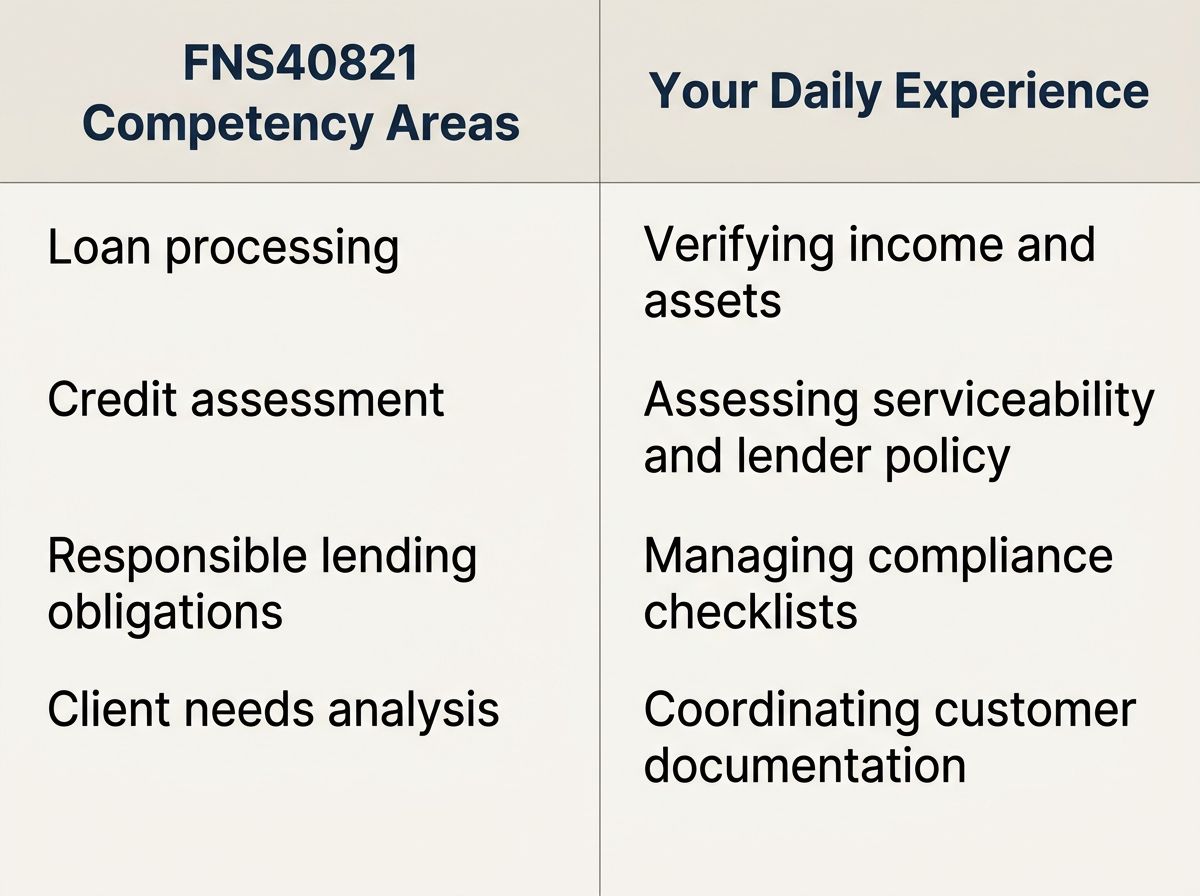
The qualification covers the core knowledge and skills required to operate as a mortgage broker. This includes understanding the credit environment, loan application processes, responsible lending obligations, lender policy, client analysis, and compliance with legislation and industry codes.
For the complete and current unit list, including core and elective units, the authoritative source is the training.gov.au qualification page for FNS40821. The qualification structure is subject to periodic review, and the official page reflects the current requirements.
For lending support staff, the competency areas covered by the Certificate IV in Finance and Mortgage Broking are not abstract. They describe the practical work of mortgage broking, which loan processors, credit analysts, broker assistants, and settlements officers handle daily. Rather than describing a different kind of work, the qualification covers the same tasks assessed against a formal standard.
Why lending support experience is what RPL assessors look for
Lending support experience directly aligns with the competencies assessed in the Certificate IV in Finance and Mortgage Broking. This is a practical reality of how the qualification is structured and what support roles actually require.
Recognition of Prior Learning (RPL) is a formal assessment pathway under the Australian Qualifications Framework. It allows candidates to demonstrate competency through evidence of existing skills and knowledge, rather than completing formal study from scratch. An RPL assessor from a registered training organisation (RTO) reviews the evidence a candidate provides and determines whether it demonstrates the required competencies.
For lending support professionals, relevant evidence for an RPL assessment includes records of work such as loan files they have processed, compliance checklists they have completed, credit assessments they have contributed to, and client correspondence they have managed. It may also include employer references, professional development records, and examples of work product that demonstrate competency in specific areas covered by the qualification.
The experience exists. The question an RPL assessment answers is whether that experience, properly documented and presented, is sufficient to demonstrate competency against the qualification's requirements. That determination is made by a qualified assessor, not by the candidate and not by RPL it. What RPL it does is guide candidates through the process of identifying, gathering, and presenting their evidence effectively.
Experience serves as evidence. The RPL pathway is designed to guide that experience through to formal recognition.
The honest reality: RPL is not automatic
RPL is a rigorous assessment process, not a guaranteed outcome or a shortcut. It is a method for having existing competence formally assessed against qualification requirements.
Not every lending support professional will have sufficient evidence for every unit in the Certificate IV in Finance and Mortgage Broking. Some competency areas may require gap training, which involves additional learning to address areas where the evidence is insufficient. Where gap training is required, it is typically provided through the delivering RTO as part of the RPL process.
This clarity is the foundation of a trustworthy process. An RPL pathway that promises guaranteed outcomes is not reliable. A genuine RPL assessment is valuable precisely because the process is rigorous and the resulting qualification is nationally recognised.
The first step, before any commitment or enrolment, is to understand whether your experience is likely to meet the requirements. That is the purpose of a Free Skills Review.
Breaking the pattern: What the next step looks like
The RPL pathway for the Certificate IV in Finance and Mortgage Broking begins with a Free Skills Review. This is a no-commitment conversation that helps identify whether your experience is likely to map to the qualification's requirements, and where gaps, if any, might exist.
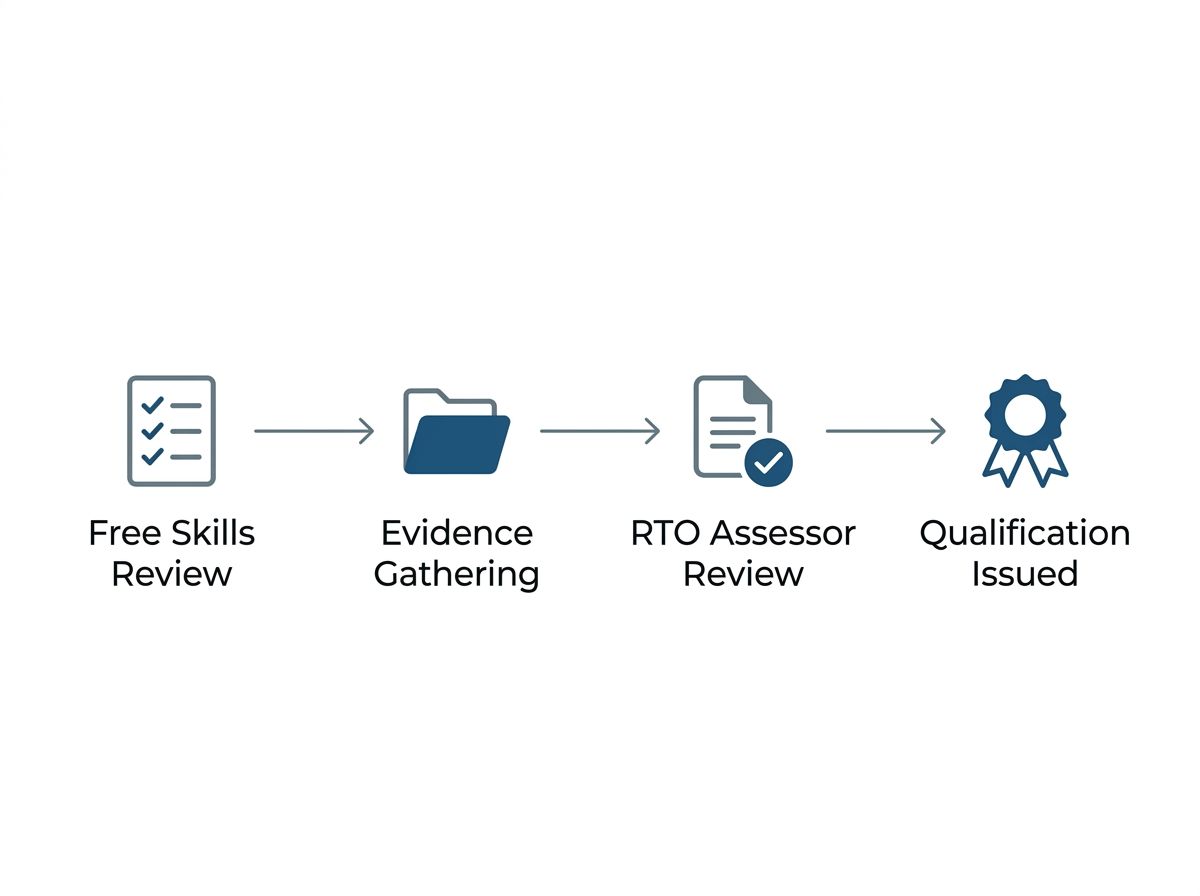
If the review indicates that RPL is a viable pathway, the next stage involves guided evidence gathering. RPL it works with candidates to identify the records, documents, and references that demonstrate their competency, and to present that evidence in a form that an RTO assessor can evaluate.
The evidence is submitted to a qualified assessor from the delivering RTO who determines whether it demonstrates the required competencies. If gaps are identified, gap training is provided. When competency is demonstrated, the qualification is awarded.
The qualification is nationally recognised and meets the requirements for credit representative appointment under Australian credit licensing requirements. It is the same qualification held by external hires, assessed through a different but equally legitimate pathway.
The timeframe depends on the completeness of the evidence you can provide. Candidates with comprehensive work records typically complete the process more quickly than those who need to reconstruct their history. RPL it guides this process from start to finish.
The lending ceiling is real and structural. It will not move on the strength of experience alone. But experience, properly documented and assessed, may be exactly what you need to move through it.
The decision is yours.
Ready to Get Recognised?
Start with a free skills review to find out if RPL is right for you.