The Industry Myth That's Keeping Real Estate Professionals Away From the CPP51122
Think the CPP51122 requires full-time study? Experienced real estate professionals may already have the evidence they need through RPL. Here's the truth.

The myth: becoming an Agency Manager means going back to school
There is a belief that circulates through Australian real estate offices, passed between colleagues and reinforced by the way most training providers talk about the CPP51122 Diploma of Property (Agency Management). It goes something like this: if you want to become an Agency Manager, you need to study. Classroom attendance. Online coursework. A significant pause in your career while you work through a qualification you may feel you have already earned on the job.
For many experienced real estate professionals — principals, senior property managers, people who have been running portfolios and leading teams for years — this belief is the reason they have not yet pursued the CPP51122. Not lack of ambition. Not lack of capability. The assumption that the only path to the qualification runs through formal study.
That assumption is, for many of them, simply wrong.
The CPP51122 is a nationally recognised qualification under the Australian Qualifications Framework. Like all qualifications delivered by registered training organisations, it can be pursued through Recognition of Prior Learning — a formal assessment pathway that evaluates what you already know and can do, rather than requiring you to sit through content you have been living for years.
Where the myth comes from — and why it persists
The belief that CPP51122 requires formal study has a traceable origin. Most registered training organisations that deliver this qualification do so through structured coursework — online modules, assignments, scheduled assessments. That is what gets promoted on qualification landing pages, in brochures, and in conversations with enrolment teams. It is the default pathway, and for many providers, it is the only pathway they actively market.
The RPL pathway exists — and registered training organisations are required to offer it. Under the regulatory standards that govern Australia's vocational education and training sector, RTOs must make Recognition of Prior Learning available to candidates. It is not optional. But being available and being visible are different things. RPL generates fewer enrolment hours and less structured delivery revenue than coursework. The result is a market where experienced professionals assume study is the only route, because that is the only route they have been shown.
This is not a conspiracy. It is a market dynamic. But it has a real cost for the professionals it affects.
What the CPP51122 actually requires — and what counts as evidence
The CPP51122 Diploma of Property (Agency Management) is a competency-based qualification. It assesses what you can do, not where you learned it. The qualification comprises 12 units of competency — 7 core and 5 elective — covering areas including compliance with legislation, ethical practice, property management operations, business management, and workplace health and safety. These are not abstract academic concepts. They are the operational reality of running a real estate agency.
Competency-based assessment means that a candidate who can demonstrate they already perform these functions — through documented work history, employer statements, work samples, and professional records — can have that competency formally recognised without repeating the learning journey. The assessment is conducted by a qualified assessor from the delivering registered training organisation. RPL it guides candidates through the evidence-gathering process; the RTO's assessor determines competency and issues the qualification.
Experience can be evidence. For most experienced real estate professionals, the gap is not competency. It is documentation.
The CPP51122 Diploma of Property (Agency Management) product page outlines the qualification and the RPL pathway in more detail.
The real estate experience that already maps to CPP51122 units
Consider what a senior property manager or agency principal actually does. They manage a rent roll — overseeing multiple properties, coordinating maintenance, handling tenancy disputes, and ensuring compliance with residential tenancy legislation. They supervise staff — setting performance expectations, conducting reviews, managing workflows. They handle trust accounting oversight — ensuring funds are receipted, disbursed, and reconciled in accordance with legislative requirements. They navigate compliance — staying current with state-based property law, managing risk, and maintaining records that would withstand regulatory scrutiny.
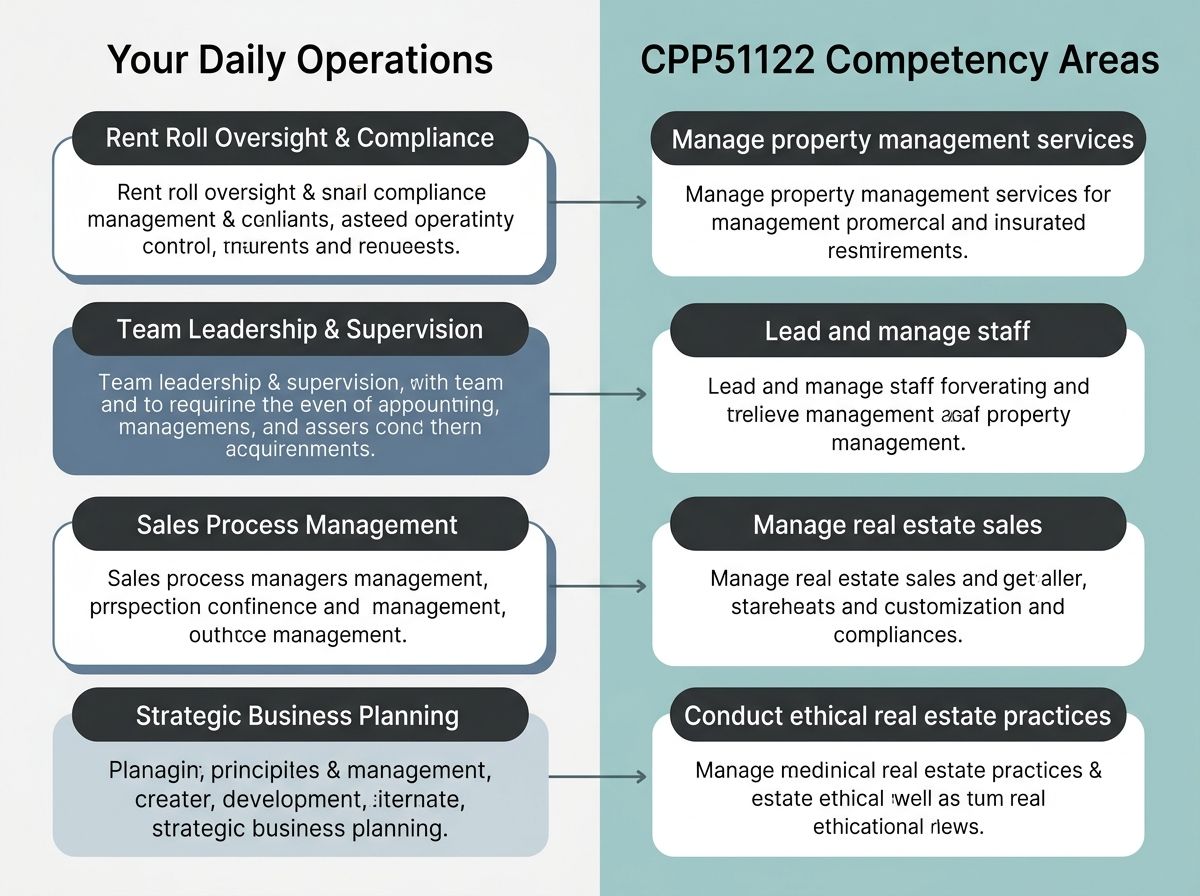
Each of these activities corresponds directly to competency areas within the CPP51122. Managing a portfolio under legislative frameworks maps to compliance and property management units. Supervising a team maps to leadership and business management units. Overseeing trust accounts maps to financial management competencies. Navigating regulatory requirements maps to ethical practice and risk management units.
The work is not preparation for the qualification. For many experienced professionals, the work is the qualification. What is missing is the formal documentation that translates years of professional practice into evidence an assessor can evaluate.
- Portfolio management and rent roll oversight — maps to property management compliance and operational units
- Team supervision and performance management — maps to leadership and business management units
- Trust accounting oversight and financial record-keeping — maps to financial management competencies
- Legislative compliance and risk management — maps to ethical practice and regulatory units
- Client relationship management and dispute resolution — maps to communication and stakeholder management units
Why this myth has a real cost — and who pays it
A qualification requirement should not stall a high-performing real estate professional's career. But when experienced practitioners believe the CPP51122 requires full-time study, they delay pursuing it — sometimes for years. Sometimes indefinitely.
The cost is not abstract. It shows up in agency manager positions filled by candidates with less experience but the right paper. It shows up in salary ceilings that cannot be broken without the qualification. It shows up in the quiet frustration of training new staff who will eventually hold credentials that their trainer does not.
Real estate agency managers in Australia typically earn significantly more than senior property managers or agents — the gap reflects the responsibility differential that experienced professionals are already carrying without the formal recognition to match. The myth does not protect those professionals. It holds them in place while the qualification they have effectively already earned remains just out of reach.
What RPL for the CPP51122 actually looks like
Recognition of Prior Learning for the CPP51122 is not a shortcut. It is a rigorous assessment process. A candidate presents evidence of their existing competency against the qualification's 12 units. The assessor — employed by the registered training organisation — evaluates that evidence against national standards and determines whether competency has been demonstrated.
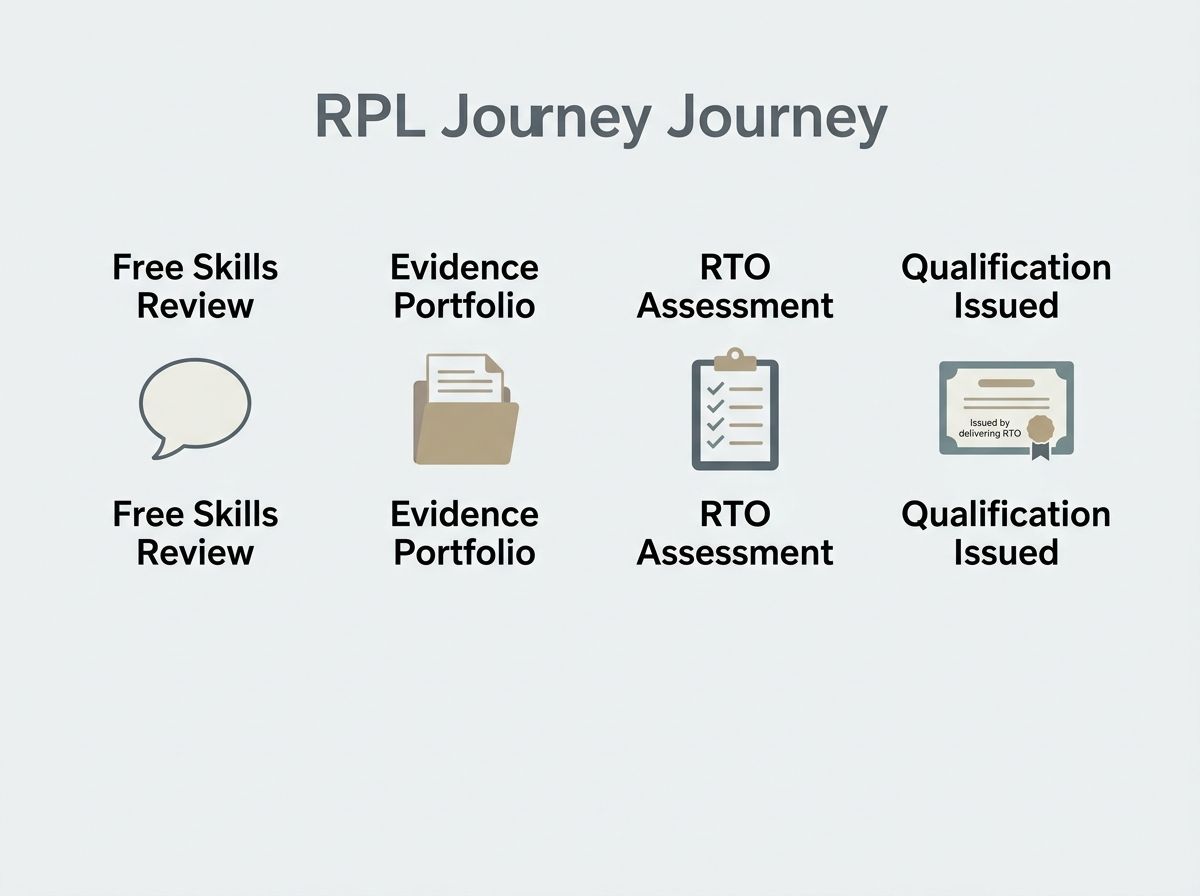
The process involves gathering documentation: employment records, position descriptions, work samples such as management reports and compliance records, employer or principal statements, and professional references. For candidates with genuine agency management experience, this documentation exists — it is the paper trail of a professional career. The work of RPL is organising and presenting it in a form the assessor can evaluate.
If gaps are identified during assessment, gap training is provided. The assessment is conducted by the delivering RTO. The qualification, when awarded, is nationally recognised — because the assessment is genuine.
Indicative timeframes for CPP51122 RPL assessment vary depending on the RTO and the completeness of evidence provided. Some candidates move through the process in a matter of weeks; others take longer. These are indicative ranges, not promises. What RPL it provides is guidance through the evidence-gathering process — the assessment itself remains the professional judgement of the RTO's assessor.
Is your experience enough? The honest answer
Not every real estate professional will be suitable for CPP51122 RPL. Suitability depends on the depth and recency of experience, the types of roles held, and the evidence available.
A property manager with two years of residential experience managing a small portfolio is in a different position to a principal with ten years of agency management across multiple offices. The CPP51122 covers agency management — the leadership, compliance, financial oversight, and operational responsibility that comes with running or managing a real estate business. Candidates who have genuinely held those responsibilities, and who can document them, are typically well-positioned for RPL assessment. Candidates whose experience is primarily in sales or entry-level property management may find gaps that require additional evidence or training.
The honest starting point is not an enrolment. It is a skills review — a structured conversation about your experience, the qualification's requirements, and whether the two align. That conversation costs nothing and commits you to nothing.
Ready to Get Recognised?
Start with a free skills review to find out if RPL is right for you.