When you know the chemicals better than the inspector (but still need the licence)
You know the termiticides, rates, and treatment protocols. Here is how RPL gets your Certificate III in Urban Pest Management recognised.
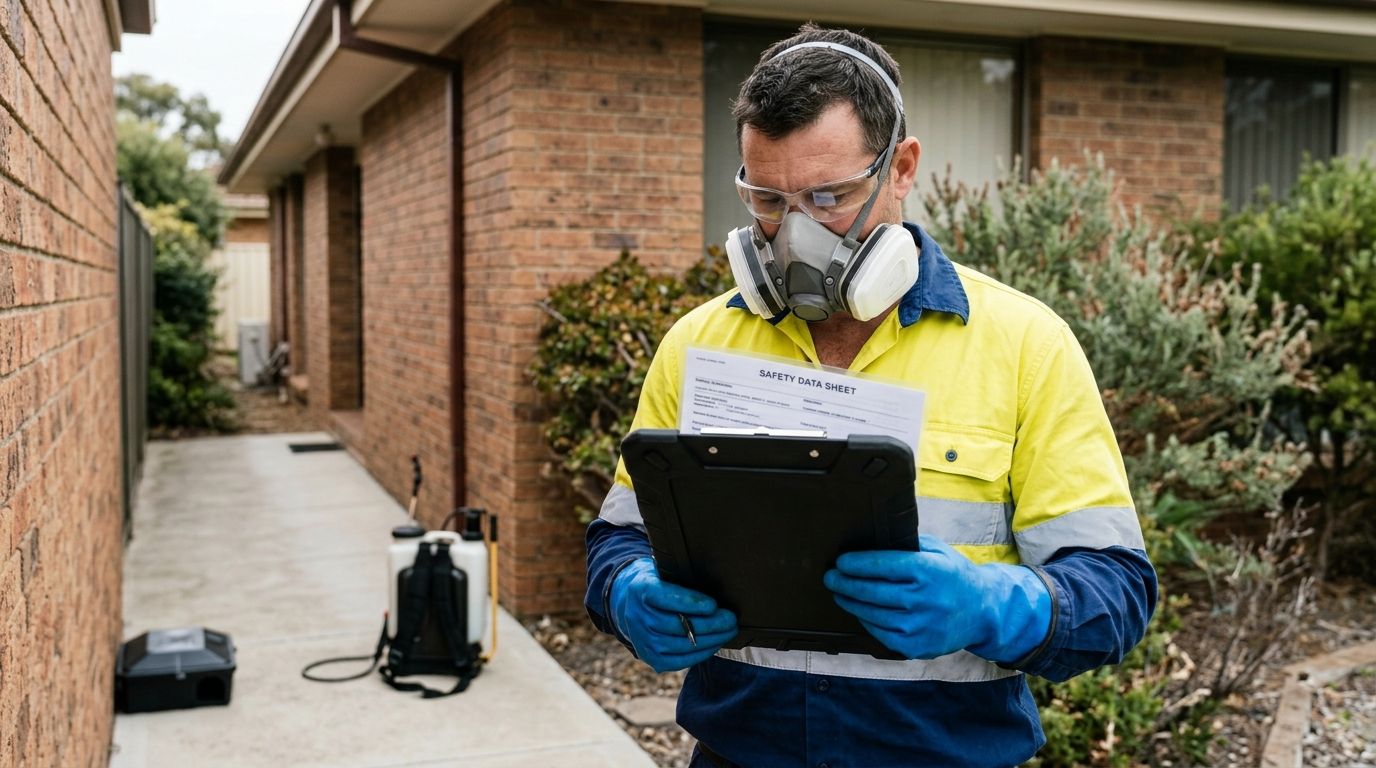
The technician who knows more than the inspector
You know the chemicals and you know the application rates. You know exactly what a German cockroach infestation looks like before the client even finishes their sentence. You can read a Safety Data Sheet faster than most people can find one. You have mixed termiticides, run baiting programs, written treatment reports, and managed chemical storage compliance. You have done all of this for years without anyone questioning your competence on the job.
Yet when the paperwork comes out, you hit a wall.
The Certificate III in Urban Pest Management (CPP30119) is the nationally recognised qualification behind pest management licensing across Australia. Without it, or an equivalent qualification, you cannot hold a pest management technician licence in your own name in most states. You can work under someone else's licence and do the technical work. However, you cannot operate independently, sign off on your own treatment reports as the responsible party, or build the business you are capable of running.
This is not a skills problem; you have the skills. This is a recognition problem, and Recognition of Prior Learning exists to fix it.
What the Certificate III in Urban Pest Management actually covers
The Certificate III in Urban Pest Management (CPP30119) is a nationally recognised qualification under the Australian Qualifications Framework. It is listed on the national register at training.gov.au and consists of 10 units of competency, which include five core units and five elective units. This qualification replaced the older CPP30115 version, which some experienced technicians may have completed in the past.
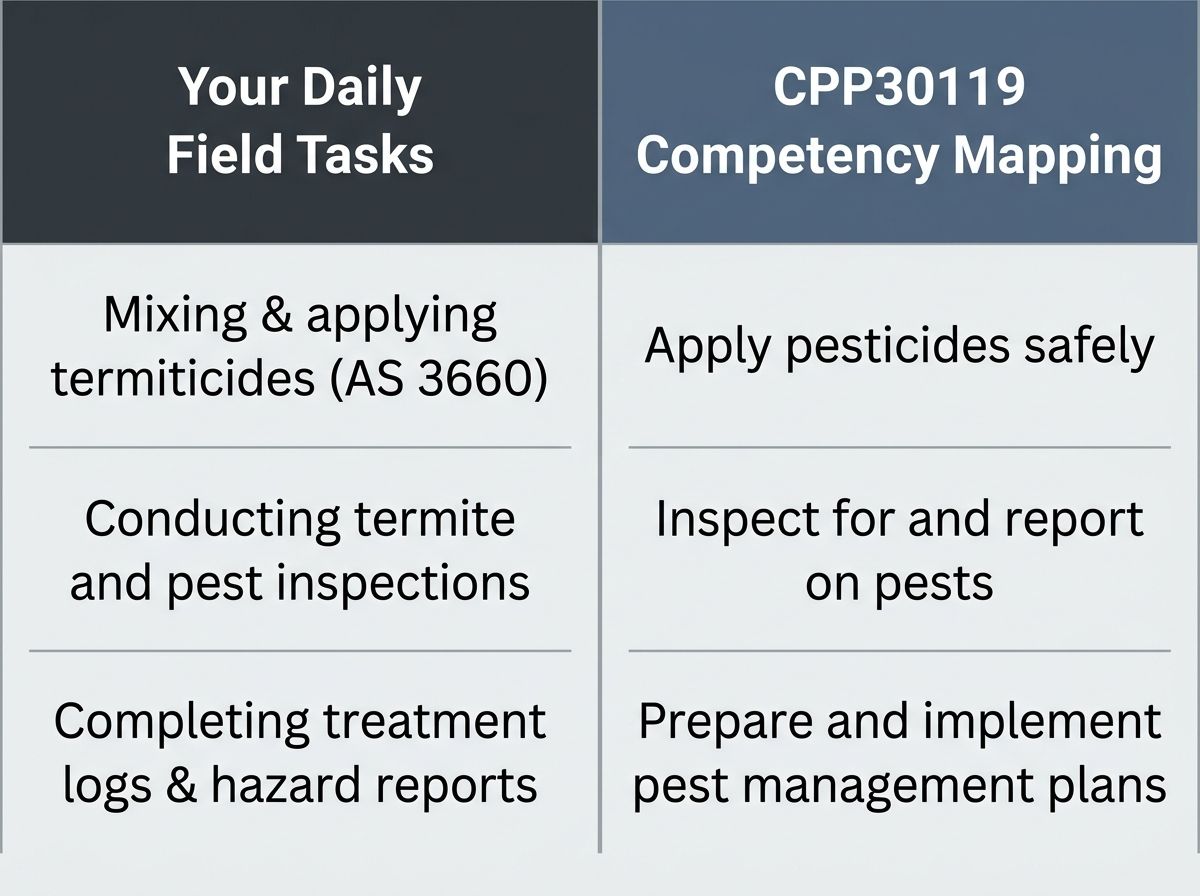
The core units cover the foundational competencies of professional pest management practice. This includes applying pesticides safely and competently, conducting thorough pest management inspections, preparing and implementing pest management treatment programs, managing work health and safety risks, and communicating clearly with clients. The elective units allow for specialisations such as termite management, rodent control, and other specific treatment areas.
In practice, this matches what you already do daily:
- Mixing and applying termiticides to Australian Standard AS 3660 requirements, which demonstrates chemical application competency.
- Conducting pre-treatment inspections and identifying pest species, which maps to pest identification and inspection competency.
- Completing treatment documentation and client reports, which covers treatment planning and professional communication.
- Following safety protocols for chemical handling and PPE, which proves workplace safety competency.
- Advising clients on treatment outcomes and follow-up, which demonstrates client communication competency.
The qualification does not teach experienced technicians how to do their job. It formally assesses whether they already perform it to the required standard.
Learn more about the RPL pathway for this qualification on the product page.
Why the licence gate exists and why it is not going away
Pest management is a high-stakes trade. The chemicals used in commercial pest control, including termiticides, rodenticides, and insecticides, are heavily regulated substances. Applied incorrectly, they create genuine public health and environmental risks. A failed termite treatment can result in structural damage worth hundreds of thousands of dollars, while a misapplied pesticide in a food-handling environment can trigger a serious public health incident.
This is why licensing exists. It is not bureaucratic obstruction; it is a regulatory framework designed to protect the public, the environment, and the industry's professional reputation. Pest management licensing requirements are administered at the state level by bodies such as the Western Australia Department of Health, state EPAs, and fair trading authorities, and these standards are not becoming less stringent over time.
In Western Australia, for example, the Department of Health administers pest management technician licensing, and the CPP30119 or equivalent is a prerequisite for obtaining that licence. Other states have their own licensing frameworks, but the pattern is consistent: formal qualification is required to operate independently as a licensed pest management technician. Working under a licensed operator's supervision may be permissible in some circumstances, but it is not a permanent solution. It limits what you can do, what you can charge, and the business you can build.
The licensing requirement is here to stay. The only question is how you meet it.
The problem with starting from zero when you already know the work
Here is the frustration that experienced pest control technicians face: the standard pathway to the CPP30119 is a course delivered through a registered training organisation (RTO), typically running over 12 to 18 months, with costs that RTOs place in the range of several thousand dollars. The course is designed for people who are new to pest management. It covers chemical safety, pest identification, treatment planning, and client communication from the very beginning.
If you have been doing this work for years, sitting through these classes is pure repetition. You are forced to re-learn familiar skills at a beginner's pace, while paying for training you do not actually need.
Recognition of Prior Learning fixes this issue. Instead of making you start from scratch, RPL evaluates the skills you have already built.
Experienced tradespeople across other industries face the same issue. The need for a formal credential is real, but repeating basic training is unnecessary.
Read how this plays out for tradespeople in other industries.
How RPL works for the Certificate III in Urban Pest Management
Recognition of Prior Learning (RPL) is a formal assessment pathway within the Australian vocational education and training system. It allows a qualified assessor from a registered training organisation to evaluate your existing skills and knowledge against the units of competency in the CPP30119, without requiring you to complete the full classroom course.
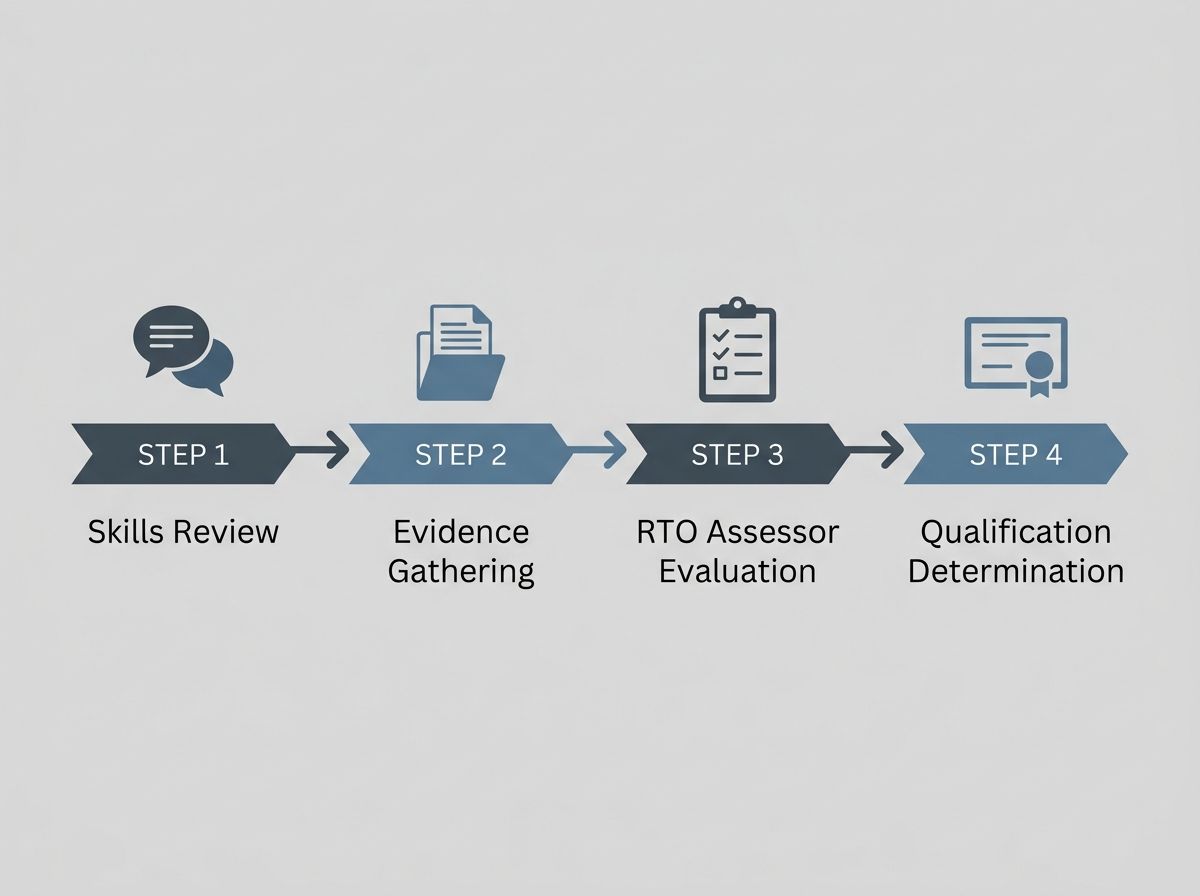
The process begins with a skills review. This is a straightforward conversation about your experience and the work you do. Rather than a formal test, it is a structured check to confirm whether your experience supports an RPL application.
If the skills review indicates that RPL is suitable for your situation, the next step is evidence gathering. You compile documentation from your work history that demonstrates your competency against the CPP30119 units. This evidence is then assessed by a qualified assessor from the delivering RTO. Note that RPL it guides you through this process, but does not conduct assessments or issue qualifications.
If the assessor identifies any gaps where your documentation does not cover a specific requirement, you can complete targeted gap training. This is highly focused on what is missing, rather than repeating the entire course.
The outcome of the assessment is determined by the RTO's qualified assessor. If competency is demonstrated, the Certificate III in Urban Pest Management (CPP30119) is issued by the RTO. It is a nationally recognised qualification, reflecting genuine assessment rather than classroom attendance.
What experienced pest control technicians are already doing that counts as evidence
Many technicians think they need to create new evidence for RPL. In reality, you only need to compile proof you already generate during your daily work.
If you have worked in pest management for a couple of years, you have been building an evidence portfolio without realising it. This paperwork is part of your normal routine:
- Treatment reports and job records: every completed treatment report shows your ability to document pest management activities, identify species, and record treatment methods.
- Chemical handling logs: records of chemical mixing, dilution rates, and application volumes prove your competency in safe chemical handling and compliance with label requirements.
- Safety Data Sheet (SDS) familiarity: your practical use of SDS information is a demonstrable competency verified through job records and employer statements.
- Employer or supervisor references: a statutory declaration or written reference from a licensed pest operator who has observed your work is significant evidence of your practical competency.
- WHS compliance records: records of PPE use, chemical storage compliance, and risk assessments demonstrate your workplace health and safety competency.
- Pest identification records: documented evidence of identifying species across different treatment environments demonstrates your technical knowledge.
- Client communication records: job sheets, client sign-offs, and follow-up documentation prove your ability to communicate treatment outcomes professionally.
Workplace records, including digital treatment records generated through job management software, are generally accepted as RPL evidence provided they are verifiable and aligned with the relevant competency standards. If your business uses digital job management tools, the records those systems generate may form part of your evidence portfolio, though confirmation of acceptability should be sought from the delivering RTO.
In short, if you do the work, you generate the evidence. RPL simply organises these documents into a format the assessor can evaluate.
The honest reality: What RPL can and cannot do
RPL is a rigorous assessment pathway. It is not a rubber stamp or an easy shortcut. The assessment is conducted by a qualified assessor from a registered training organisation, and the outcome depends on whether your evidence demonstrates competency against the CPP30119 units, rather than how many years you have been working.
If your experience is broad and well-documented, the assessment is likely to reflect that. If there are genuine gaps where your work history does not cover a unit of competency, gap training will be required. This is a standard part of the process, identifying what you know and filling in what you do not.
RPL it guides candidates through this process. We help you understand what evidence is needed, how to organise it, and what to expect from the assessment. We do not conduct assessments or issue qualifications. Those functions belong entirely to the registered training organisation and its qualified assessors.
We can tell you honestly that if you have been working in pest management for a meaningful period, applying chemicals, conducting inspections, and writing reports, you likely have significant evidence to support an RPL application. Whether that evidence is sufficient to demonstrate full competency across all CPP30119 units is something a qualified assessor will determine, and a Free Skills Review is the honest first step toward finding out.
Your experience has value: Here is how to find out how much
You have the experience, the technical knowledge, and the field hours. The Certificate III in Urban Pest Management (CPP30119) is not about teaching you pest control; it is about formally recognising that you already practise it to a professional standard.
The RPL pathway exists for exactly this situation. It is a legitimate, rigorous, nationally recognised assessment process that honours what you have already achieved without asking you to repeat the training.
The decision about whether to pursue it is yours. But the first step, finding out whether your experience is likely to support an RPL application, costs nothing and commits you to nothing.
Ready to Get Recognised?
Start with a free skills review to find out if RPL is right for you.