The practical advantage of formalising your supply chain experience
You already manage the chaos. Learn how a logistics qualification translates your experience into negotiating power without starting over.

The invisible challenge for supply chain professionals
You manage freight delays, reroute shipments when suppliers fail, and hold the supply chain together when things go wrong. Yet, without a formal logistics qualification, that capability remains largely invisible to the corporate systems that determine your salary scale and evaluate your suitability for a promotion.
This is an issue of recognition, not competence. The Australian transport and logistics sector employs hundreds of thousands of people, and a significant portion of this workforce carries deep operational expertise that formal credentials have never captured. Your day-to-day work is real, your experience is genuine, but the formal qualification is missing.
This gap matters more than most logistics professionals realise. Without a nationally recognised qualification, your role is often benchmarked against positions that assume no formal training, regardless of your daily responsibilities. A qualification does not teach you logistics; instead, it translates your existing knowledge into a language that employers and HR systems understand.
What a logistics qualification actually measures
Many logistics professionals assume that getting qualified means sitting in a classroom to learn things they already do daily. The reality is different. Australian logistics qualifications, such as the Certificate IV in Supply Chain Operations (TLI40324) and the Diploma of Logistics (TLI50224), are competency frameworks. They assess what a capable practitioner does on the job, rather than what a student is taught in class.
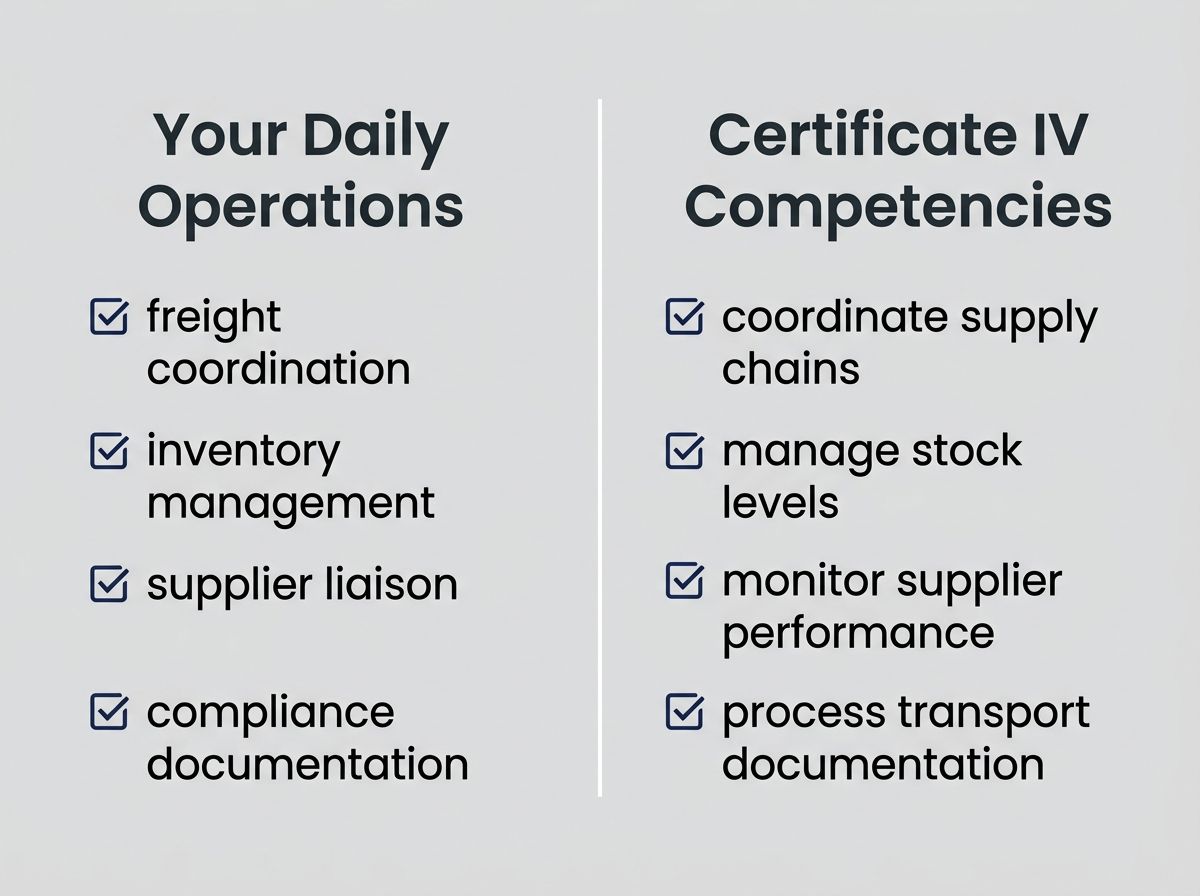
The Certificate IV in Supply Chain Operations, for instance, covers key areas like freight coordination, inventory management, supplier liaison, compliance documentation, and operational problem-solving. These are not theoretical concepts; they describe the practical work you perform routinely. The assessment process simply asks if you can demonstrate that you already perform this work, rather than whether you have sat through a classroom course on it.
This is where Recognition of Prior Learning (RPL) applies. RPL is the formal assessment process that maps your existing experience against national competency standards. For logistics professionals with years of operational practice, this pathway is designed to assess what you already know, using evidence from your daily work instead of requiring classroom attendance.
RPL it partners with registered training organisations to guide you through this process. You can view the logistics qualifications available through RPL on our Transport and Logistics page.
The practical advantage that textbook graduates lack
Logistics professionals who have managed real supply chain disruptions, such as freight delays, supplier failures, and inventory shortfalls under pressure, develop practical problem-solving skills that classroom graduates cannot replicate. This capability is not a minor detail. It is the core reason why experienced logistics practitioners are highly valuable to employers.
Australian vocational education commentary supports this view. One RTO career guide notes that practical operational experience is essential for logistics management, explaining that book-based training cannot prepare managers for real-world pressures like peak-period staffing shortages or unexpected operational failures. The same source indicates that most logistics managers build their careers from coordinator or supervisor roles rather than graduate entry points.
Separately, vocational sector reports indicate that mid-level supply chain specialists are scarce in Australia. Workers who combine hands-on experience with formal credentials and systems knowledge are often well positioned to advance as the industry becomes more automated and complex.
If you have rerouted freight, managed supplier failures, and kept operations moving when things break down, those are not background tasks. Those are the exact competencies a logistics qualification recognises. This is an advantage that no recent graduate can match on day one.
Australian vocational training providers note that the logistics sector prioritises workers who combine operational experience with formal credentials to navigate growing industry complexity.
Why formal qualifications matter at salary review time
Without a formal qualification, experienced logistics professionals are often benchmarked against entry-level positions regardless of their actual capabilities. A nationally recognised qualification shifts this baseline, changing the conversation from vague years of experience to demonstrated competency against national standards.
This makes a difference during salary reviews. Without the credential, you must argue from experience alone; with it, you negotiate with formal proof. The qualification does not create your skills, since you already have them. Instead, it makes your capability clear to hiring managers, salary benchmarking systems, and promotion panels who use credentials to assess suitability.
Vocational sector commentary on Australian logistics career pathways highlights that candidates typically require operational experience before moving into management. It also notes that formal qualifications increasingly dictate how that experience is valued and rewarded in the industry.
An Australian RTO career guide on becoming a logistics manager notes that formal qualifications play an important part in how operational experience is recognised and rewarded in the sector.
The negotiation reality is simple: a credential does not guarantee a pay rise, but it does remove ambiguity. It gives you a concrete, verifiable basis for discussions that employers and HR departments are set up to recognize.
The RPL pathway for logistics professionals
Recognition of Prior Learning (RPL) is the formal assessment process that translates your existing logistics experience into a nationally recognised qualification. This pathway does not require classroom attendance or repeating training you have already completed. Instead, you compile evidence of your daily competency, such as work records, supervisor references, process examples, and KPI reports, to be assessed against national qualification standards.
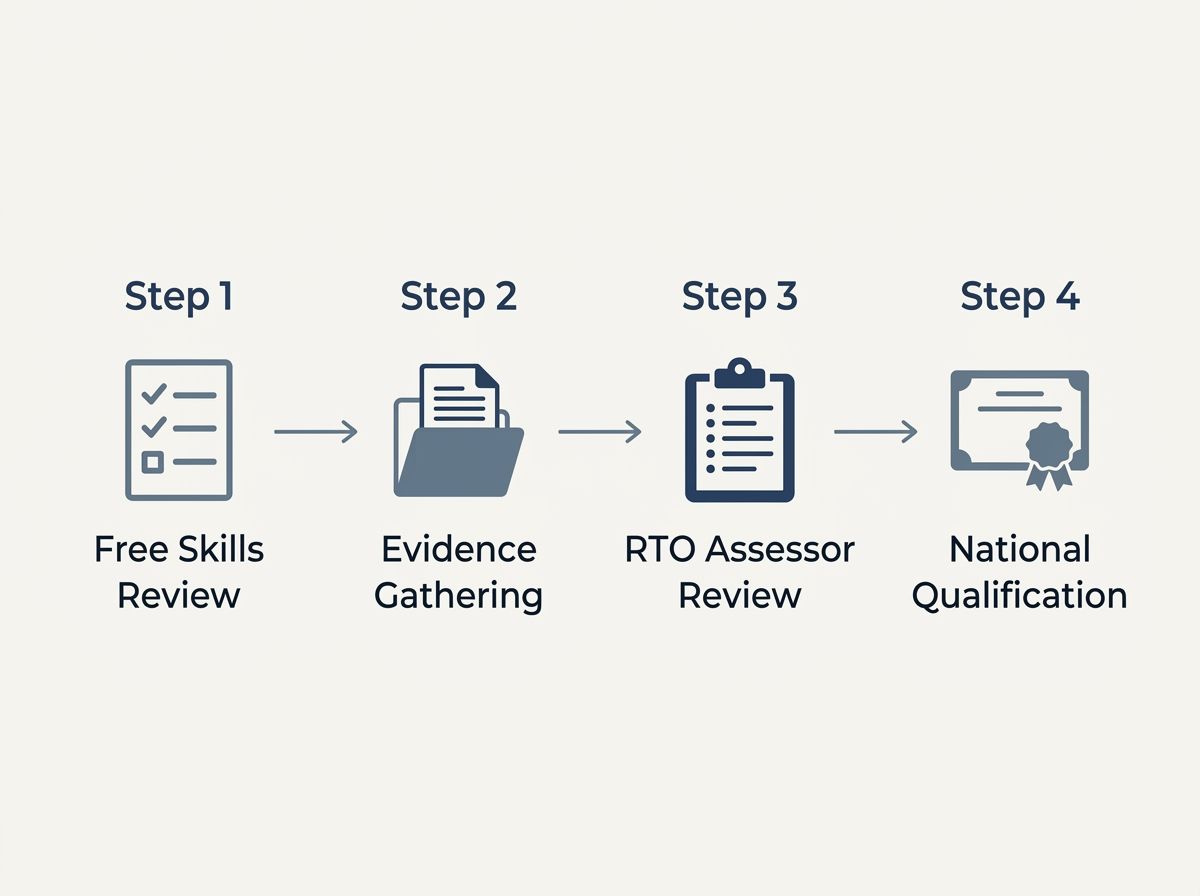
A qualified assessor from a registered training organisation (RTO) conducts the formal assessment. While RPL it guides you through the process, from the initial skills review through to evidence preparation and submission, the partner RTO evaluates the submission and issues the qualification. The final outcome depends on the evidence you present and the assessor's evaluation.
Timeframes for RPL applications vary depending on individual cases. One Australian RTO notes that the process can take between two and eight weeks, depending on the complexity of your evidence and the specific qualification. This is an indicative range rather than a guarantee, and it is not specific to transport and logistics. Your actual assessment timeline will depend on your individual situation.
If any gaps in your evidence are identified during the assessment, they can be addressed through targeted training. This does not mean starting from scratch. It simply means the assessment accurately reflects what your evidence shows and identifies any specific areas that need support.
Is your experience enough?
Not every logistics worker is suitable for RPL, and honest advice is far more valuable than enrolling in a program that does not fit your needs. The process begins with a Free Skills Review, which provides a no-obligation assessment of whether your experience matches the requirements of a formal logistics qualification.
The Free Skills Review requires no commitment. It is a practical first step to determine whether this pathway suits your situation before you invest time or money. Some Australian RTOs indicate that an initial skills assessment can be completed quickly, often providing a response within a few business days.
If your experience qualifies, you will have a clear pathway to a nationally recognised qualification that translates your working knowledge into an industry standard. If gaps are identified, you will receive clear feedback so you can make an informed decision. The next step is entirely up to you.
Ready to Get Recognised?
Start with a free skills review to find out if RPL is right for you.