The real cost of subcontracting licensed guards (and the faster path to in-house compliance)
Paying premium subcontractor rates for guards? Your experienced staff could qualify for a Certificate II in Security Operations via RPL.

The subcontractor premium nobody talks about
Security operations managers across Australia routinely pay more per hour for subcontracted licensed guards than for directly employed staff. It is not because the subcontracted guards are more capable. It is because the contract rate must absorb the labour-hire margin, insurance, superannuation, rostering overheads, and compliance costs that sit behind every subcontracted shift. That premium is real, and it compounds across every roster cycle.
The assumption most managers make is that this cost is fixed and that subcontracting is simply what compliance requires. But in many cases, the guards already on your payroll who know the venue, clients, and protocols already do the work that the Certificate II in Security Operations (CPP20218) assesses. They simply have not had that experience recognised.
This is a major advantage security managers often overlook. Experience is evidence. For experienced guards, Recognition of Prior Learning (RPL) offers a path to formal qualification without classroom study, block release, or time off the floor.
What the licence requires (and what your staff already do)
The Certificate II in Security Operations (CPP20218) is the entry-level qualification for security officers and crowd controllers in Australia. It sits within the CPP Property Services Training Package and has 293 nominal hours in Western Australia's training package guide.
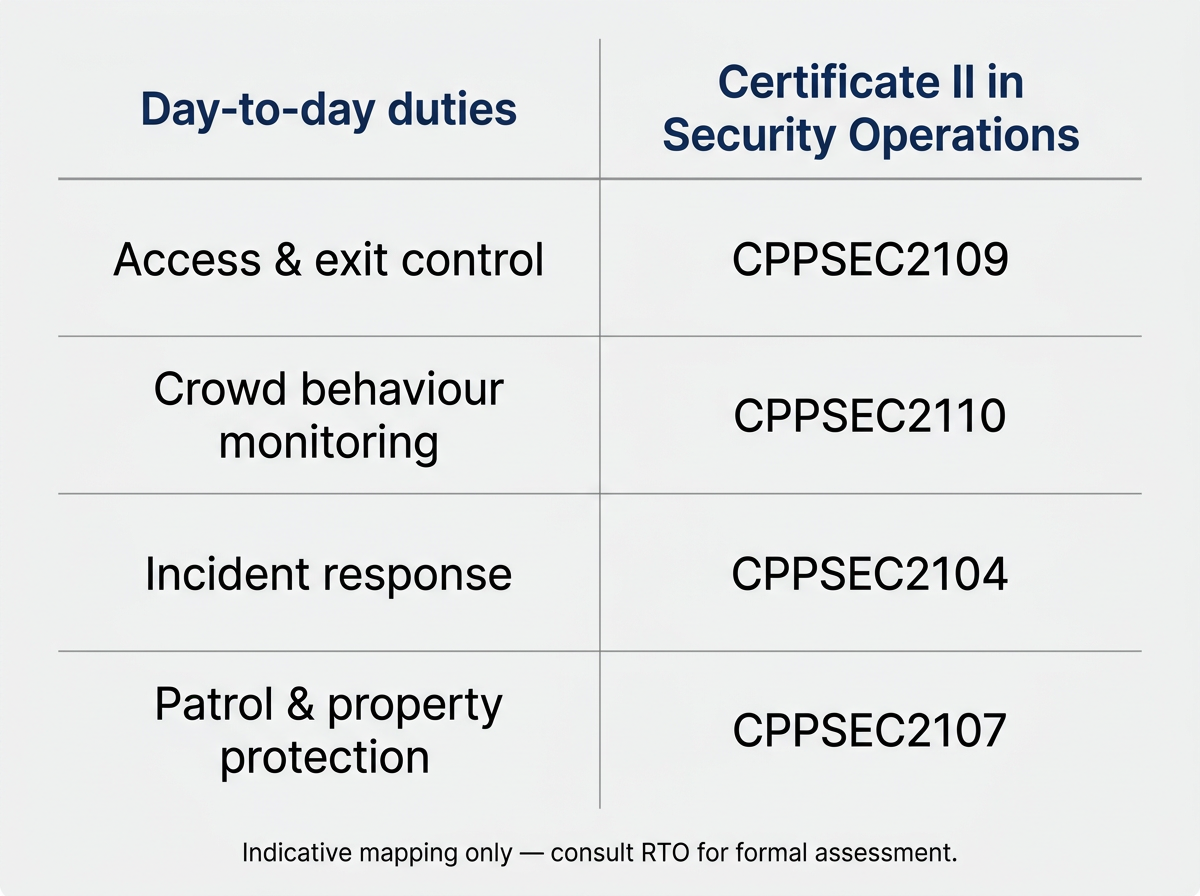
The qualification comprises 14 core units of competency. As published by registered training organisations, these units cover the practical work experienced guards do every shift, including applying communication skills, managing access and exit of people and vehicles, monitoring crowd behaviour, screening people, patrolling premises, applying WHS and emergency procedures, managing intoxicated people, removing people from premises, and providing first aid.
The qualification describes the role of security officers working under limited supervision to maintain safety across different environments. Occupational outcomes include unarmed security officers, crowd controllers, control room operators, and security patrol officers.
Licensing requirements vary by state and territory, and individuals must check with their local licensing authority. One registered training organisation notes that CPP20218 supports licensing outcomes for specific roles in Queensland, the Northern Territory, South Australia, the ACT, and Tasmania. A South Australian provider states the qualification meets Consumer and Business Services licensing requirements in that state for General Guarding and Crowd or Venue Control endorsements.
The compliance exposure your subcontractor arrangement might not cover
Beyond the premium rate, relying on subcontractors creates compliance risks that managers often underestimate. The assumption is that a subcontractor's licence transfers all liability, but this is worth examining closely.
In Victoria, amendments to the Private Security Act 2004 (Vic) impose specific subcontracting obligations at both the principal contractor and subcontractor levels. These include obtaining written consent from the client before subcontracting, and giving written notice of proposed subcontractors' names and licence numbers. Non-compliance carries maximum penalties of over $47,000 for companies and $23,000 for individuals, and can lead to the cancellation of a labour hire provider's licence.
The Victorian Government has noted that security supply chains, where a client engages a principal contractor who then sources workers from subcontractors, carry an increased risk of non-compliance. The definition of subcontractors in this context is broad, encompassing both businesses registered under the Labour Hire Licensing Act 2018 (Vic) and workers engaged as independent contractors.
The Victorian Labour Hire Authority has published guidance on these changes and their impact on security providers operating in Victoria.
Australian Government procurement documentation for security guarding services references compliance with state and territory security legislation, including the Security Industry Act 1997 (NSW), Private Security Act 2004 (VIC), Security Industry Act 2003 (ACT), Security and Related Activities (Control) Act 1996 (WA), and Security Providers Act 1993 (QLD), alongside the ASIAL Professional Code of Conduct where applicable.
Reviewing your state or territory's security industry legislation will clarify where your obligations begin and end. Rules vary by jurisdiction, and the consequences of non-compliance are significant. This article is not legal advice; if you are uncertain about your obligations, seek guidance from your licensing authority or a qualified legal adviser.
Why RPL can be faster than expected for experienced guards
Recognition of Prior Learning (RPL) is an assessment pathway conducted by a registered training organisation (RTO). For experienced security staff, it replaces classroom study with an assessment of existing skills. Work records, employer references, logbooks, and practical observation can all form part of the evidence portfolio, meaning staff remain on the roster throughout.
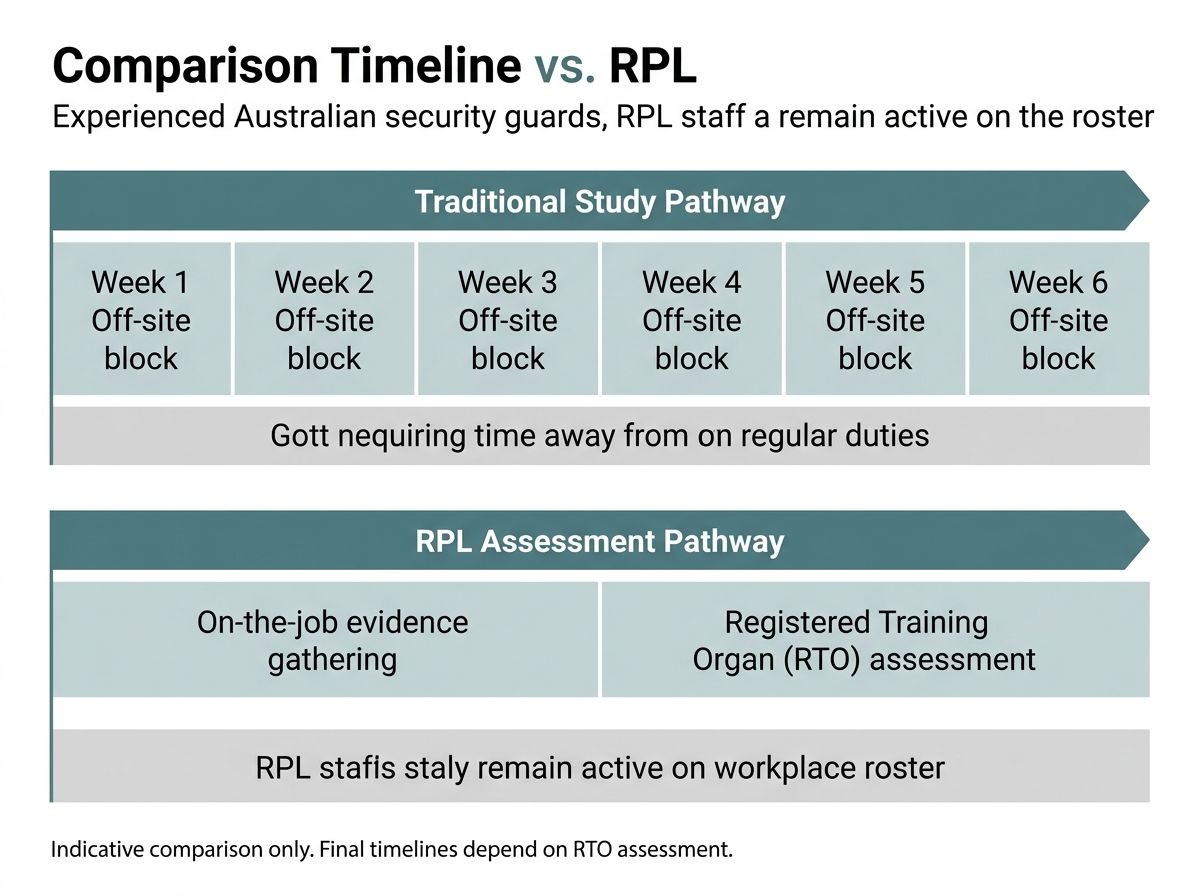
Timelines vary by RTO, the quality of evidence, and the specific licensing requirements in your state. One registered provider lists a minimum of 28 days for CPP20218 RPL review and assessment. General RTO guidance suggests that for candidates with well-prepared evidence, the RPL process can be completed in weeks rather than months, which is much faster than traditional study pathways.
RPL is not a shortcut; it is a rigorous assessment process. An assessor from the RTO evaluates whether the candidate demonstrates competency in each unit. If gaps are identified, some gap training may be necessary, which reputable providers offer at no extra cost. The qualification is nationally recognised because the assessment is genuine.
For guards with substantial experience, the RPL pathway recognises their existing skills without requiring them to repeat training. Your RTO assessor can provide an indicative timeline based on your team's situation and the evidence you have.
The cost comparison: subcontractor premium versus in-house qualification
The ongoing cost of paying subcontractor rates for licensed guards compounds over time. A one-time RPL investment to assess an existing employee eliminates that recurring premium for the life of the qualification. The break-even point depends on your staffing model, the number of guards, and the rate differential in your market.
The principle is simple: subcontracting a licensed guard means paying for their licence, their agency margin, on-costs, and availability every time they are on the roster. Certifying an experienced in-house guard via RPL means paying once for a formal assessment of skills they already use. The maths favours in-house compliance over time, though the calculation depends on your specific numbers.
The security industry award structure includes shift, weekend, and public holiday loadings that apply to both directly employed and subcontracted staff. Subcontracting adds a contractor margin and extra on-costs on top of those award obligations, which in-house qualification can remove from the equation.
What the RPL process looks like for your guards
The RPL pathway for CPP20218 follows a structured process. RPL it guides candidates through each stage while the RTO conducts the assessment and issues the qualification.
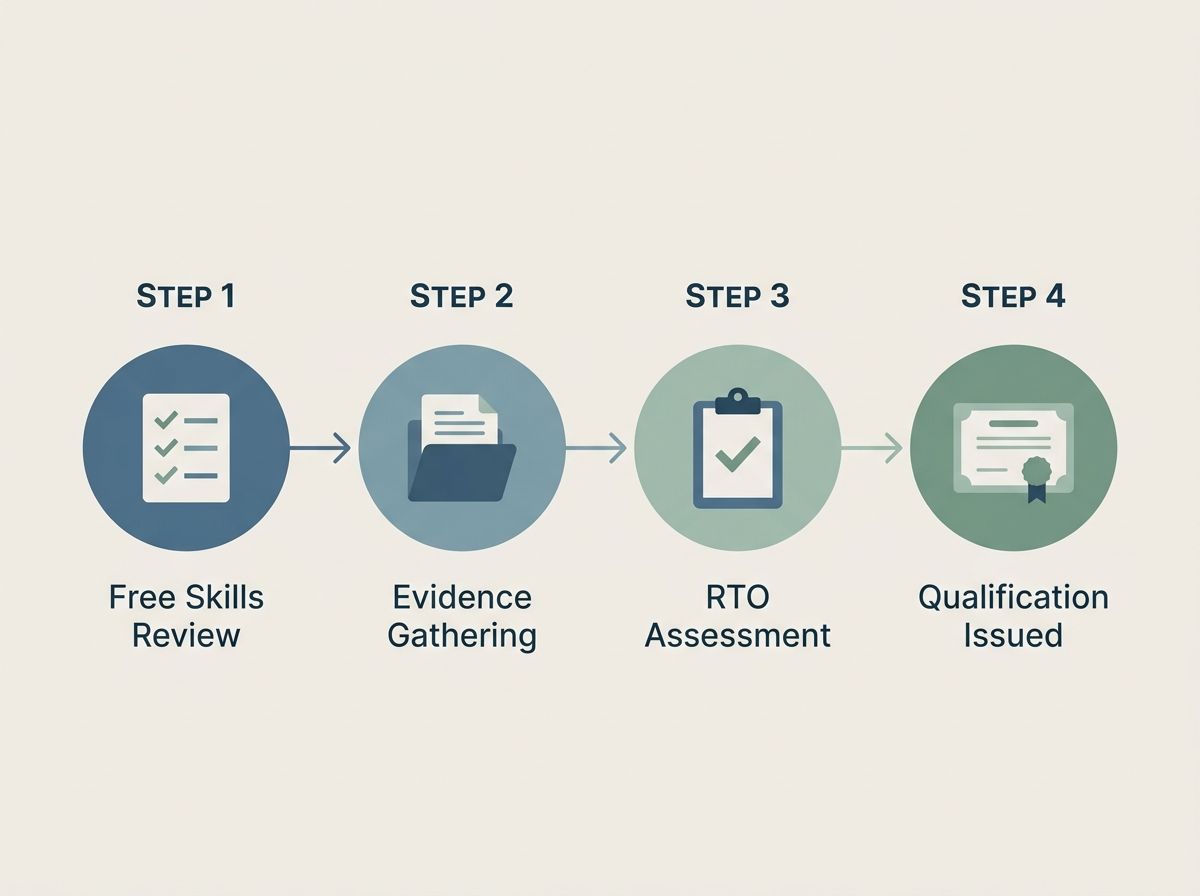
- Free Skills Review: An initial review of whether the candidate's experience is likely to support an RPL application. This is where honest suitability guidance begins.
- Evidence Gathering: The candidate compiles evidence of their existing competency, including work records, employer statements, logbooks, references, and documentation of practical experience mapped to the units.
- RTO Assessment: A qualified assessor from the RTO reviews the evidence and may conduct a practical observation or structured conversation. If competency gaps are identified, gap training is provided at no additional cost.
- Qualification Issued: When competency is demonstrated across all units, the RTO issues the Certificate II in Security Operations (CPP20218). This qualification is nationally recognised.
Throughout this process, staff remain available for shifts. The evidence-gathering phase can be completed alongside normal duties. The assessment itself is typically the main stage, and its duration depends on the quality and completeness of the evidence provided.
ASIAL, the Australian Security Industry Association Ltd, is the registered employer body for the security industry and a useful starting point for understanding industry standards and compliance expectations.
Is your team ready? What to check before starting
RPL is not suitable for every candidate, and honest suitability guidance is central to the process. We would rather guide someone to the right pathway than enrol them in the wrong one.
Candidates most likely to benefit from CPP20218 RPL have meaningful, documented experience in security operations roles such as patrolling, access control, crowd management, and incident response. One registered provider indicates that candidates with more than one year of experience in security operations are encouraged to consider the RPL process, though requirements vary by RTO.
Candidates with limited documented experience, or those whose work history does not closely align with the CPP20218 competencies, may find RPL less suitable. In those cases, a traditional study pathway or a combination of partial RPL and gap training may be more appropriate. The Free Skills Review is designed to answer this question honestly before any commitment is made.
For security managers considering this for a team rather than an individual, the Free Skills Review helps identify which guards are strong RPL candidates and which may need a different approach. Recognition should not require starting over, but it does require the right foundation.
Ready to Get Recognised?
Start with a free skills review to find out if RPL is right for you.