The Difference Between a Great Pastry Cook and a Qualified Pastry Chef
You have the skills, but luxury employers filter by credentials. Learn how to convert your pastry experience into a Cert IV in Patisserie.
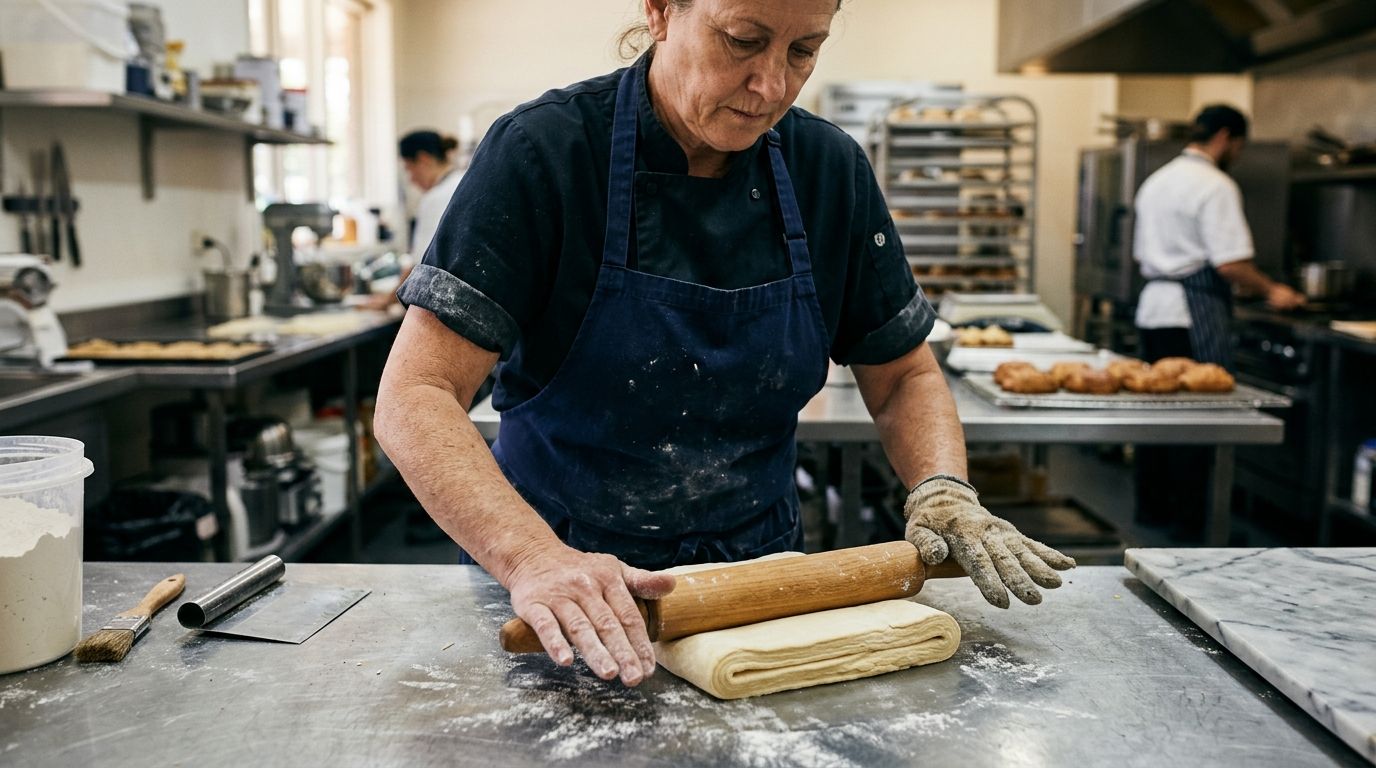
When culinary skill alone is not enough
You have the practical experience. Indeed, you have years of it. You have worked the pastry section in busy commercial kitchens, produced technically demanding work under high pressure, and trained staff who now hold senior titles that you do not. When a senior patisserie role opens at a hotel group or a fine dining venue, you apply. But the automated recruitment system does not evaluate your portfolio of work. Instead, it screens for specific qualifications. If the Certificate IV in Patisserie is missing from your application, the process stops there.
This is not a reflection of your actual culinary ability. It is simply how formal hiring systems operate in modern, high-volume environments. Skill and qualifications are two different currencies in this industry. You have spent your career building one of these currencies, but the modern market expects you to hold the other.
The credential filter: A repeating career pattern
Experienced pastry workers who lack formal qualifications often find themselves stuck in a repeating pattern. This professional cycle consists of four distinct stages, and it continues to repeat until something breaks the loop.
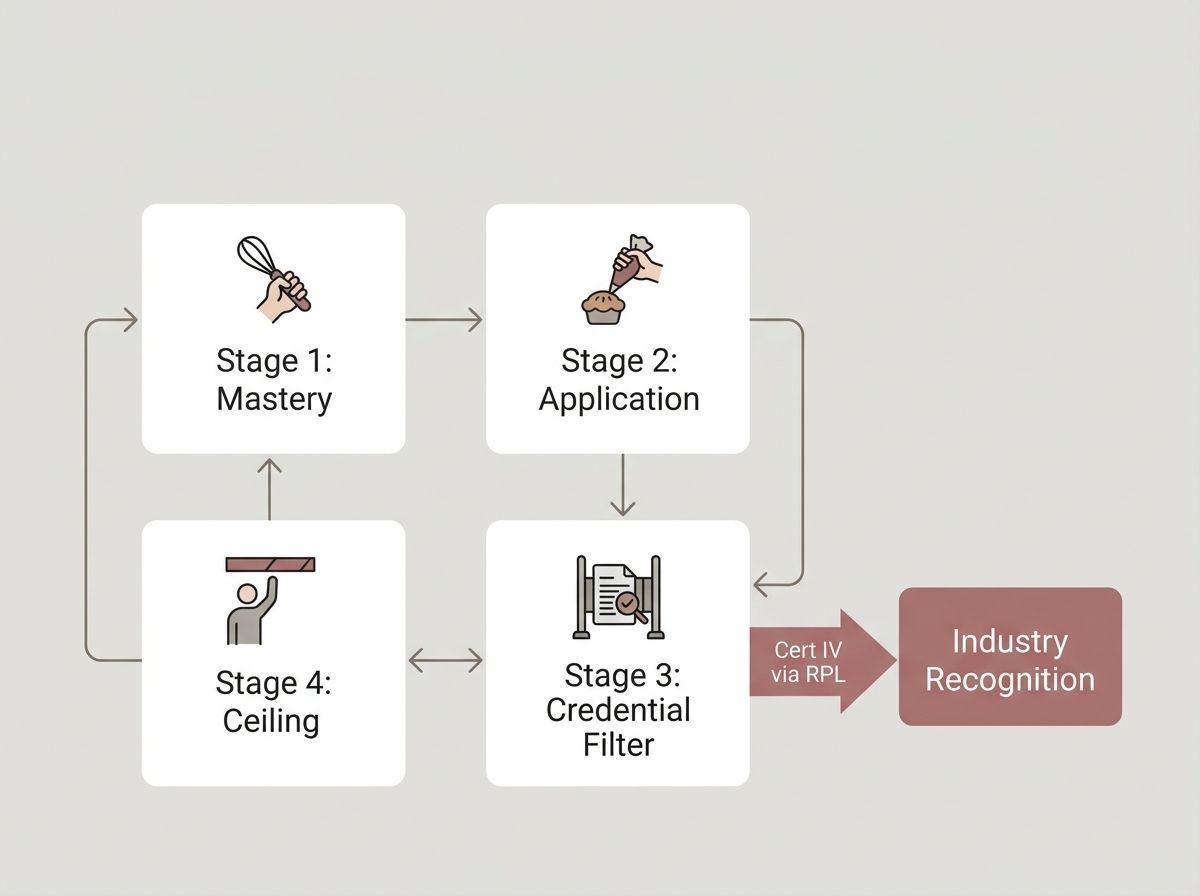
- Stage 1 - Mastery: You build genuine competency through years of hands-on kitchen work. You learn by doing, observing, and mentoring others. Your technical skills are highly developed and proven.
- Stage 2 - Application: A career opportunity opens that matches your practical capability. You apply for the role, backed by substantial kitchen experience and a strong portfolio of work.
- Stage 3 - The Credential Filter: Before any chef reviews your skills, the recruitment process screens your qualifications. Because the Certificate IV in Patisserie is missing, your application does not progress.
- Stage 4 - The Ceiling or the Restart: You either accept a career ceiling by remaining in roles that do not require credentials, or you consider returning to study, which feels like starting over on techniques you already master.
This cycle is systemic rather than personal. Employers are not necessarily wrong to ask for formal qualifications; they use credentials as a reliable trust shortcut in high-volume recruitment. However, this process disadvantages experienced cooks whose competency is practical rather than academic. Their valuable skills exist in a format that automated human resource systems simply cannot read or evaluate.
What the Certificate IV in Patisserie signals to employers
The Certificate IV in Patisserie (SIT40721) is a nationally recognised qualification within the Australian Qualifications Framework. For experienced kitchen professionals, it is important to understand exactly what this credential represents.
It does not mean you are just learning the trade; you already know patisserie. Instead, it signals that your competency has been formally assessed against national standards by a registered training organisation. For luxury hotels, fine dining venues, and premium pastry brands, this qualification acts as a trust mechanism. It confirms that your skills meet a recognised national benchmark without requiring a manual review of your entire work history.
In a competitive market, this formal signal is highly practical. It is not a measure of your worth as a pastry professional, but a matter of legibility. Without this credential, your years of experience remain in a format that hiring software and human resource departments cannot easily read.
You can find more detail regarding the qualification units and requirements on the Certificate IV in Patisserie (SIT40721) page.
Learn more about the Certificate IV in Patisserie (SIT40721) and its structured units.
The career barrier is evidence, not practical skill
Your skill is not in question. The gap exists because your practical expertise is not in a format that formal systems recognise. This is a straightforward, solvable problem.
Recognition of Prior Learning (RPL) is the formal process that assesses your existing competency against the units of a qualification. Rather than studying content you already know, you provide evidence of your previous work. A qualified assessor from a registered training organisation reviews your documentation against the SIT40721 standards. If your experience demonstrates competency, the RTO awards the formal qualification.
Evidence for an RPL assessment typically includes documentation of your work history, references from qualified head chefs, and photos of complex patisserie items you have produced. It can also include kitchen logs, menu designs, and third-party observation reports. The exact requirements depend on the assessing registered training organisation and the specific units being evaluated. What matters is that this evidence is current, authentic, and clearly demonstrates the precise level of competency required by the qualification.
RPL is not a shortcut; it is a rigorous assessment pathway. The difference is that it evaluates your existing knowledge instead of teaching you skills you already use daily. The qualification is nationally recognised precisely because this assessment process is genuine and strict.
Who this pathway suits
RPL for the Certificate IV in Patisserie is designed for professionals with substantial, demonstrable experience. If you have worked at a senior or specialist level—producing complex items, managing production, and operating with autonomy over a period of years—this pathway is a practical option worth exploring.
It is not suitable for those early in their culinary career or whose experience is limited in scope and complexity. Because RPL is a formal evaluation, an assessor must verify your skills against the official requirements. If your evidence does not fully demonstrate competency in specific areas, you may need targeted training before the qualification is awarded.
We prefer to give you an honest answer about your suitability rather than guide you into a process that does not fit your experience. This straightforward approach is central to how RPL it operates. If RPL is the correct option for you, we will say so. If it is not, we will tell you directly.
How to break the career cycle
The career cycle of mastery, application, rejection, and stagnation repeats until you break it. The Certificate IV in Patisserie is what breaks this loop. It does not teach you new kitchen techniques, but it makes your existing skills visible to the recruitment systems that currently filter you out.

To find out if your experience matches the qualification requirements, you do not have to navigate the process alone. A Free Skills Review provides a direct, straightforward conversation with an RPL specialist who can evaluate your eligibility and offer a clear assessment of your options.
Your practical skills are real. Getting them formally recognised is the next step. The decision is entirely yours.
Ready to Get Recognised?
Start with a free skills review to find out if RPL is right for you.