Stop treating the Cert 4 Plumbing like a chore: it's your career insurance
Your employer wants you to get the Cert 4 plumbing. Here is why you should want it too, and why it is worth more than satisfying a compliance deadline.
By RPL it Australia7 min read

You didn't ask for this qualification
The email came from HR, or during a site meeting, or as a new contract clause that appeared out of nowhere. However it arrived, the message was the same: you need a Cert 4 plumbing qualification, and you need it soon.
You have been doing this work for years. You know the job. You have trained people who now run their own crews. Now, someone behind a desk is telling you that your experience does not count until you have a piece of paper to prove it.
That frustration is legitimate. This article will not pretend otherwise. But it does offer a different way to look at the situation, because how you view this qualification determines the value you get from it.
The problem with treating it like a chore
Here is the mental model most tradespeople bring to an employer mandate: get the certificate, tick the box, and move on. Treat it like a tax. Pay it and forget it.
The issue with that approach is not that it is wrong, but that it leaves most of the value behind. A tax is money spent and gone. An asset is something you own that keeps working for you. The Cert 4 plumbing is an asset, and the distinction is significant.
When you treat the qualification as a chore, you do the work to get it without claiming the long-term benefit. You satisfy your employer's requirement and stop there. But the qualification does not stop there. It stays attached to your name, recognised across the industry, regardless of who you work for next.
What 'career insurance' actually means for a plumber
The Cert 4 plumbing is portable. That is the word that matters. Portable.
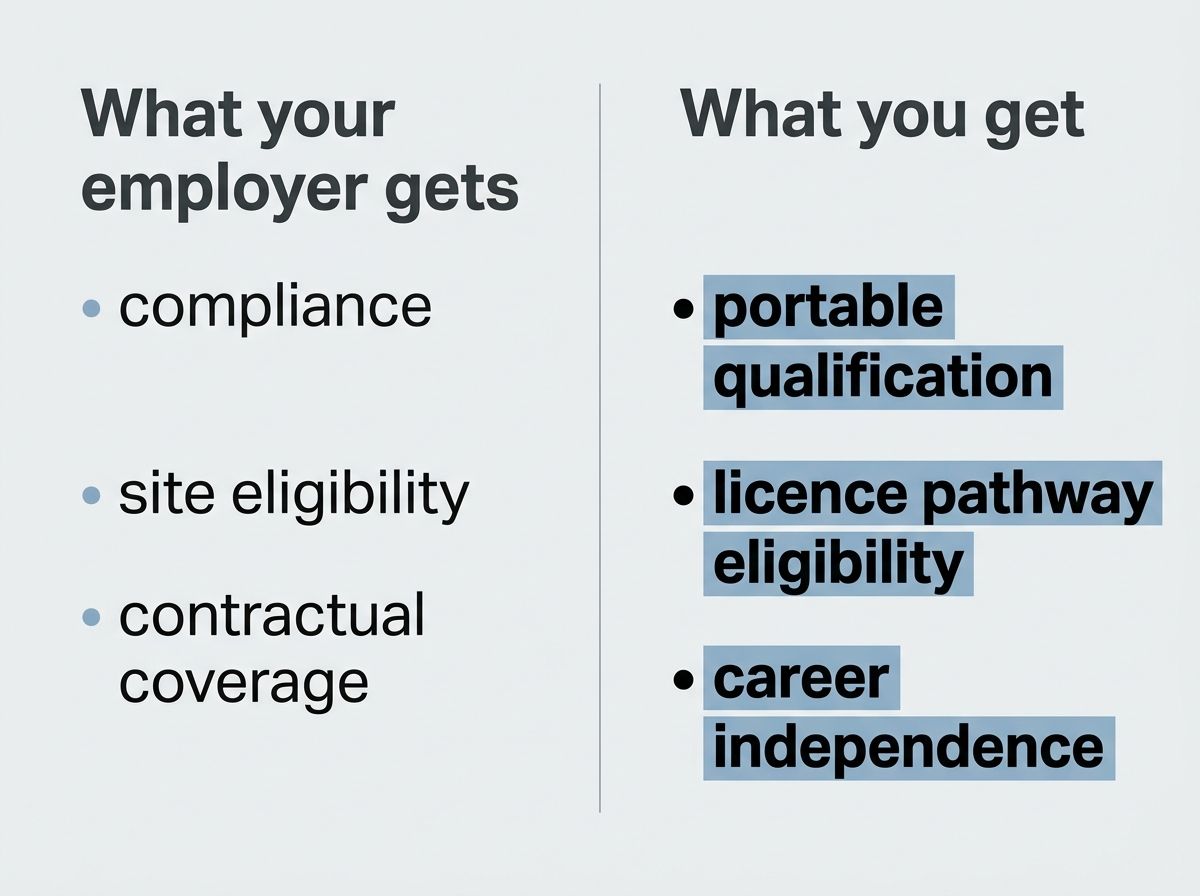
It belongs to you, not your employer. If your company loses a major contract next year, the qualification goes with you. If a better opportunity comes up interstate, the credential travels. If you decide in three years to work for yourself rather than under someone else's licence, the qualification is already in your corner.
Your employer is currently applying pressure through a compliance deadline to get you to obtain something that will benefit you for the rest of your career. That is not a chore. If you choose to see it this way, it is an asset delivered with a tight deadline, but an asset nonetheless.
Look at it from the other direction. Imagine you obtained this qualification five years ago on your own initiative. You would have spent the last five years with that credential attached to your name, opening doors, satisfying requirements, and giving you options you did not have before. The employer mandate is simply accelerating something that was always worth having.
The doors that open with a Cert 4 (and stay shut without one)
Let's be direct. The Cert 4 plumbing is more than a compliance checkbox. It is the qualification required for several major career moves. The exact requirements vary by state and are set by the relevant licensing authority in each jurisdiction, so you should always check with your local authority. Generally, here is the territory the Cert 4 opens up:
- Plumbing contractor and supervisor licence applications: in many Australian states, a Certificate IV in Plumbing and Services (CPC40920) or equivalent is part of the pathway to holding your own contractor licence. This means working under your own licence, not someone else's.
- Supervisory roles on major commercial and government projects: larger projects increasingly require plumbing supervisors to hold formal qualifications. The Cert 4 positions you for those roles in a way the Cert III does not.
- Independence: many experienced plumbers eventually move toward independent contracting. The Cert 4 is one of the foundations that makes that move possible. Without it, you remain dependent on someone else's licence to operate.
- Future-proofing: compliance requirements in Australian construction are tightening, not loosening. The qualification you obtain today keeps you on the right side of regulations that do not yet exist.
None of these steps require you to start over. They simply require the qualification you are already being asked to get.
Your experience is already most of the work
For experienced plumbers, getting a Cert 4 plumbing through Recognition of Prior Learning (RPL) is not about learning new skills. It is about proving the skills you already use every day on site.

RPL is a formal assessment pathway within Australia's vocational education system. Rather than completing a training course from scratch, you work with a registered training organisation (RTO) to document your existing experience and have it assessed against the qualification's requirements. The RTO conducts the assessment and issues the qualification. RPL it helps you present your experience as evidence.
What that evidence looks like in practice—such as specific types of documentation, site records, or assessments—is determined by the delivering RTO and the units of competency within CPC40920. The national register at training.gov.au lists the qualification's structure and units; your RTO will guide you on what evidence is needed for your specific situation.
One important note: gap training may be required if there are areas where your documented experience does not fully cover the qualification's scope. This is not a failure; it is part of an honest assessment process, and it is handled as part of the RPL pathway. The starting point is simply finding out where you stand.
The shift: from compliance to ownership
Here is a scenario that plays out more often than most people realise. A plumber gets the compliance email. He is annoyed. He goes through the RPL process because he has to. He gets his Cert 4 plumbing and moves on.
Then, two years later, his employer loses a major contract. Half the crew is laid off, but he is not, because he holds the qualification that the new contractor needs on site. Or he uses the certificate as part of his application for a contractor licence and starts taking on his own work. Or he moves interstate for a better opportunity, and the qualification travels with him without question.
He did not plan any of that when he was filling out the compliance form. But the qualification was working for him the whole time, whether he was thinking about it or not.
That is what career insurance looks like. It is not something you use every day. It is there when you need it, and you rarely know exactly when that will be.
The employer mandate is the trigger, and career insurance is the outcome. These two realities do not conflict. The qualification belongs to you, not your employer. The sooner you make that shift in how you think about it, the more value you will get from something you had to do anyway.
Find out if your experience qualifies
Before you commit to anything, find out where you stand. The Free Skills Review is an honest assessment of whether RPL is the right pathway for your experience—not a sales call or an enrolment form. It is the starting point.
If your experience qualifies, you will know what the process looks like. If there are gaps, you will know that too, along with what is involved in addressing them. Either way, you are better informed than you are right now.
General information only, current at the date shown. Licensing rules change, so check the current requirements with the relevant regulator before you rely on them. RPL it Australia is a student support service, not a Registered Training Organisation; qualifications are assessed and issued by our partner RTOs.