Knife skills vs. paper skills: Getting paid what you're worth as a butcher
Experienced butchers know the trade. Without a Cert 3 in Meat Processing, the pay ceiling is real. Learn how RPL recognises what you already do every day.

The butcher who trains everyone but gets paid like a casual
You know the person. They handle the complex primals on the floor, train the new starters, and keep the counter running when things get busy. Yet they still take home roughly the same pay as someone who started last month with a certificate and half the experience. Maybe that person is you.
This is not a personal failure. It is a structural issue with how the meat processing industry classifies skill. The Meat Industry Award 2020 sets minimum pay rates across eight classification levels, from MI 1 through to MI 8. These minimum hourly rates range from $25.74 at the entry level to $30.53 at the top, based on the consolidated award rates shown by the Fair Work Ombudsman. The classification definitions that determine where you sit in that range are detailed in Schedule A of the award, and they matter.
The award does not make it obvious how a formal qualification like the Certificate III in Meat Processing interacts with those classification levels, at least not in the sections most workers ever read. That ambiguity is part of the problem, and it costs experienced butchers money.
To look at the broader context of what butchers and smallgoods makers earn across Australia, the Australian Government's Jobs and Skills Australia data, drawn from the ABS Survey of Employee Earnings and Hours, shows median full-time weekly earnings of $1,550 for this occupation group. That is a useful baseline, but it does not show the clear gap between a classified and an unclassified worker doing the same job.
The gap is real. For many experienced butchers, it remains invisible until they start asking questions.
What the Cert 3 in Meat Processing actually covers (and why you already know it)
The Certificate III in Meat Processing (Retail Butcher), coded AMP30815, is the trade qualification for butchers on the Australian Government's training register. It includes 37 core units and 7 elective units, totalling 44 units of competency.
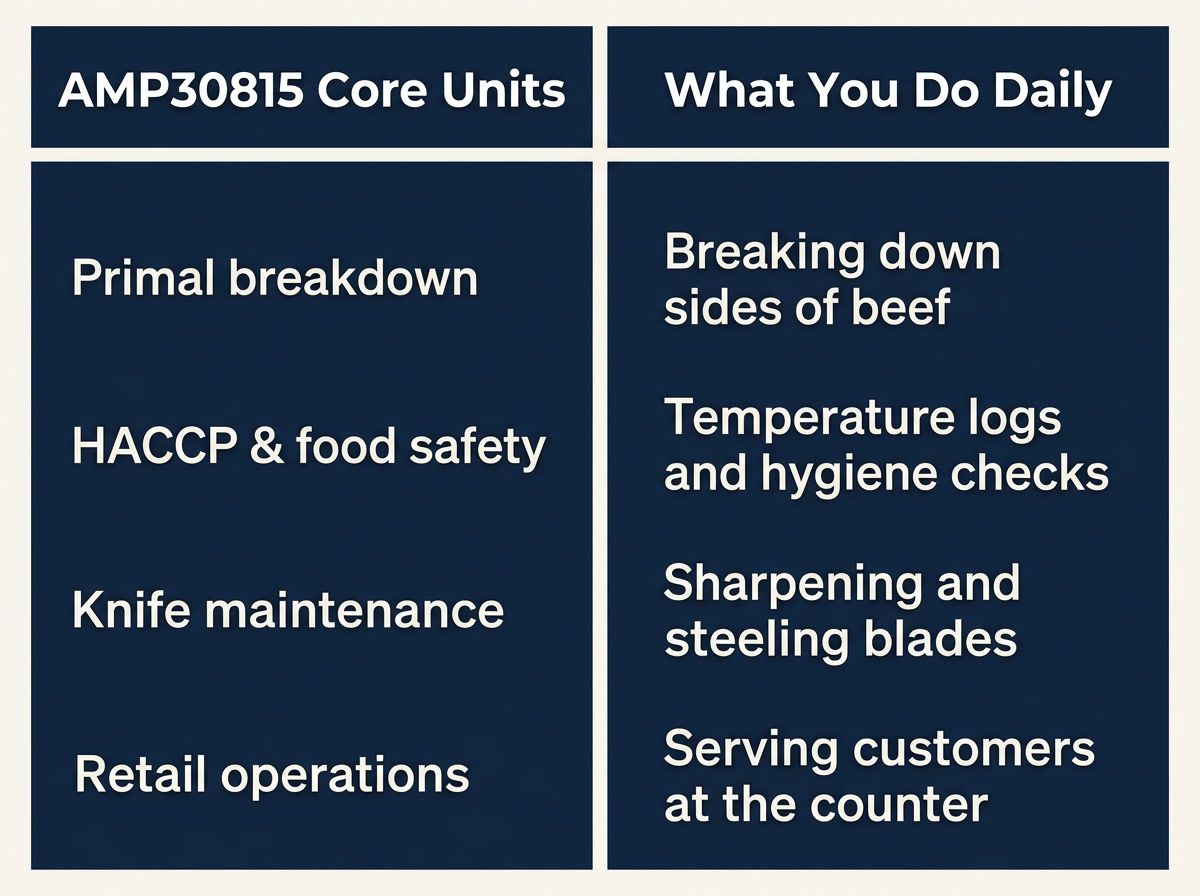
These units cover what an experienced retail butcher does every single day. This includes breaking down primal cuts, portioning and labelling product, maintaining knives, and applying food safety and HACCP requirements. It also covers operating at the retail counter and managing product quality and presentation. If you have been working in a butcher shop for several years, you demonstrate these competencies on every shift.
The qualification is not designed to teach you the trade. It is designed to formally recognise that you already know it. That distinction matters because it changes the question from 'how do I learn this?' to 'how do I prove what I already do?'
The AMP30815 qualification document states that no entry requirements apply. This means there is no prerequisite study or prior qualification needed to undergo assessment.
Why the pay gap is real—and getting harder to ignore
The Meat Industry Award 2020 is the floor, not the ceiling. Under the award, some meat processing employees are paid through incentive payment systems or piece rates rather than a straight hourly rate. During ordinary hours, those employees must receive at least the minimum classification rate plus applicable loadings. This includes a 20% incentive loading for full-time and part-time employees, as well as additional loadings for daily hire or casual arrangements.
In practice, the structure of pay in the meat industry is more complex than a simple hourly rate. Your classification level matters. The classification definitions that determine where a worker sits are worth understanding if you want to be paid fairly for what you actually do.
You should verify the relationship between holding a formal qualification like the Certificate III in Meat Processing and your classification level directly against Schedule A of the Meat Industry Award 2020 and with your employer. What is clear is that formal qualifications are increasingly how employers and the award system assess and describe skilled work. Experienced butchers without the paper credential are often at a disadvantage during classification discussions, pay negotiations, and hiring decisions.
This same pattern plays out across skilled trades in Australia. Experienced workers who know the job better than anyone in the room find themselves blocked by a qualification barrier that has nothing to do with competence and everything to do with formal recognition.
The problem with 'I learned on the job'
On-the-job learning is real learning. Nobody who has spent years breaking down carcasses, managing a retail counter, and training new staff needs to be told that. The problem is not the learning, but the form it takes.
Formal systems like award classifications, employer hiring criteria, and migration skills assessments require evidence in a specific format: a qualification issued by a registered training organisation. Without this, years of expertise remain invisible. This is not because your expertise is lacking, but because it exists in the wrong form.
This is the core injustice, but also the main opportunity. The evidence already exists; it just needs to be presented correctly.
This is particularly true for butchers who trained overseas. Overseas butchery qualifications are not automatically recognised in Australia, and a separate skills assessment process applies for migration and employment purposes. For workers in this situation, the path to formal recognition runs directly through the Australian qualification system.
Your skills are real. Your experience counts. The system simply needs to see it in a different format.
How RPL turns your knife skills into a recognised qualification
Recognition of Prior Learning (RPL) is a formal assessment process conducted by a registered training organisation (RTO) to evaluate your existing skills and experience. For an experienced retail butcher, this means showing through evidence that you already meet the standard for the Certificate III in Meat Processing (Retail Butcher), AMP30815.
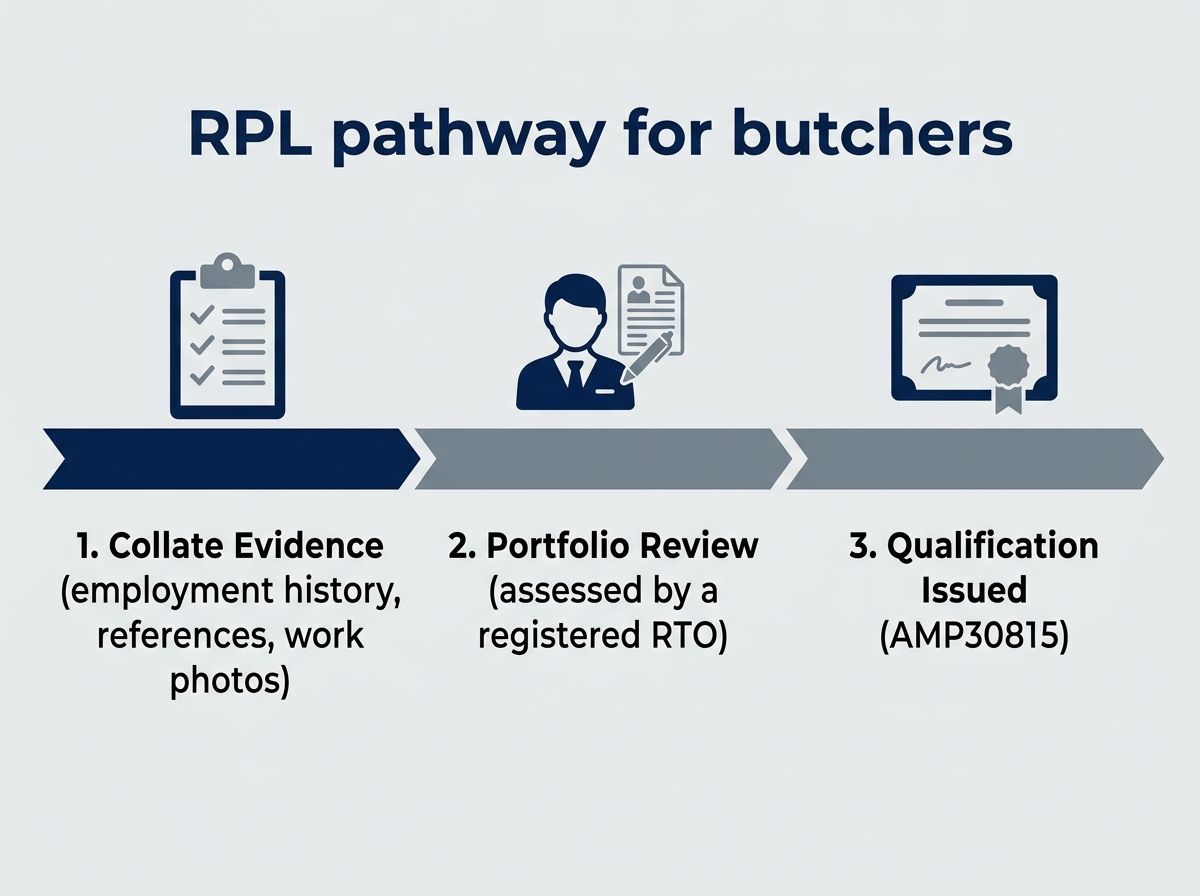
You are not learning new skills. You are simply presenting your existing skills in the format the system requires.
The evidence typically accepted in an RPL assessment includes employment records and payslips that confirm your work history, position descriptions, supervisor references, work samples, and photographs of your work. In some cases, a practical demonstration of competency is also required. The specific requirements depend on the RTO conducting the assessment. This assessment is conducted by a qualified assessor from that RTO, not by RPL it.
This is a rigorous process, and it is designed to be. The qualification is nationally recognised precisely because the assessment is genuine, rather than handed over without scrutiny.
The Australian Skills Quality Authority (ASQA) provides guidance on how registered training organisations must conduct RPL, including requirements for evidence and assessor qualifications. Source: Meat Industry Award 2020.
To understand what the RPL pathway looks like for the Certificate III in Meat Processing (Retail Butcher), our product page has the detailed breakdown you need.
What happens if there are gaps?
Not every experienced butcher has documented evidence for every unit in the qualification. That is normal. Where gaps exist, targeted gap training is provided. This training focuses only on the specific areas where evidence is missing. It is not starting over; it is simply filling in the places where your formal record does not yet match your practical experience.
The assessment is straightforward. If gaps are identified, they will be named clearly and addressed. That clarity is the foundation of a qualification that holds genuine value in the industry.
Gap training for AMP30815 is typically targeted to specific units rather than the full qualification. This means the time and effort involved is proportionate to what is actually missing, rather than repeating what you already know.
Is RPL right for every butcher?
RPL is not suitable for everyone. A butcher who is newer to the trade, or who has worked in a narrow role without exposure to the full range of tasks covered by the qualification, may not yet have enough evidence to support a complete RPL assessment.
As a general guide, and this is indicative rather than a guarantee, RPL for a Certificate III qualification typically requires several years of hands-on experience across a broad range of tasks. For a retail butcher, this means experience with primal breakdown, portioning, food safety compliance, counter operations, and knife maintenance, rather than just one or two of these areas.
Whether your specific experience is sufficient is a question worth answering before you make any commitments. That is exactly why we offer the Free Skills Review.
Your skills are real. Your recognition should be too.
You have the experience. You have been doing the work, from complex cuts and food safety compliance to counter management and training new staff, for years. The qualification does not ask you to learn something new. It simply asks you to demonstrate what you already know.
This is about recognition, not repetition. Your work deserves to be counted.
The decision is yours. If you want to understand whether your experience qualifies, start with our Free Skills Review. There is no cost and no obligation.
Read more about the Certificate III in Meat Processing (Retail Butcher) and the RPL pathway available through RPL it.
Ready to Get Recognised?
Start with a free skills review to find out if RPL is right for you.