Why Your Years on the Tools Do Not Count Without an ARCTick Licence
You can fix any system in QLD, but without an ARCTick licence, you cannot legally handle refrigerants or sign off work. Here is how to get licensed.

The licence that stops experienced technicians cold
You have the experience. You know how to diagnose a fault before the gauges are even on. You have commissioned systems, traced leaks in commercial cold rooms, and fixed problems that stumped the apprentices. In Queensland, however, none of that experience gives you the legal right to handle refrigerants or sign off the work. That right requires an ARCTick licence. This licence belongs to the qualification, not the years.
This is the wall experienced refrigeration mechanics hit. It is not a skills gap or a knowledge gap; it is a credential gap. The licensing system cannot see what you know. It only sees what you can prove in a form it officially recognises.
If you work in refrigeration and air conditioning in QLD without a current ARCTick licence, you are operating with real and growing regulatory risks. This article explains what the ARCTick licence is, why experience alone does not satisfy the legal requirement, the consequences of working without it, and how Recognition of Prior Learning (RPL) converts your hands-on experience into the formal qualification required to get licensed.
What the ARCTick licence actually is (and why it exists)
An ARCTick licence is a federal credential that authorises technicians to legally purchase, handle, and recover refrigerants in Australia. It is issued by the Australian Refrigeration Council (ARC), which is commonly known as ARCTick. This licence is required because refrigerants are strictly regulated substances under Australian environmental law.
The licence is not a state-by-state arrangement; it applies nationally. Whether you work in Brisbane, Cairns, or anywhere else in QLD, the requirement is the same. If you handle refrigerants through purchasing, recovering, or servicing systems that contain them, you must hold a current ARCTick licence to do so legally.
The ARCTick licence is not an assessment of your trade skills. It simply verifies whether you hold the formal qualification showing you can work safely within the regulatory framework. The licence follows the qualification. Without the qualification, you cannot get the licence. Without the licence, you have no legal right to handle refrigerants, regardless of how many years you have done the job.
This is the distinction that matters. The system does not question your trade competence, but it does require that your competence be formally assessed and recorded. These are two different things, and the gap between them is where experienced technicians find themselves stuck.
The QLD licensing stack: ARCTick, QBCC, and why you need both
In Queensland, air conditioning and refrigeration technicians operating as contractors face a two-layer licensing requirement. The first layer is federal, being the ARCTick licence needed to handle refrigerants. The second layer is state-based, being the licence issued by the Queensland Building and Construction Commission (QBCC) to carry out regulated contracting work in QLD.
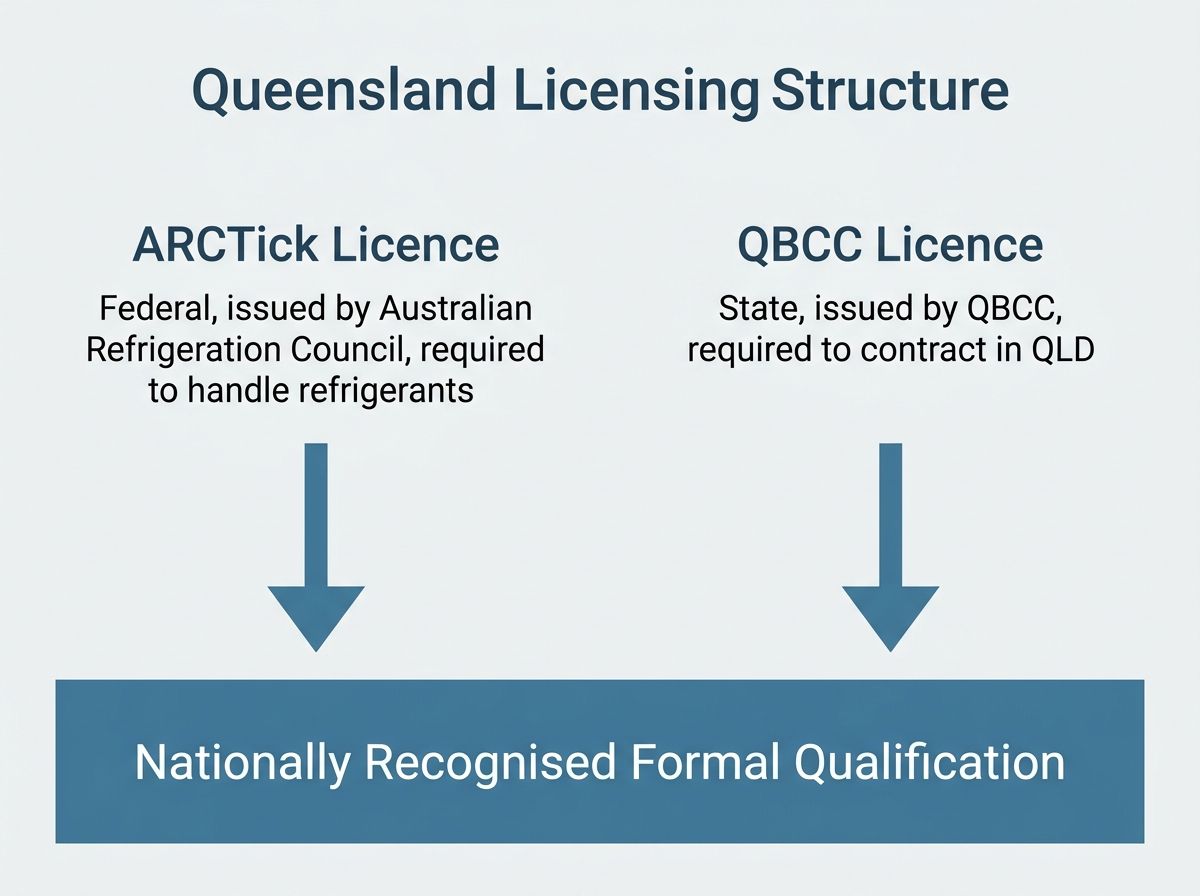
Both licences require an underlying formal qualification. That qualification is the foundation of the entire licensing structure. Without it, neither licence is accessible. Without both licences, you cannot legally operate as an independent contractor in the Queensland refrigeration and air conditioning industry.
- ARCTick licence: A federal requirement issued by the Australian Refrigeration Council (ARC). It is required to legally purchase, handle, and recover refrigerants, and requires a specified formal qualification.
- QBCC licence: A state requirement issued by the Queensland Building and Construction Commission. It is required to carry out regulated contracting work in QLD, requiring a formal qualification and usually proof of your ARCTick licence.
- Formal qualification: The shared foundation. This is a nationally recognised qualification assessed by a Registered Training Organisation (RTO), which both licensing bodies require before they will issue a licence.
The practical implication is straightforward: if you do not hold the formal qualification, you cannot apply for either licence. Without these licences, you cannot legally operate as a contractor in QLD, regardless of how long you have been doing the work.
Why experience alone does not satisfy the requirement
Your experience is real. The hours you have put in, the systems you have diagnosed, and the problems you have solved do not disappear because a piece of paper is missing. However, the regulatory system that governs refrigerant handling and trade licensing in QLD does not assess competence on the job directly. It assesses credentials.
The ARC has no pathway to issue an ARCTick licence based solely on ten years of refrigeration work. Similarly, the QBCC does not grant contracting licences based only on employment history. Both bodies require a formally assessed qualification from a Registered Training Organisation. That remains the sole pathway to licensing.
This does not reflect on your ability. It is a structural feature of the regulatory system. The system requires that competence be assessed in a specific way, by a specific type of organisation, against set standards. Experience that has not been assessed through this channel is invisible from a regulatory perspective.
A technician who has serviced commercial refrigeration systems for fifteen years and one who completed a traineeship last year are treated identically by the licensing system: both must hold the qualification. The difference is that the experienced technician already has the skills, though they currently exist in the wrong form for formal recognition. This is the gap RPL is designed to close.
What happens when you keep working without the licence
Continuing to work without an ARCTick licence in QLD carries real risks. Handling refrigerants without a current licence is a breach of federal law. The consequences include substantial financial penalties under federal legislation, and regulatory enforcement is active.
Beyond the federal refrigerant handling requirement, working as an unlicensed contractor in QLD without a QBCC licence also carries serious consequences. The QBCC has powers to issue stop-work orders, impose fines, and take further action against unlicensed operators. The penalties are structured to be a genuine deterrent, not a cost of doing business.
There are also practical consequences that accumulate over time. Public liability insurance policies typically require that work be carried out by appropriately licensed tradespeople. If a claim arises from work performed without the required licence, the insurer may decline coverage. That financial risk falls directly on you, or on the employer who permitted the unlicensed work.
This is not stated to cause alarm, but because the timeline matters. Every day of unlicensed operation is a day of compounding risk. The longer you go without a formal qualification, the greater your exposure and the more urgent the need to address it.
Note: Specific penalty amounts under federal legislation and QBCC regulations should be confirmed directly with the Australian Refrigeration Council, the QBCC, or a legal adviser, as figures are subject to change. This article does not state specific penalty figures because they could not be independently verified at the time of writing.
How RPL turns your experience into the qualification that unlocks the licence
Recognition of Prior Learning (RPL) is a formal assessment process through a Registered Training Organisation (RTO). It evaluates your existing skills and experience against the units of competency in a nationally recognised qualification. For experienced QLD refrigeration mechanics, RPL means your years on the tools are assessed as evidence rather than ignored.
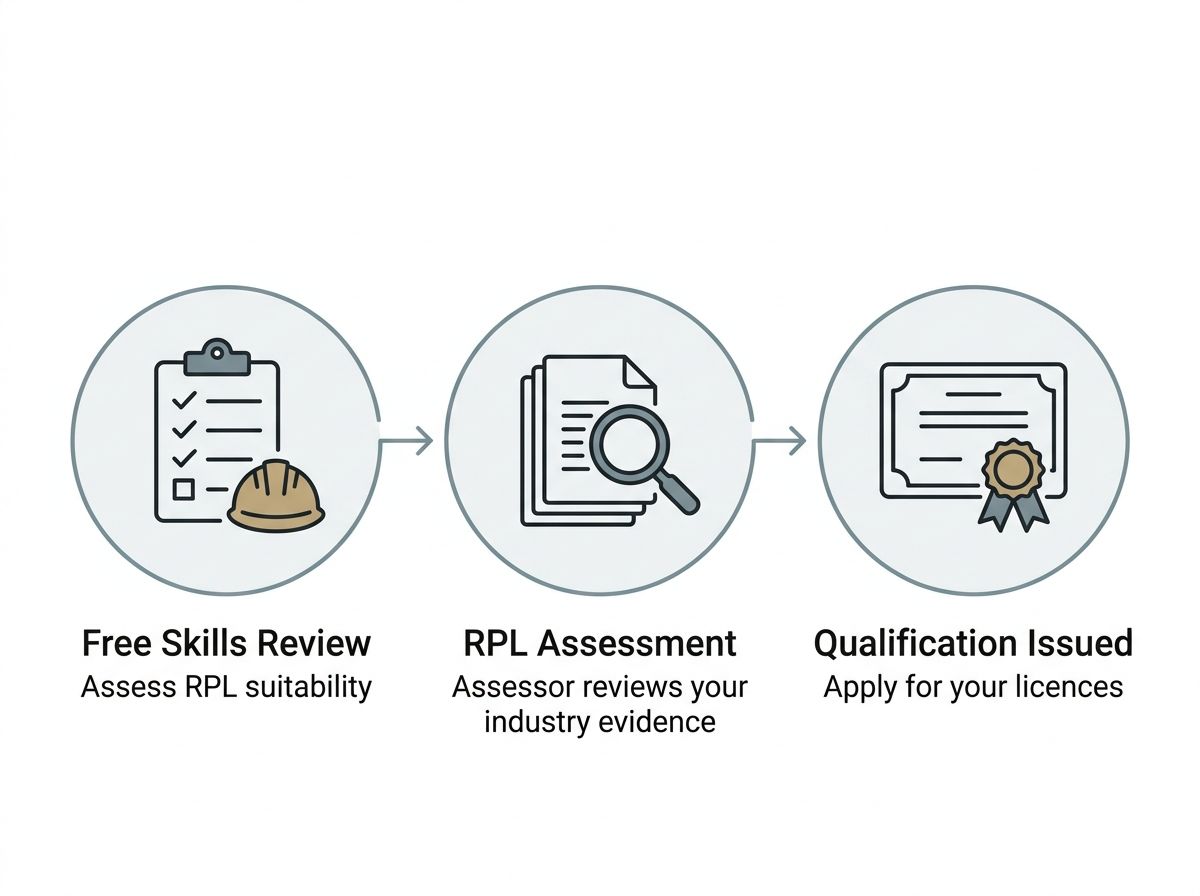
The outcome of a successful RPL assessment is a nationally recognised qualification. That qualification is the same credential that satisfies the ARCTick and QBCC licence application requirements. It is not a lesser certificate or a provisional document. It is the same formal qualification that any other pathway produces, because it is assessed by the same standard through an RTO.
RPL is not a shortcut. It is a rigorous assessment process. The assessor, employed by the RTO rather than RPL it, will evaluate your evidence against each unit of competency in the qualification. If gaps are identified, gap training is provided. The assessment is genuine because the qualification it produces is genuine. That is what makes it nationally recognised and accepted by licensing bodies.
What RPL does is remove the requirement to repeat training for things you already know how to do. If you can demonstrate competency against the units through evidence of your work, experience, and knowledge, the RTO can formally recognise that competency and issue the qualification. Your experience is presented as evidence, the assessor evaluates it, and the qualification follows.
Experience can be evidence. RPL is the process that makes it so.
What the RPL process looks like for a QLD fridge mechanic
The RPL process begins with a skills review, which is an honest assessment of your experience against the requirements of the relevant qualification. This initial step helps you determine whether RPL is a suitable pathway before making any formal commitment.
If the skills review indicates that RPL is suitable, the formal assessment process begins. This involves gathering evidence of your competency to demonstrate you can perform the work to the required industry standards. For a refrigeration mechanic, that evidence may include records of work completed, photographs of systems you have worked on, references from employers or supervisors, logbooks or service records, and potentially a practical skills demonstration assessed by the RTO.
The assessor reviews your evidence against each unit of competency in the qualification. Where your evidence clearly demonstrates competency, that unit is recognized. Where gaps are identified, which are areas where your evidence does not fully satisfy the requirements, gap training is provided. Gap training is a standard part of the RPL process and does not mean starting from zero. It simply addresses specific gaps in an otherwise strong evidence base.
The documentation process can feel daunting if you approach it alone. Guided support makes a practical difference here. RPL it works with you to identify the evidence you have, how to present it effectively, and what the assessor will look for, making the process manageable rather than overwhelming.
Once the assessment is complete and the qualification is issued by the RTO, you have the formal credential required to apply for both your ARCTick licence and your QBCC licence. The qualification does not expire like a licence; it is a permanent record of formally assessed competency.
The first step: find out if your experience qualifies
You have the experience. The question is whether it can be formally recognised, and the only way to answer that honestly is to have it assessed.
The Free Skills Review is that first step. It is a no-obligation assessment of whether your experience is suitable for RPL. It costs nothing, carries no commitment to enrol, and is an honest starting point rather than a sales pitch.
If RPL is suitable for your situation, you will know what the pathway looks like. If it is not suitable, you will know that too, and you can make an informed decision about what comes next. Either way, you are better informed than you are now.
The decision is yours. Start with an honest assessment of where you stand.
Ready to Get Recognised?
Start with a free skills review to find out if RPL is right for you.