Why Your HVAC Experience Isn't Enough to Win NSW Commercial Contracts
Experienced HVAC technicians in NSW keep losing commercial contracts to the same qualification wall. Here's the pattern — and how RPL breaks it.
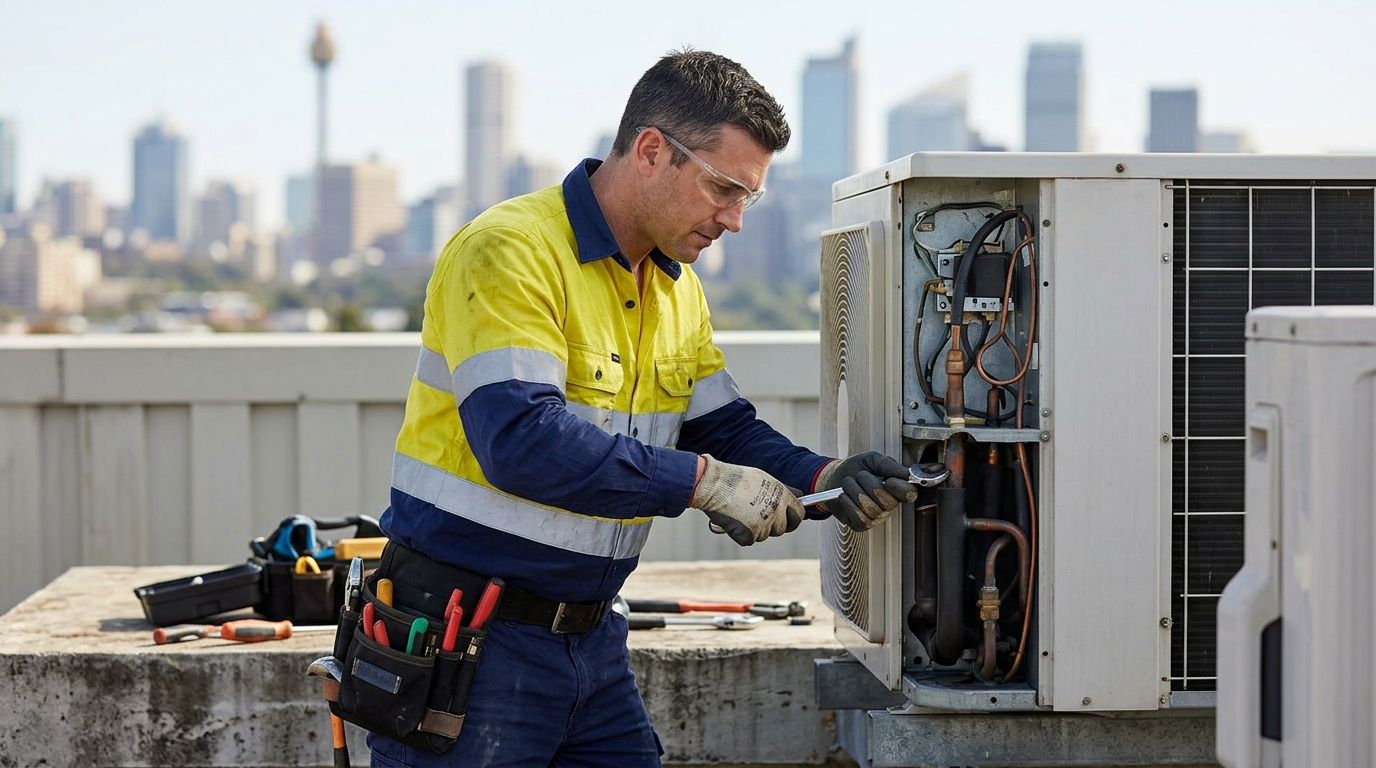
The pattern every experienced NSW HVAC technician recognises
You have the experience. Years of it. Commercial rooftop installs, split system diagnostics, refrigerant handling, complex fault-finding on systems most technicians have never seen. You know the work. You do the work. And then a direct-to-client commercial contract comes up — the kind that would meaningfully change your income — and it slips away. Not because of your capability. Because of a piece of paper you don't hold.
This is not a one-off. It is a cycle. And if you have been in the HVAC trade in NSW for any length of time, you have probably watched it repeat. The quote goes out. The licence question comes back. The contract goes elsewhere. The pattern is the same every time the job gets bigger.
The Certificate III in Air Conditioning and Refrigeration sits at the centre of this cycle. It is the formal qualification that underpins the contractor licence required to take on commercial HVAC work independently in NSW. Without it, the regulatory gate stays closed — regardless of how many years you have spent on the tools.
Stage 1 — the work is there. The contracts are not.
The first stage of the cycle is familiar. You are doing the work. Residential installs, commercial maintenance, fault diagnostics, refrigerant handling. The capability is not in question. But when a larger commercial opportunity appears — a strata building, a government facility, a commercial fit-out — something changes.
Direct-to-client commercial contracts in NSW typically require the person responsible for the work to hold a contractor licence issued by NSW Fair Trading. That licence is not just a formality. It is the legal mechanism that authorises a tradesperson to contract independently for certain classes of work, carry the associated liability, and sign off on completed jobs.
Without that licence, the options narrow. You can work as a subcontractor under someone else's licence — but that arrangement comes with a ceiling. Someone else quotes the job. Someone else holds the client relationship. Someone else captures the margin. Your skills are real. Your access to the full value of those skills is not.
Stage 2 — Fair Trading draws the line
NSW Fair Trading administers contractor licences for air conditioning and refrigeration work in New South Wales. To hold a contractor licence in this trade, a technician must demonstrate a formal qualification that meets Fair Trading's requirements. Experience alone — no matter how extensive — does not satisfy this requirement.
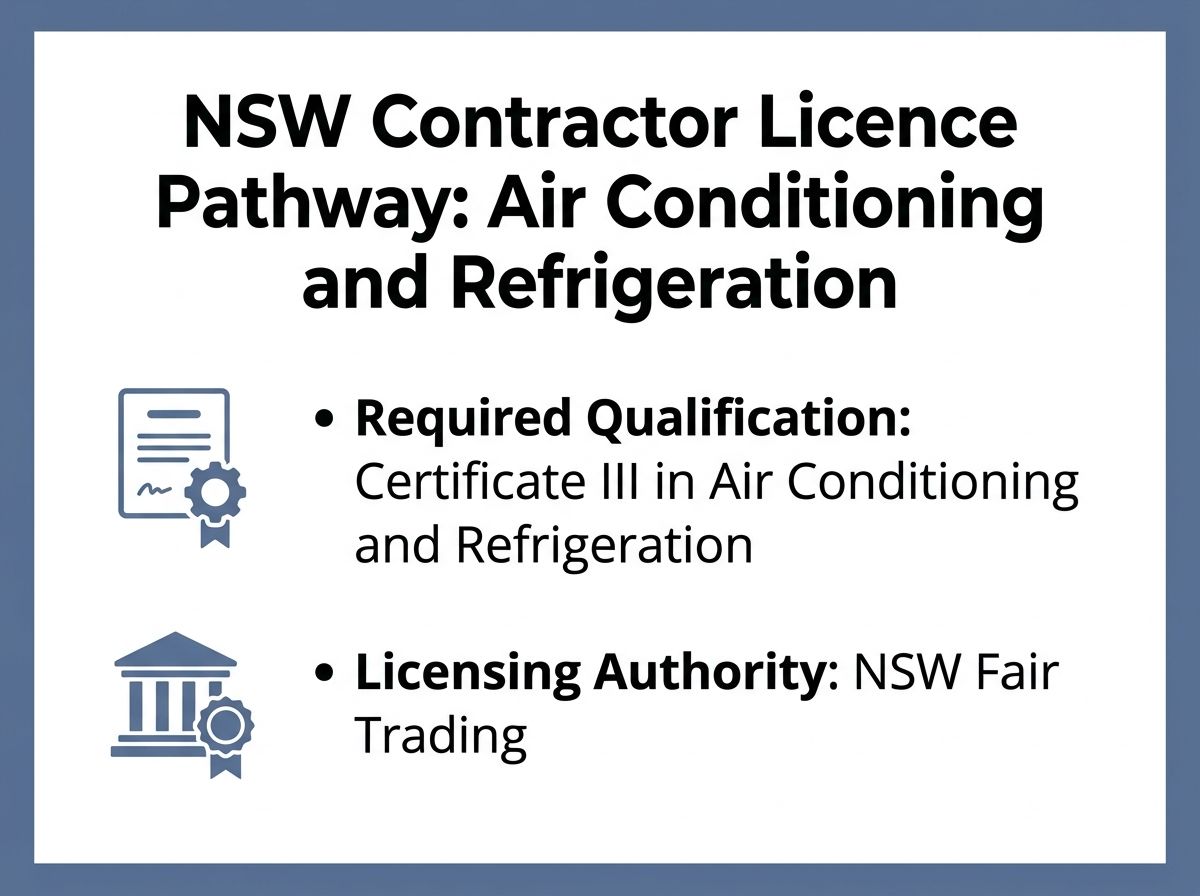
Fair Trading is not asking whether you can do the work. It is asking whether you hold the credential that formally demonstrates you can. The gate is regulatory, not practical. A technician who has been commissioning commercial HVAC systems for a decade is not automatically closer to a contractor licence than one who has been doing it for two years. What matters to Fair Trading is the qualification on paper.
The Certificate III in Air Conditioning and Refrigeration is the nationally recognised qualification that typically underpins this licensing pathway. It covers the competencies that commercial HVAC work requires — installation, commissioning, fault diagnosis, refrigerant handling, and compliance with relevant standards. It is the formal credential the system recognises.
It is also worth noting that refrigerant handling in Australia requires authorisation from the Australian Refrigeration Council (ARC). The relationship between the Certificate III and ARC authorisation requirements is something worth confirming directly with ARC and your chosen registered training organisation, as requirements can vary depending on the specific work you perform.
Stage 3 — the qualification wall repeats
You have been here before. The quote goes out. The licence question comes back. The contract goes elsewhere.
The third stage of the cycle is not a single event. It is a recurring cost. Every time a commercial opportunity appears and the qualification is not in place, the pattern repeats. The wall does not move. It compounds.
Working as an unlicensed subcontractor under a licensed contractor's authority is a common workaround — but it is a ceiling, not a solution. The income differential between a licensed contractor operating independently and a subcontractor working under someone else's licence can be significant, though the exact gap varies by market, specialisation, and the specific arrangement in place. What is consistent is the structural limitation: without the contractor licence, the full commercial opportunity remains out of reach.
The longer the qualification gap goes unaddressed, the more it costs. Not just in lost contracts. In the compounding reality of doing the work at someone else's rate, under someone else's licence, for someone else's client.
What the Certificate III in Air Conditioning and Refrigeration actually covers
The Certificate III in Air Conditioning and Refrigeration is a nationally recognised vocational qualification. It is the formal credential that maps to the competencies required for licensed HVAC and refrigeration work in Australia.
For an experienced technician, the units within this qualification are not unfamiliar territory. They cover the technical and practical competencies that commercial HVAC work demands — installing and commissioning systems, diagnosing faults, handling refrigerants safely, working to relevant Australian standards, and completing work to a compliant standard. These are not classroom concepts. They are the daily reality of experienced HVAC work.
The qualification code and specific unit list are maintained on training.gov.au, the national register of vocational qualifications. If you want to see exactly what the qualification covers, that is the authoritative source. What matters here is simpler: the competencies assessed in this qualification are, in most cases, competencies that experienced HVAC technicians are already demonstrating on the job.
Traditional delivery of this qualification through a registered training organisation (RTO) typically involves structured coursework and practical assessment over an extended period. For someone who has already spent years in the trade, repeating that journey from the beginning is not the only option.
Why experienced technicians don't have to start from scratch
Recognition of Prior Learning — RPL — is a formal assessment pathway within the Australian vocational education and training system. It allows experienced workers to have their existing skills, knowledge, and experience assessed against the units of a qualification, without repeating training they have already completed through years of work.
RPL is not a shortcut. It is a rigorous assessment process conducted by a qualified assessor from a registered training organisation. The assessor evaluates evidence of your existing competency against the units of the Certificate III in Air Conditioning and Refrigeration. If your experience maps to those units, the assessment reflects that. If gaps are identified, gap training may be required — and that is provided as part of the process.
The qualification issued through RPL is the same nationally recognised Certificate III. It carries the same standing with NSW Fair Trading as a qualification delivered through traditional study. The difference is the pathway — not the outcome.
How the RPL process works for HVAC technicians
The RPL pathway for the Certificate III in Air Conditioning and Refrigeration follows a structured process. Each step is navigable. The complexity is real, but it is manageable with the right guidance.
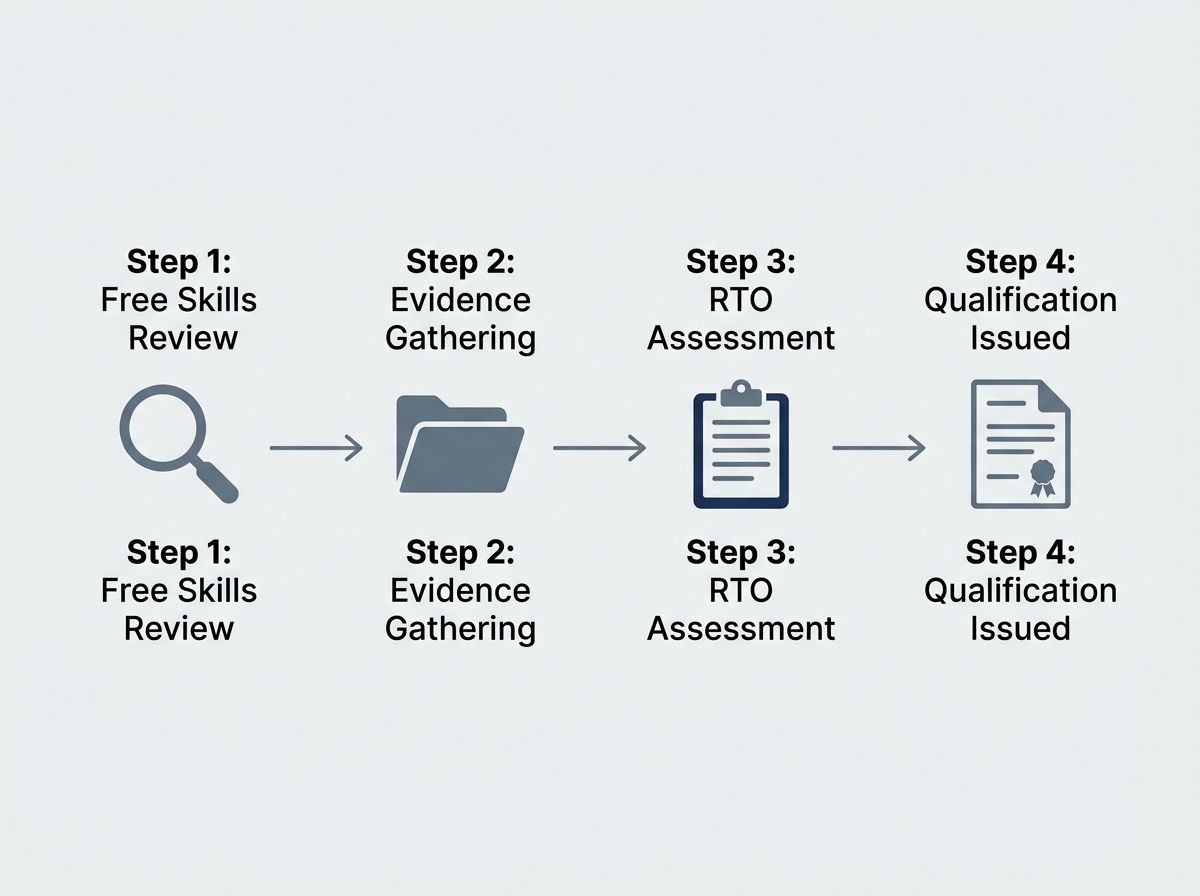
- Step 1 — Free skills review: A no-obligation conversation to assess whether your experience is likely to map to the qualification units. No commitment at this stage.
- Step 2 — Evidence gathering: You compile evidence of your existing competency. This typically includes documentation such as work records, job logs, photos of completed work, employer or supervisor references, and third-party reports. The specific evidence required depends on the units being assessed.
- Step 3 — RTO assessment: A qualified assessor from the delivering registered training organisation reviews your evidence against the qualification units. This is a formal assessment — not a rubber stamp. If gaps are identified, gap training is provided.
- Step 4 — Qualification issued: If competency is demonstrated across the required units, the RTO issues the Certificate III in Air Conditioning and Refrigeration. This qualification can then support your NSW Fair Trading contractor licence application.
RPL it guides candidates through this process — helping you understand what evidence is needed, how to present it, and what to expect at each stage. The assessment itself is conducted by the RTO. The qualification is issued by the RTO. RPL it's role is to guide, support, and advocate for you throughout.
Breaking the cycle: what changes when you hold the Certificate III
Your skills are real. Your experience counts. Your recognition is earned.
When the Certificate III in Air Conditioning and Refrigeration is in hand, the regulatory gate opens. The contractor licence application becomes possible. Direct-to-client commercial quoting becomes available. The subcontracting ceiling lifts. The recurring pattern — quote, licence question, lost contract — stops repeating.
The work was always there. The credential makes it accessible. This is not about learning new skills. It is about formal recognition of what was already earned through years of professional practice.
Commercial HVAC work in NSW — strata buildings, government facilities, commercial fit-outs, industrial refrigeration — requires a licensed contractor. Once you hold that licence, those opportunities are open to you directly. The client relationship is yours. The margin is yours. The professional standing that your experience has always deserved is formally recognised.
Learn more about what the NSW Air Conditioning and Refrigeration trade licence involves and how the qualification pathway works.
Frequently asked questions
Does NSW Fair Trading accept a qualification obtained through RPL?
A qualification issued through RPL is a nationally recognised vocational qualification — the same credential as one delivered through traditional study. It is issued by a registered training organisation and recorded on the national register. For the purposes of a contractor licence application, you should confirm directly with NSW Fair Trading that the specific qualification meets their current requirements, as licensing rules can change. RPL it recommends verifying this with Fair Trading before commencing any RPL process.
How much experience do I need to be eligible for RPL?
There is no fixed minimum years-of-experience threshold that applies universally. Eligibility for RPL depends on whether your existing skills and knowledge can be evidenced against the specific units of the qualification. A free skills review is the practical first step — it gives you an honest assessment of whether your experience is likely to map to the qualification requirements before you commit to anything.
What if gaps are identified during my RPL assessment?
Gap training is a normal part of the RPL process. If an assessor identifies units where your existing evidence does not fully demonstrate competency, gap training is provided to address those specific areas. This is included as part of the RPL pathway — it does not mean starting the qualification from scratch. The assessment focuses on what you already know and can demonstrate; gap training addresses only what remains.
Is RPL available for the Certificate III in Air Conditioning and Refrigeration nationally?
The Certificate III in Air Conditioning and Refrigeration is a nationally recognised qualification, and RPL is available as a delivery pathway through registered training organisations across Australia. Specific delivery arrangements and RTO availability may vary. RPL it works with partner RTOs to guide candidates through the process. A skills review will confirm the practical options available for your situation.
Ready to Get Recognised?
Start with a free skills review to find out if RPL is right for you.