The Hidden Insurance Threat of Unlicenced HVAC Technicians on Site
Deploying unlicenced HVAC technicians in NSW can void your insurance and trigger penalties. Here's what employers need to know — and how to fix it.
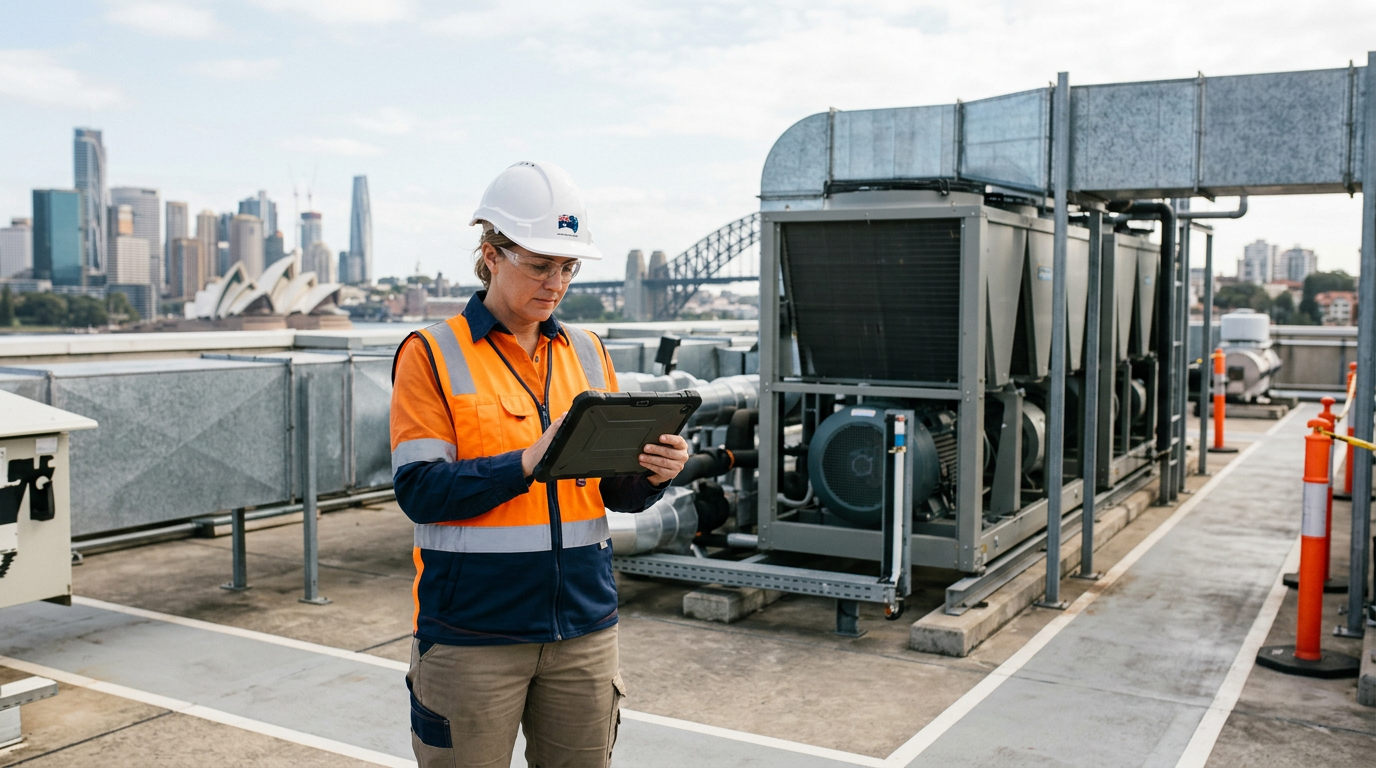
The scenario most HVAC employers do not see coming
You have experienced technicians. They know the work. They have been doing it for years — commissioning systems, handling refrigerants, troubleshooting complex installations on commercial sites. You hired them because they are good at what they do.
Now picture this. A project is underway. One of your technicians performs regulated refrigerant handling or installation work. An incident occurs — a property claim, a third-party injury, a system failure. Your insurer investigates. They discover the technician did not hold the required licence for the work performed. The claim is denied.
This is not a hypothetical. It is the documented consequence of a compliance gap that most employers assume is someone else's problem. The technician goes home. The employer absorbs the liability.
One unlicenced technician can void your insurance on a major HVAC project. Understanding where that exposure sits — and how to close it — is what this article is about.
What 'licenced' actually means for HVAC work in NSW
Many employers conflate experience with compliance. They are not the same thing. In NSW, the licensing framework for HVAC work operates across two separate systems, and a technician can be highly skilled while remaining unlicenced under both.
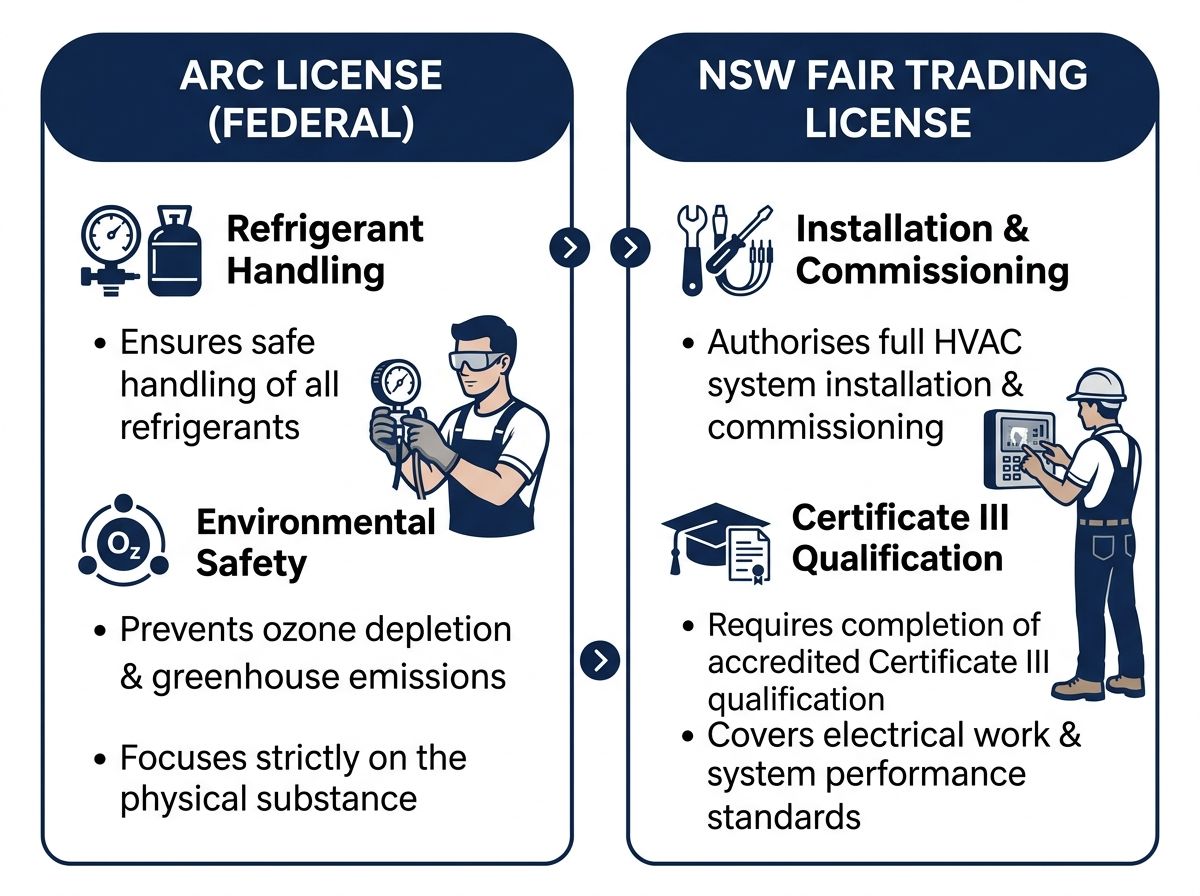
The first is the federal ARC (Australian Refrigeration Council) licence, which is required for anyone who purchases, handles, or works with refrigerants. This requirement exists under federal environmental legislation governing ozone-depleting substances and synthetic greenhouse gases. Without an ARC licence, a technician cannot legally handle refrigerants — regardless of how competent they are.
The second is the NSW contractor licence issued through NSW Fair Trading. Businesses and individuals performing certain air conditioning and refrigeration installation or commissioning work in NSW are required to hold the appropriate contractor licence. This is a separate obligation from the ARC licence, and the two are not interchangeable.
The qualification pathway that underpins the NSW trade licence for this work is the Certificate III in Air Conditioning and Refrigeration. A technician who has never formally obtained this qualification — regardless of how many years they have spent on the tools — may not meet the licensing requirements for the work they are performing.
The practical implication for employers is this: deploying a technician who lacks the required licence — whether ARC, NSW Fair Trading, or both — is not simply the technician's problem. It is a business compliance issue with consequences that land on the employer.
The insurance void: how unlicenced work triggers policy exclusions
Commercial insurance policies — public liability, professional indemnity, and contractor all-risk — are not unconditional. They are contracts. And like most contracts, they contain conditions that must be met for coverage to apply.
One of the most common conditions in trade contractor policies is a compliance requirement: the work must be performed by appropriately licenced and qualified personnel. When work is performed by an unlicenced person in a regulated trade, the insurer may treat this as a breach of policy conditions. The consequence is that coverage for that incident — and potentially for the broader project — may be voided.
This is not about the insurer being unreasonable. It is about the fundamental structure of insurance contracts. When you represent to an insurer that your workforce is compliant, and that representation turns out to be inaccurate, the basis of the policy is undermined.
The financial exposure does not stop with the denied claim. If a third party is harmed — a building owner, a tenant, a member of the public — and your insurer declines to indemnify you, the liability falls directly on your business. Legal costs, compensation, remediation. These are not abstract risks. They are the real-world consequences of a compliance gap that could have been closed.
This is not about blame. It is about understanding where the exposure sits. The technician performed the work. The employer deployed them. The insurer looks at the policy conditions. And if those conditions were not met, the employer is the one left holding the liability.
The same compliance dynamic applies across other regulated trades — this article explores why principal contractors are increasingly demanding valid trade licences from subcontractors before they set foot on site.
Fair Trading penalties: what employers face when compliance fails
Beyond the insurance exposure, there is a regulatory dimension that employers often underestimate. NSW Fair Trading has enforcement powers that apply to businesses operating in the building and construction sector, including air conditioning and refrigeration.
The regulatory framework in NSW makes it an offence to perform or contract out work that requires a licence without holding the appropriate licence. While the specific penalty amounts and their application to employers versus individuals depend on the relevant legislation and the circumstances of each case, the principle is clear: the compliance obligation does not sit solely with the worker performing the task.
Employers who engage unlicenced contractors or deploy unlicenced employees for regulated work may face scrutiny from Fair Trading, particularly following an incident, a complaint, or a routine audit. The consequences can include financial penalties, orders to rectify work, and reputational damage that affects future tendering opportunities.
We are not in a position to quote specific current penalty figures here — those should be verified directly with NSW Fair Trading or a qualified legal adviser. What we can say is that the regulatory framework is clear: licenced work must be performed by licenced people, and the responsibility for ensuring that extends to the business deploying them.
Why this gap exists: the experience-evidence problem
Most employers with unlicenced HVAC technicians are not negligent. They are operating in a system where competence and formal recognition have diverged — sometimes by years, sometimes by decades.
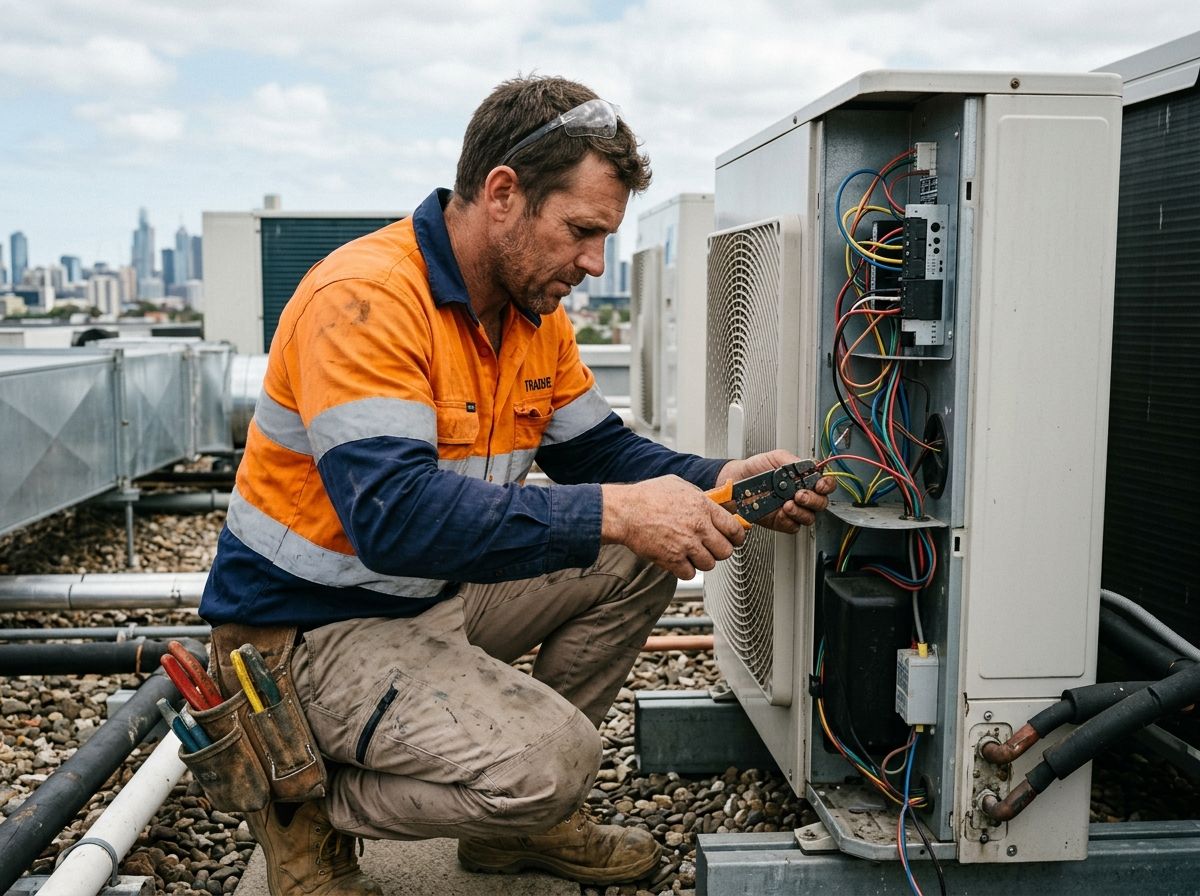
The skills are real. The experience is deep. The paperwork is missing.
A technician who has spent ten years commissioning commercial refrigeration systems, handling refrigerants, and troubleshooting complex HVAC installations has accumulated genuine expertise. But if they never completed a formal apprenticeship, or if their training happened informally on the job, or if they came from overseas with qualifications that were not formally recognised in Australia, the formal system may not see any of that.
You hired for capability. The formal system requires evidence. Those two things are not always aligned — and closing the gap between them is not about questioning the technician's competence. It is about translating what they already know into a form the regulatory system can recognise.
This is a fixable problem. And the pathway to fixing it does not require your technicians to leave the job site.
Employer-sponsored RPL: qualifying your workforce without disruption
Recognition of Prior Learning — RPL — is the formal assessment pathway that allows experienced technicians to have their existing skills assessed against the requirements of a nationally recognised qualification, without attending classes or repeating work they already know.
For HVAC technicians, the relevant qualification is the Certificate III in Air Conditioning and Refrigeration. Through RPL, a technician's existing experience is assessed by a qualified assessor from a registered training organisation (RTO). If the assessor determines that the technician's skills and knowledge meet the requirements of the qualification, the qualification can be issued on the basis of that assessment.
This is not a shortcut. RPL is a rigorous assessment process — it is simply an assessment of what the technician already knows, rather than a requirement to re-learn it. The qualification issued through RPL carries exactly the same national recognition as one earned through a traditional apprenticeship.
Employers can initiate and support this process for their workforce. Your technicians can continue working on site while the evidence-gathering and assessment process occurs. The disruption to your operations is minimal. The compliance outcome is real.
It is worth being clear about what RPL it does in this process. We guide candidates through the evidence-gathering process, help them understand what is required, and support them through the assessment pathway. The assessment itself is conducted by a qualified assessor from a registered training organisation. The RTO issues the qualification. We guide — we do not assess or award.
What employer-sponsored RPL looks like in practice
The RPL process for HVAC technicians follows a structured pathway. Here is what to expect at each stage.
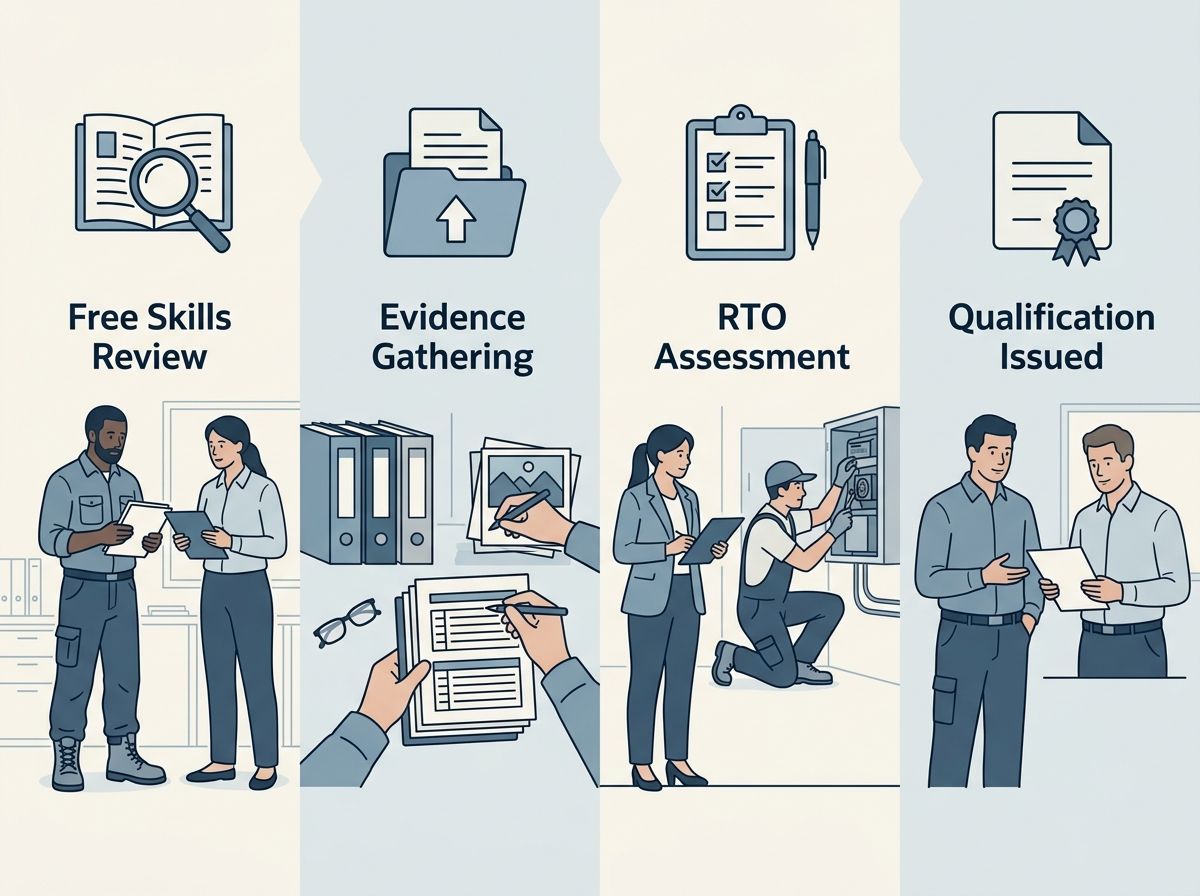
- Free skills review: The process begins with an honest assessment of whether RPL is likely to suit your technicians. This is a no-obligation conversation about their experience, the work they perform, and whether their background aligns with the requirements of the Certificate III in Air Conditioning and Refrigeration. There is no cost for this step and no commitment required.
- Evidence gathering: If the skills review indicates RPL is appropriate, your technicians work with a guide to compile evidence of their existing skills and experience. This typically includes records of work performed, employer declarations, site documentation, and other materials that demonstrate competency against the qualification's requirements. Your technicians do not need to leave the job site to gather this evidence.
- Assessment by the RTO: The compiled evidence is submitted to a qualified assessor at a registered training organisation. The assessor reviews the evidence against the requirements of the qualification. They may conduct a practical assessment or structured interview as part of this process. The assessor's determination is independent — the outcome depends on the evidence presented.
- Qualification issued: If the assessor determines that the technician's skills and knowledge meet the requirements of the qualification, the Certificate III in Air Conditioning and Refrigeration is issued by the RTO. If gaps are identified during assessment, gap training is provided to address those specific areas — this is included in the process at no additional cost.
The timeline for this process varies depending on the individual technician's circumstances, the evidence available, and the RTO's assessment schedule. We present timelines as indicative rather than guaranteed — honest guidance about the process is more useful to you than a promise we cannot control.
Getting your compliance in order: the decision that protects the business
The employer who acts before an incident — before an audit, before a claim is denied — is the employer who controls the outcome.
Employer-sponsored RPL is not an administrative burden. It is a practical decision that protects your insurance coverage, satisfies your regulatory obligations under the NSW licensing framework, and retains the experienced technicians you have already invested in. Your technicians do not need to leave the site. They do not need to repeat training they have already done. They need their existing expertise to be formally recognised.
The skills are already there. The recognition is what is missing.
Experience can be evidence. And we help you demonstrate that it is.
The decision is yours. The first step costs nothing.
You can also learn more about the NSW air conditioning and refrigeration trade licence pathway on our dedicated product page.
Ready to Get Recognised?
Start with a free skills review to find out if RPL is right for you.