University RPL Up to MBA Level in Australia: Why Most Skilled Migrants Have Never Heard of It
Learn how Recognition of Prior Learning (RPL) in Australia applies to Diploma, Graduate Diploma, and MBA levels for skilled migrants with overseas degrees.

The assumption holding back skilled migrants
Ask most skilled migrants whether RPL applies to them, and the answer is almost always identical: 'Isn't that for trades?' The public conversation around Recognition of Prior Learning in Australia is dominated by trade qualifications, specifically for electricians, plumbers, chefs, and carpenters. This visibility creates a strong assumption among professionals with overseas degrees and senior management experience that the pathway does not apply to their careers.
This assumption is incorrect, and it costs professionals years of career progress.
Recognition of Prior Learning (RPL) is a formal assessment process that evaluates whether an applicant's existing skills, knowledge, and experience meet the requirements of a specific qualification, without requiring them to complete the standard study process. It is available across the entire Australian Qualifications Framework, from Certificate levels up to the Graduate Diploma. Most skilled migrants with overseas business, management, or professional qualifications are never informed about this option. This is because the sectors that generate the highest volume of RPL activity are trade and care-related occupations, which is where the public discussion remains focused.
The full qualification range covered by RPL in Australia
RPL in Australia extends to the Graduate Diploma level (AQF Level 8). This is an established pathway rather than a recent development. The Australian Qualifications Framework explicitly lists Graduate Diploma qualifications as available in both higher education and vocational education and training. Vocational education in Australia covers AQF Levels 1 to 8, which means the Graduate Diploma sits within the vocational sector's scope and is not exclusive to universities.
The Australian Qualifications Framework sets out the range of nationally recognised qualifications and confirms that Graduate Diploma qualifications can be accredited and issued in both higher education and vocational education.
Under the Standards for Registered Training Organisations 2015, RTOs must offer RPL to learners. RPL is defined as an assessment process that evaluates competency acquired through formal, non-formal, and informal learning to determine how well an individual meets the requirements of a training package or VET accredited course. When an RTO holds registration to deliver a qualification, they are required to offer RPL as an assessment pathway for it.
This means the qualification range for skilled migrants with overseas professional credentials includes the Diploma of Business (AQF Level 5), Advanced Diploma of Business (AQF Level 6), and Graduate Diploma qualifications at AQF Level 8, provided the delivering RTO holds scope for those qualifications. For an overview of how an RPL certificate at this level can be used for direct entry into postgraduate study, see our article on
how an RPL certificate can be used as direct entry into postgraduate study
Why trade RPL dominates the conversation and leaves professional candidates invisible
Trade RPL has a larger candidate pool, a clear regulatory trigger, and a longer history of public awareness. Licensing requirements mandate a formal qualification before a professional can legally work in these trades. When a plumber or electrician needs a licence to operate, the pathway to obtain that licence is actively communicated, making the urgency clear.
Graduate-level RPL has no equivalent regulatory trigger for most business and management professionals. No licensing body demands a Diploma of Business before you can manage a corporate team. The pathway exists, but no official system actively directs professionals toward it. ASQA, the national regulator, notes that RPL risks and compliance concerns are concentrated in sectors like aged care, individual support, childcare, security, and trade occupations. This regulatory focus reinforces the public perception that RPL is primarily a tool for trade sectors.
This creates an information gap. Skilled migrants with overseas MBAs, Graduate Diplomas, and decades of senior management experience arrive in Australia and search for recognition. They find information about trade RPL and assume the pathway does not apply to professional fields. This assumption is incorrect, but there is little public effort to correct it at scale. For a deeper look at why senior management experience is often invisible on paper in Australia, see our article on
why senior management experience is often invisible on paper
The types of overseas qualifications and experience that can be assessed
The assessment focuses on demonstrated competency, not the origin of your credential. This distinction is what makes RPL valuable for skilled migrants. An overseas degree, a professional diploma from another country, or years of senior management experience can all serve as evidence. The primary requirement is that this evidence shows competency against the specific standards of the Australian qualification you seek.

Evidence used in RPL assessments generally falls into several broad categories. This includes academic transcripts and qualification certificates from overseas institutions, employment records such as position descriptions, contracts, and performance reviews, and professional references from supervisors or colleagues who can verify your competency. It also includes work samples like reports, projects, strategies, or other outputs from your professional practice. Specific requirements vary by RTO and qualification, and the exact evidence mix is determined by the assessor based on the units of competency.
The Standards for RTOs 2015 place no restrictions on using overseas qualifications as RPL evidence. The framework assesses competency regardless of where or how it was developed. Your overseas MBA is valid evidence, and your ten years of experience as a regional director is highly relevant. The key question is whether that evidence, properly documented and presented, demonstrates the competency required by the Australian qualification.
To assess whether your specific overseas qualification and experience meet the criteria for a particular pathway, see our self-check guide on
whether your specific overseas qualification and experience meet the criteria
The qualification levels relevant to skilled migrants: from Diploma to Graduate Diploma
The qualification levels most relevant to skilled migrants with overseas business or management credentials include the following.
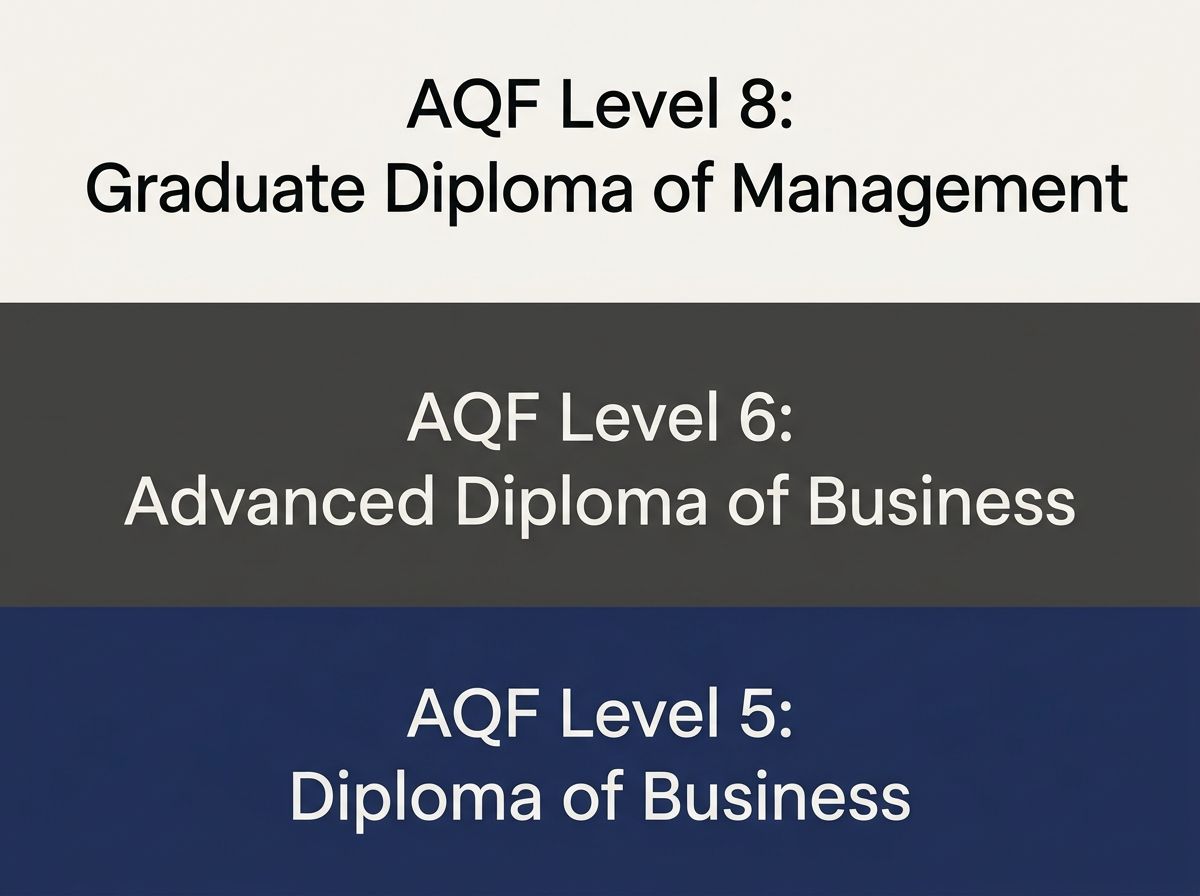
- Diploma of Business (AQF Level 5): Suited to professionals with solid operational experience in business functions. This credential can act as a pathway to further study or stand alone for employment and visa purposes.
- Advanced Diploma of Business (AQF Level 6): Designed for professionals with broader management or strategic experience. Sits above the Diploma and is frequently used as a university entry pathway.
- Graduate Diploma (AQF Level 8): This is the highest level available within the VET sector. Currently registered qualifications at this level include the BSB80120 Graduate Diploma of Management (Learning) and the BSB80320 Graduate Diploma of Strategic Leadership, both active on the National Training Register. These qualifications are designed for senior professionals with extensive leadership and organisational experience.
The BSB80120 Graduate Diploma of Management (Learning) is a registered qualification on the National Training Register, released in October 2020, and serves as an example of a Graduate Diploma available within the VET sector.
Each level corresponds to different experience profiles and has distinct uses, including skills assessments for visas, professional registration, and university entry. Working out which level aligns with your background is the first step. For a detailed look at how overseas MBA holders navigate the Australian recognition system, see our article on
how overseas MBA holders navigate the Australian recognition system
Why this pathway is legitimate and rigorous
The qualification is nationally recognised because the assessment process is thorough. This is not a shortcut or a loophole. University-level RPL is a formal process governed by ASQA standards and the Australian Qualifications Framework. The qualification awarded through RPL is identical to one earned through traditional study, as the competency requirements are the same and the assessment must meet the same regulatory standards.
VETASSESS, one of Australia's designated skills assessing authorities, uses its RPL system to assess trade applicants. This process aligns skills and knowledge to an Australian qualification without penalising the absence of a formal credential. This reflects the principle that RPL-based qualifications are equivalent to traditionally earned qualifications within the Australian recognition system, because the assessment is conducted against the same national standards.
VETASSESS has stated in submissions to government reviews that its RPL process aligns skills and knowledge to an Australian qualification without penalising a lack of formal qualifications. This reflects the equivalence principle that underpins RPL across the Australian system.
For skilled migrants, this is important because the outcomes of the qualification, including visa skills assessments, professional registration, and employment, depend on genuine recognition. RPL qualifications issued by registered training organisations under the Standards for RTOs 2015 meet this standard. However, acceptance by individual skills assessment authorities, such as Engineers Australia or ANMAC, varies by occupation. Candidates should verify specific requirements with their relevant skills assessment body or a registered migration agent.
Who this pathway is and is not designed for
University-level RPL is generally suitable if you hold an overseas qualification at degree level or above and have significant senior professional experience in a relevant field. The pathway is designed for professionals who have developed the competencies required by the target Australian qualification through formal study, professional practice, or both.
It is less suitable if your professional experience is limited or in the early stages of your career, if the target qualification requires practical skills assessment in a regulated field like clinical health or engineering, or if your overseas qualification is significantly below the level of the Australian qualification you seek. Gap training may be required if your evidence does not fully cover all required competencies. This is a standard part of the process rather than a failure.
Our goal is to direct you to the correct pathway, not the most convenient one. If RPL is not suitable for your situation, an honest assessment will state that clearly. To use a structured self-check to assess whether this pathway fits your situation, see our guide on
use this self-check to assess whether the pathway fits your situation
How to find out if your experience qualifies
The pathway is available. Graduate Diploma RPL is a real, nationally recognised option within the Australian VET sector. The next step is determining whether it applies to your specific overseas qualification, career history, and target Australian credential.
We help translate your professional experience into recognized Australian credentials. The choice of how to proceed is yours.
Ready to Get Recognised?
Start with a free skills review to find out if RPL is right for you.