When Your MBA Stops Counting: Recognition for Skilled Migrants in Australia
Your overseas MBA was highly valued back home, but in Australia, it may not be recognized. Learn how RPL converts your senior experience into local credentials.

The email you were not expecting
The email arrived. Your qualifications, the ones that defined your career back home, do not count here.
Perhaps it came from your migration agent. Perhaps it was a brief, formal response from the skills assessment authority, or the visa form itself, asking for Australian qualifications you do not have. Whatever the source, the message was clear: the MBA you spent two years earning, your decade of senior roles, the teams you led, and the strategies you built do not map cleanly onto the Australian system.
You have the experience. That has not changed. What has changed is the country you are standing in.
Why years of senior experience can become invisible overnight
This is not a judgment on the quality of your work. It is a format mismatch.
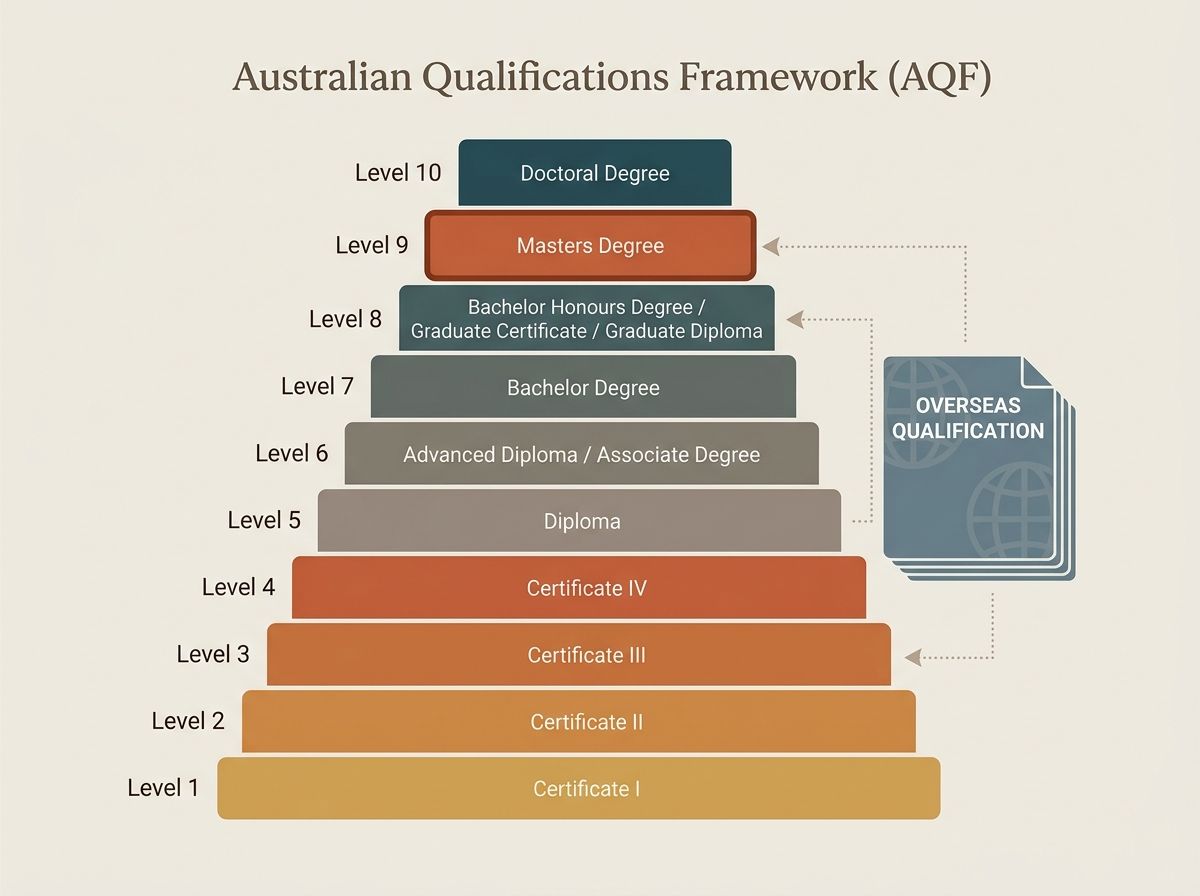
Australia operates a national qualifications framework, the Australian Qualifications Framework (AQF), which categorises every recognised qualification from Certificate I through to a Doctoral Degree. A Masters Degree (Coursework) sits at AQF Level 9. That is where an Australian MBA is positioned.
The Australian Government provides qualification assessment services that compare overseas qualifications to AQF levels for general purposes, helping employers and organisations understand your educational level in an Australian context. But these assessments are only indicative. They are not legally binding, and they do not automatically translate into visa points, professional registration, or employer recognition.
Your overseas MBA is real. The experience behind it is real. However, the formal Australian system requires evidence in a specific format, and overseas credentials rarely map directly onto Australian qualification structures without a formal assessment process. The credentials and your competence exist. The challenge is that neither is visible in the exact format the system requires.
The Australian Qualifications Framework, administered by TEQSA, sets out the levels at which Australian qualifications are recognised, ranging from Certificate I to a Doctoral Degree, with a Masters Degree (Coursework) sitting at Level 9.
The frustration of being asked to start over at 38
Being asked to study what you already know, at 38 with a family depending on the outcome, is more than a minor inconvenience. It is a significant professional setback.
You arrived here with real achievements. You built a career, earned professional respect, and made decisions that mattered. Now, a formal process is asking you to prove yourself from the beginning, as though none of that occurred.
The stakes are practical: residency, family security, and the professional identity you spent a decade building. Everything depends on securing the right credential, in the right format, recognised by the correct authority.
Recognition should not require starting over.
This is a basic principle. It is why a formal pathway exists in Australia that does not require you to repeat your studies, but simply to demonstrate that you have already achieved this level of capability.
What recognition of prior learning actually means for graduate-level professionals
Recognition of Prior Learning (RPL) is a formal assessment process that recognises skills and knowledge gained through work, training, or life experience. It allows individuals to gain credit toward nationally recognised qualifications without repeating previous study. It is a legitimate, regulated pathway within the Australian training system, overseen by the Australian Skills Quality Authority (ASQA).
For graduate and postgraduate professionals, this makes a practical difference. RPL does not simply compare your overseas credential to an Australian standard to declare it equivalent or insufficient. Instead, it assesses whether you can demonstrate competency against the specific requirements of an Australian qualification. Your years of senior management, strategic leadership, or specialist practice are the actual evidence evaluated by a qualified assessor.
Experience is evidence. RPL is the process that formalises it.
RPL is not a shortcut, nor is it a workaround. It is a rigorous, regulated assessment process that exists because the Australian system recognises that professional expertise is not only acquired in a classroom. Qualifications obtained through RPL are issued by Registered Training Organisations (RTOs) that conduct the actual assessment. While RPL it guides candidates through compiling the application, the RTO's qualified assessors make the final determination of competency.
What your overseas MBA and senior experience are assessed against
The main question most skilled migrants ask at this point is what evidence they actually have.

You likely have more than you think. In an RPL assessment, the evidence is drawn from your professional life, not from a classroom. This includes work history documentation, performance reviews, project portfolios, and examples of strategic decisions you made alongside their outcomes. References from senior colleagues who can verify your competence are also valuable. Your overseas MBA transcript is key evidence, and your decade of senior roles is also evidence. The RPL process structures this material so a qualified assessor can evaluate it against Australian qualification standards.
If the assessment identifies gaps where your existing evidence does not fully cover the qualification requirements, gap training is typically provided. This is standard practice in RPL, not an indication of failure. It is how the process ensures the resulting qualification is genuine.
Your work deserves recognition. RPL is the mechanism that makes this recognition possible.
The skills assessment process for business and management professionals
For skilled migrants in business and management roles, the skills assessment process is critical. For managers seeking Australian skilled migration, parliamentary reporting identifies the Australian Institute of Management as the assessing authority for senior management occupations. The Institute of Managers and Leaders Australia and New Zealand (IML ANZ) is also contracted by the Australian Government to assess senior-level management skills.
The skills assessment for migration and the RPL process for qualification recognition are distinct pathways. A skills assessment determines whether your overseas experience meets the requirements for a visa occupation, while RPL determines whether your experience can be recognised toward an Australian qualification. Both are important, and many skilled migrants require both.
Parliamentary reporting on the Australian skilled visa system identifies the Australian Institute of Management as the assessing body for managers under the skilled migration program.
The fast-track university pathway: graduate and postgraduate RPL in Australia
For skilled migrants whose qualifications and experience are at a graduate or postgraduate level, the Fast Track University pathway offers a structured route to RPL assessment for nationally recognised Australian qualifications.

The pathway is guided by RPL it and assessed by registered training organisations, which are the same bodies that issue qualifications to students who complete traditional study. The difference lies in the assessment method: your experience, your evidence, and your demonstrated competence are evaluated directly against the qualification standard.
This is not a guarantee of a specific outcome. RPL is a genuine assessment process, and the assessor's professional judgement determines the result. This pathway offers a guided process that treats your overseas experience as evidence to be assessed, rather than a deficit to be corrected.
If your qualifications and experience are at a graduate or postgraduate level, the Fast Track University pathway is a practical next step.
Is this pathway right for you?
Not everyone is suitable for RPL, and we would rather guide you to the correct pathway than enrol you in the wrong one. This straightforward approach is the foundation of a process you can trust.
Graduate-level RPL is designed for candidates who have significant relevant work experience at a professional or senior level, can document that experience through detailed records and references, and hold overseas qualifications in a relevant field. If you have worked in your profession for several years and can verify your skills through real-world documentation, RPL is a practical pathway worth exploring.
The first step is a Free Skills Review. This is not a sales conversation. It is an objective assessment to determine if your experience is suitable for RPL before you make any commitments. If RPL is not the right option for your situation, we will tell you directly.
The decision is yours, and we provide the clear information you need to make it.
Ready to Get Recognised?
Start with a free skills review to find out if RPL is right for you.