The Academic Fast Track Australian Universities Quietly Offer (But Rarely Advertise)
Australian universities offer formal RPL pathways that let experienced professionals bypass prerequisites — covering diplomas, graduate certificates, and MBAs.

The prerequisite wall most experienced professionals hit
You have the experience. You are already doing the work — managing teams, running projects, and solving problems that textbooks describe in theory. But when you look at the entry requirements for the qualification you actually want, you find a prerequisite you do not hold. The system says you need to study for it first, even though you already know the material.
This is the education lockout. It is not about competence. It is about credential format. It affects experienced professionals across business, healthcare, IT, education, and management — anyone who built their expertise on the job rather than in a lecture theatre.
What most people do not know is that Australian universities have formal, regulated pathways designed for this exact situation. These options are available, but they are rarely the first thing universities mention.
What universities offer — and what they don't advertise
Australian universities are required to have policies for Recognition of Prior Learning (RPL) and credit arrangements. This is not optional. The Tertiary Education Quality and Standards Agency (TEQSA) — the national regulator for higher education — provides guidance on how universities must implement these pathways under the Higher Education Standards Framework. RPL is an assessment of your prior learning to determine whether credit can be granted, and it covers formal, informal, and non-formal learning — meaning your work experience counts.
TEQSA's guidance on credit and recognition of prior learning sets out the regulatory framework that underpins these pathways across Australian universities.
Why don't you hear about them? Because universities are structured around cohort-based enrolment. RPL-based entry requires individual assessment. This process is resource-intensive and does not scale the way a standard application process does. Marketing teams focus on volume. Consequently, pathways that are formally available and institutionally supported tend to sit in policy documents rather than in prospectuses or on course finder pages. It is a matter of institutional incentive structures.
Three pathways to bypass prerequisites you've already outgrown
There are three formal pathways available to experienced professionals seeking university entry without holding the standard prerequisite qualifications. Which one applies depends on your specific background.
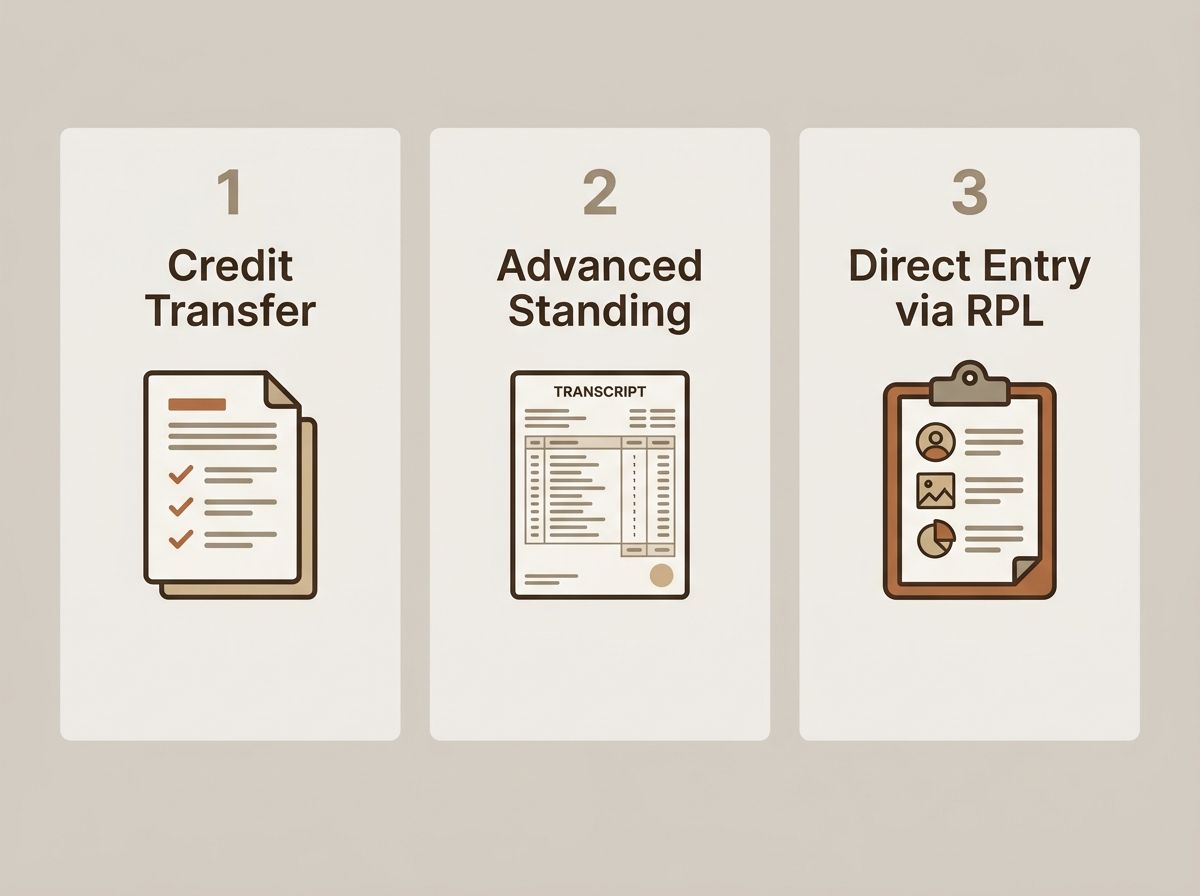
- Credit transfer applies when you hold a prior formal qualification — like a completed VET certificate, diploma, or degree — that is recognised as equivalent to the prerequisite. Credit is granted based on the credential, not a fresh assessment of your skills.
- Advanced standing is a form of credit for previous learning that reduces the overall study load once you are enrolled. It is granted after admission and reduces your course requirements rather than acting as an entry pathway.
- Recognition of Prior Learning (RPL) for entry applies when your experience — rather than a prior credential — is the primary evidence. The Australian Government's StudyAssist resource confirms that work history alone can be used to gain entry to a higher education course, without requiring a prior VET qualification.
The Australian Government's StudyAssist resource confirms that you can request recognition of your prior study or your work history to gain entry to a higher education course.
Each pathway serves a different situation. Your qualifications, your experience, and your target program will determine which option fits. If you want to understand how an RPL certificate can serve as direct entry into postgraduate study, our article on bypassing a three-year bachelor's degree to enter an MBA program explores this specific pathway.
If you want to understand how an RPL certificate can serve as direct entry into postgraduate study, this article explores that specific pathway in detail.
Which qualification levels these pathways cover
These pathways cover qualifications from Diploma level (AQF Level 5) up to Masters and MBA level (AQF Level 9). The Australian Qualifications Framework (AQF) is the national policy for regulated qualifications, and it defines the levels that apply across both the VET and higher education sectors.
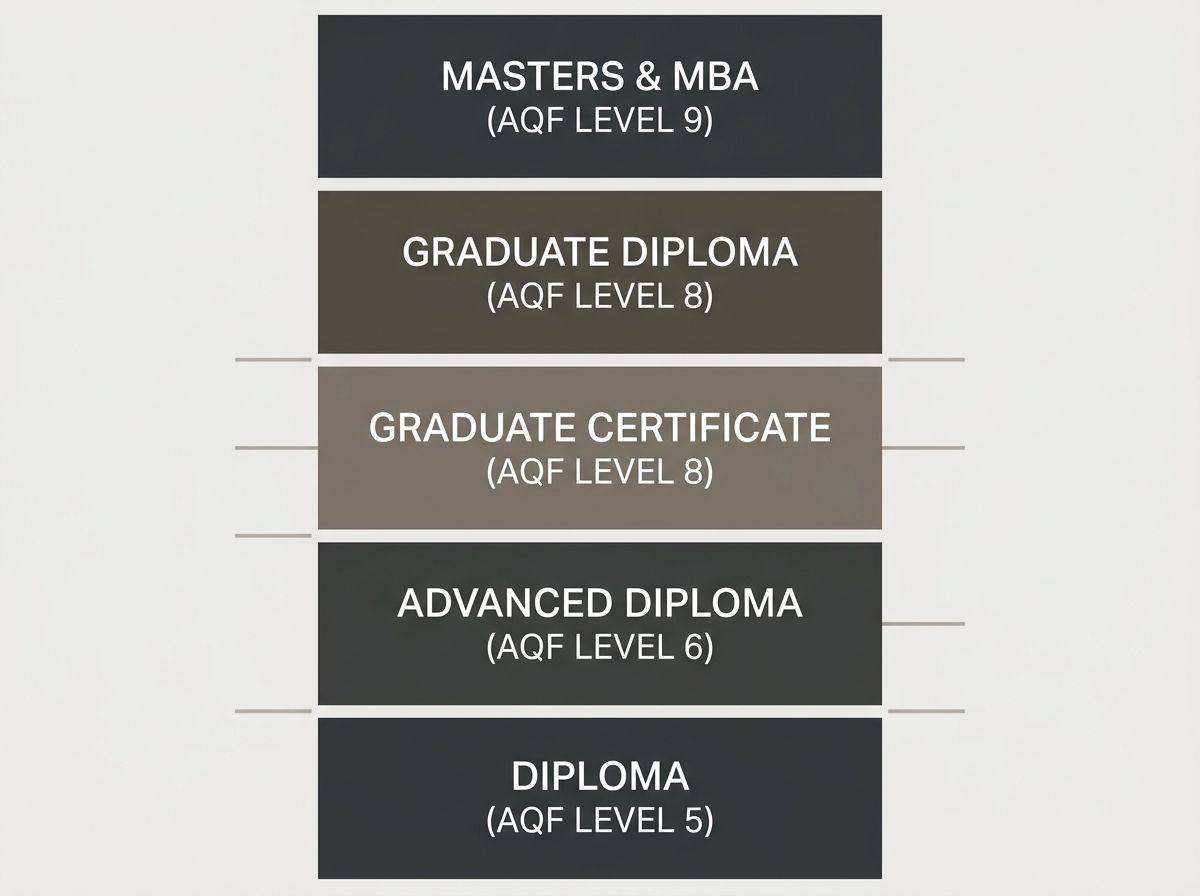
- Diploma (AQF Level 5) and Advanced Diploma (AQF Level 6): These are entry-level university programs and some TAFE-delivered higher education qualifications. RPL pathways at this level assess whether your work experience meets the competency requirements for the program.
- Graduate Certificate and Graduate Diploma (AQF Level 8): These postgraduate entry programs often serve as stepping stones to a full Masters. They are common entry points for experienced professionals who want to formalise their expertise without completing an undergraduate degree first.
- Masters and MBA (AQF Level 9): This is the qualification level most associated with RPL-based entry for senior professionals. Many universities accept a combination of work history, prior VET qualifications, and competency evidence for entry into MBA and Masters programs.
Not every institution offers every pathway at every level. Policies vary between universities, and the evidence required for RPL-based entry at postgraduate level differs from what is required at diploma level. The Fast Track University page maps the specific pathways available and is the best place to start identifying relevant programs.
For professionals whose experience sits at management level, this article on how years of management experience can translate into formal recognition at diploma and postgraduate level is worth reading alongside this one.
Why universities do not lead with this
The lack of visibility around these pathways is structural. RPL-based entry requires individual assessment, where an assessor reviews your specific evidence against academic standards. That process cannot be automated the way a standard ATAR or GPA-based application can. For an admissions team managing thousands of applications, RPL requires significant resources.
This leads to a predictable pattern. The pathways are formally available and supported by policy, but they are buried in administrative documents. They are rarely featured on main course pages, in marketing prospectuses, or during open day presentations. They exist, but you have to know to ask for them.
This is simply how large institutions operate. It explains why experienced professionals who could benefit most from these options are often unaware they exist.
What you need to demonstrate (and what you don't)
RPL-based entry is a genuine assessment of competency that requires real evidence. However, it does not require you to repeat study you have already mastered.
According to ASQA — the national regulator for VET providers — evidence commonly accepted for RPL includes work samples, portfolios, training records, certificates, and employer references. At university level, the evidence requirements are similar in principle but often require more detail.
ASQA's guidance on credit transfer and recognition of prior learning outlines the types of evidence that are commonly accepted in the assessment process.
Torrens University, for example, accepts references, testimonials, job descriptions, letters from employers on business letterhead, a curriculum vitae with corroborating evidence, work documents, portfolios, performance reviews, non-AQF professional development certificates, and industry awards as evidence for RPL applications. Requirements vary by institution, and this list serves as a general guide.
The assessment process does not make you re-learn content you already know. Gap training may be required if an assessor identifies areas where your evidence does not fully demonstrate a specific competency, but this is targeted rather than a full course repeat. The assessment is conducted by qualified academics from the delivering institution, and the outcome depends on the evidence you present.
If you want a structured way to evaluate whether this pathway fits your situation, a self-check for skilled migrants and experienced professionals is available here.
A structured self-check to evaluate whether this pathway fits your specific situation is available here.
The pathways are real, but they require the right approach
The pathways exist, institutions offer them, and the regulatory framework supports them. However, figuring out which pathway applies to your situation, which institutions accept your specific evidence, and how to present your experience is where most people get stuck.
Knowing these pathways exist is the first step. Identifying which one fits your experience, your target qualification, and your preferred institution is the work that follows. The Fast Track University page at RPL it maps the specific pathways available across diploma, graduate certificate, and MBA levels to help you take that next step.
Gaining recognition should not require starting over. Your experience is real, and the pathways to formal recognition are real. The decision to pursue them is yours.
Ready to Get Recognised?
Start with a free skills review to find out if RPL is right for you.