Why your best workers are your biggest QBCC risk without a trading licence
Your most experienced site workers may be your biggest QBCC compliance risk. Learn why unlicensed veterans fail audits and how RPL fixes it without downtime.

The worker you trust most may be the one QBCC flags first
You have a worker who has been on site for fifteen years. He knows the job better than anyone. He trains the new starters, solves the problems no one else can, and keeps projects moving when things go sideways. You trust him completely.
He may also be your biggest QBCC compliance risk.
This is the reality of trade licensing in Queensland. Workers with the most experience are often those most likely to be operating without a current, valid trading licence. This is not because they lack skill, but because the licensing system changed around them. Those who entered the industry before requirements were tightened might never have been required to formalise their credentials. The system moved, but their paperwork did not.
The Queensland Building and Construction Commission runs licensing compliance audits across the state, including on-site inspections to verify that contractors and tradespeople hold correct licences and meet their legislative obligations. According to the QBCC's reporting, the regulator is shifting toward targeted, intelligence-led enforcement. This means audits focus increasingly on areas of highest risk rather than random checks.
When an audit finds an unlicensed worker on your site, the consequences fall on the business and do not stop with the individual worker. Understanding why your most experienced people carry this risk is the first step to managing it.
What a QBCC audit actually looks for
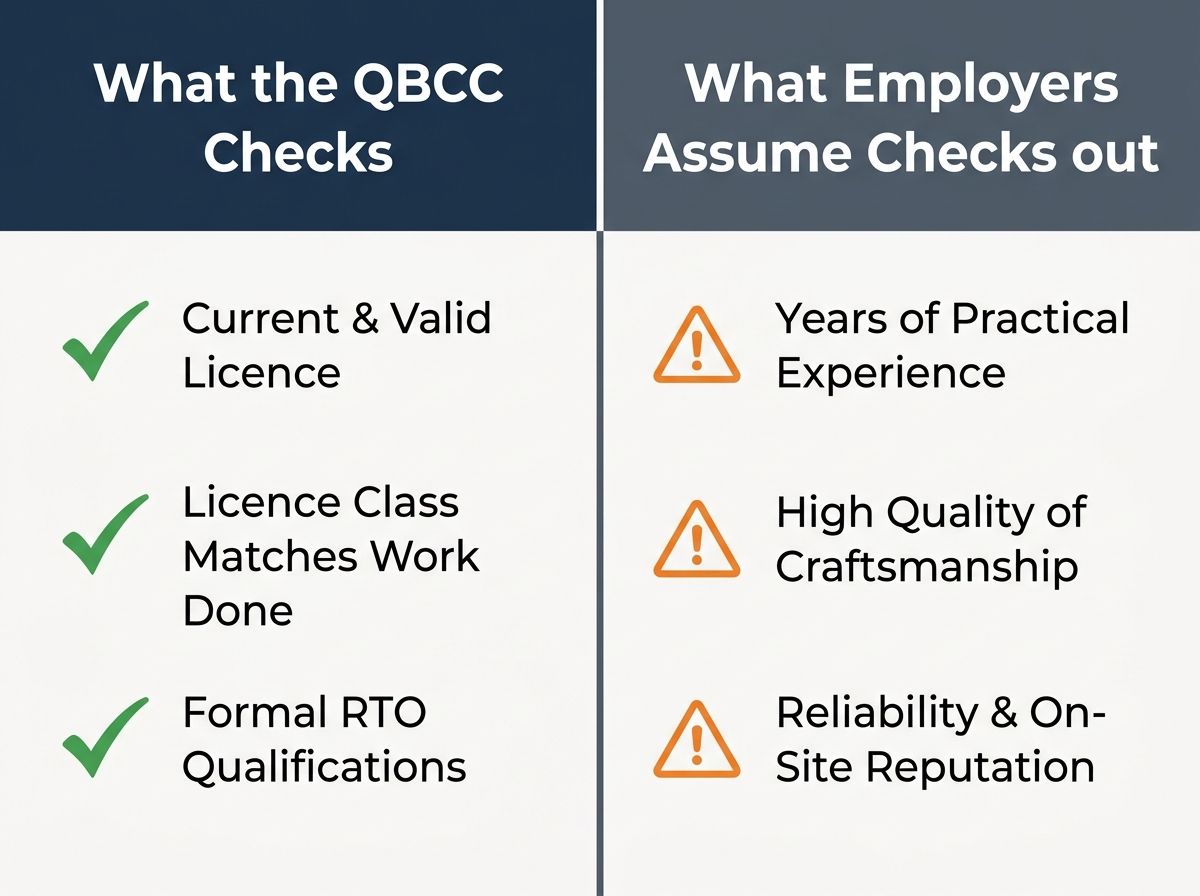
A QBCC compliance audit is primarily a document and licence verification exercise. Inspectors check whether the people performing regulated building work hold a current, valid licence for the specific work being done. They do not assess whether a worker is competent, nor do they consider how long someone has been in the trade. They simply check the licence.
For building certifiers, the QBCC runs a structured audit program. This includes assessment audits, which review documentation, approval records, and administrative practices, and technical audits, which involve on-site inspection of building work at key certification stages. The QBCC describes this program as a way to ensure fairness, transparency, and compliance with the Building Act 1975.
For licensing compliance more broadly, the QBCC conducts monthly site visits and licensing audits across Queensland. In 2024–25, the regulator reported completing 3,682 licensing audits and conducting 1,116 site visits. Where potential unlicensed activity is identified during site visits, the QBCC undertakes further investigations.
The main point is simple: a QBCC audit checks whether a worker holds a current licence. It does not look at how long they have been doing the job. The most capable worker on site can fail an audit that a less experienced but licensed worker passes.
The supervisor problem: why long-tenured workers are the greatest risk
The workers most likely to be operating without a formal trading licence are not the new starters. They are the supervisors and long-tenured tradespeople. These are the ones who were promoted based on skill and reliability rather than credentials.
Queensland's building and trade contractor licensing framework is established under the Queensland Building and Construction Commission Act 1991. Applicants for a contractor's licence must meet requirements that go beyond technical qualifications. These include a minimum level of experience, financial requirements, and a fit and proper person test. The regulator itself was formerly the Queensland Building Services Authority before becoming the QBCC. Because the range of licence classes has changed over time, the QBCC currently lists historical licence classes that can no longer be issued or restored.
In practice, workers who entered the industry before licensing requirements were tightened may never have been required to formalise their credentials. They were competent, trusted, and promoted, but the paperwork was never completed because it was not required at the time.
These are the workers who are hardest to replace, and their absence during an audit shutdown would cause the most operational damage. They are also the ones most likely to have a licensing gap that has never been examined closely.
What happens when the QBCC finds an unlicensed worker on your site
The consequences of a QBCC audit finding affect more than just the individual worker. The business holding the contract carries significant risk.
Under the Queensland Building and Construction Commission Act 1991, a person must not carry out or undertake to carry out building work without a contractor's licence. Maximum penalties are set in penalty units: 250 penalty units for a first offence, 300 penalty units for a second offence, and 350 penalty units or one year of imprisonment for a third or subsequent offence, or where the building work involves tier 1 defective work. At the third offence level, the individual commits a crime.
To show the scale, the QBCC has stated that an individual found guilty of three or more unlicensed building-related offences can face a maximum penalty of $58,415 or one year of imprisonment. In a 2025 case, a repeat offender was convicted and fined $15,000 for unlawfully carrying out building work and failing to provide a written contract.
The QBCC publishes its penalty framework on its website, including the differences between maximum court-imposed penalties and infringement notice amounts.
Beyond individual fines, unlicensed work affects your business relationships. Unlicensed building work is not covered by the Queensland Home Warranty Scheme, which is the statutory scheme administered by the QBCC to protect residential property owners against defective, incomplete, or subsidence-affected work. If your business engages unlicensed workers on residential projects, your clients lose access to that protection.
The QBCC also advises that owners contact their insurer before starting repair or rebuilding work to discuss the proposed project. This is a clear signal that insurance implications exist when unlicensed work is involved. Many construction insurance policies exclude claims arising from unlicensed work, which is a risk you should confirm directly with your insurer or broker before it becomes a problem.
Unlicensed building work is a reportable offence. Home owners and property owners can report it to the QBCC, along with other matters like the non-payment of home warranty insurance and non-compliant contracts.
For a closer look at how unlicensed workers can create insurance exposure on commercial projects, read our article on how unlicensed workers can void your insurance coverage.
RPL: the compliance pathway that keeps workers on site
Recognition of Prior Learning (RPL) is the formal assessment pathway that allows experienced workers to have their existing skills and knowledge assessed against the requirements of a nationally recognised qualification, without attending TAFE or completing a full course.
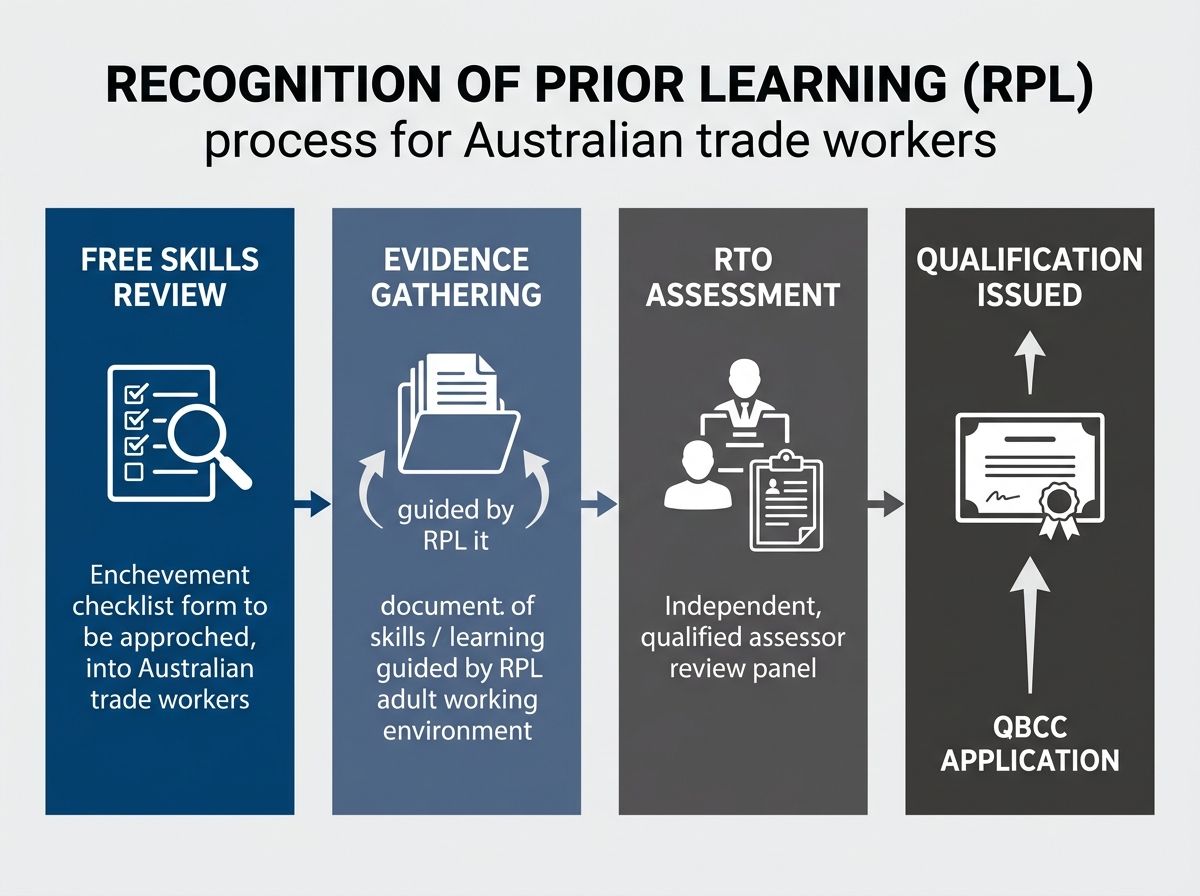
For workers who already have the competency, RPL is not about learning new skills. It is about documenting and presenting the skills they already have, so a qualified assessor from a registered training organisation (RTO) can formally evaluate them. Where competency is demonstrated, this results in a nationally recognised qualification, which is the same qualification that satisfies QBCC licensing requirements for a trade licence application.
RPL it guides experienced workers through the evidence-gathering process, helping them understand what documentation is needed, how to present their experience, and what the assessment involves. The assessment itself is conducted by the delivering RTO. RPL it does not assess or award qualifications, as only RTOs do this. If the assessment identifies any gaps in a worker's competency, the delivering RTO provides gap training at no additional cost.
This matters for employers because the RPL pathway does not require workers to take extended leave, attend block-release training, or step away from the job site for months. The evidence-gathering process works around the worker's existing schedule, keeping the tools in their hands.
For a practical look at how this works across trade categories, read our article on how RPL works for experienced tradespeople without site downtime.
Which Queensland trades require a QBCC licence
Not every trade in Queensland requires a QBCC licence, but the most common construction trades do. Under Queensland law, building work valued over $3,300 must be performed by an appropriately licensed individual. Electrical and plumbing work, regardless of job value, can legally only be performed by licensed individuals.
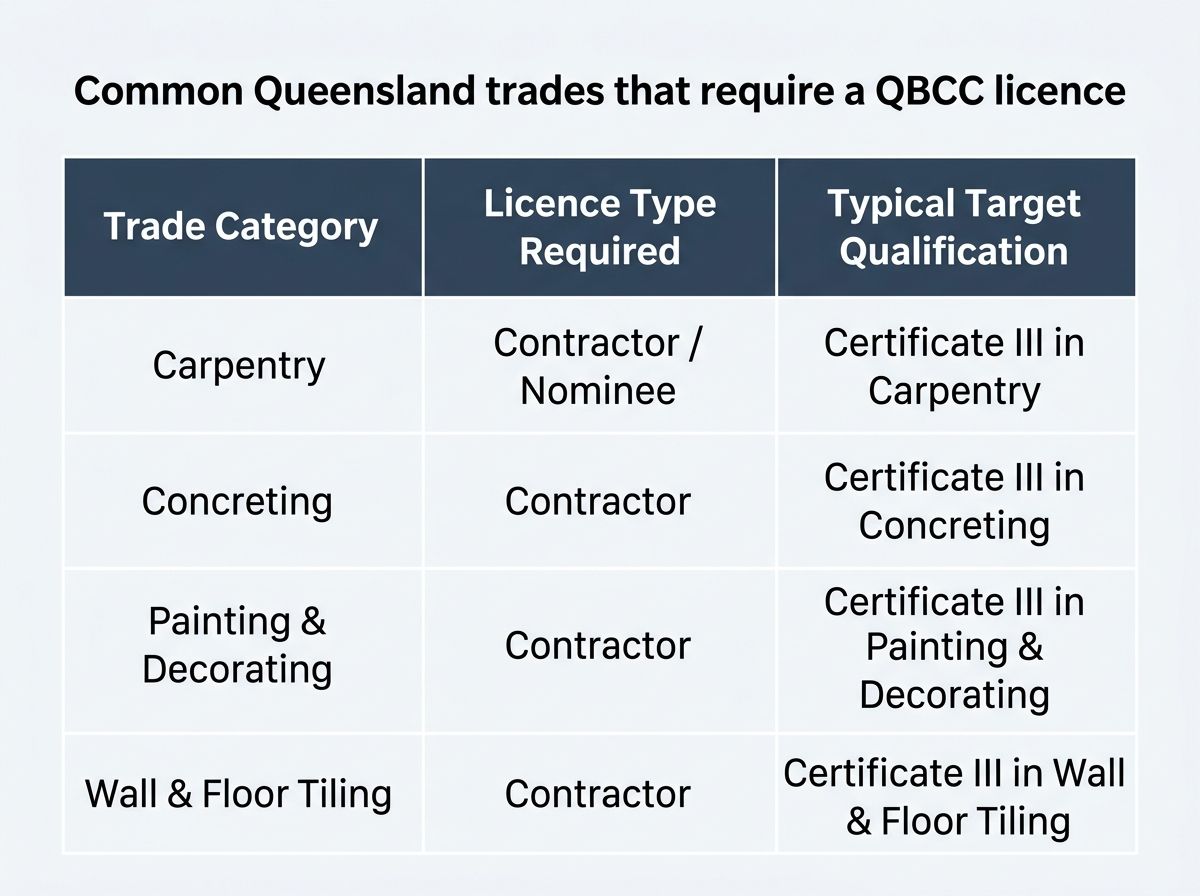
The QBCC currently licenses a wide range of trade classes. Common trades requiring a licence include carpentry, bricklaying and blocklaying, concreting, painting and decorating, plastering (drywall and solid), roof tiling, joinery, cabinet making, gasfitting, and structural landscaping. Plumbing, drainage, and fire protection work are also regulated.
The QBCC maintains the authoritative list of available licence classes on its website, and employers should check directly with the regulator to confirm which licence type applies to the work their staff perform.
The QBCC also maintains historical licence classes that can no longer be issued or restored. This is a reminder that the licensing framework has changed over time, and that a worker's understanding of their own licence status may not reflect current requirements.
If your business operates across multiple states, licensing requirements differ by jurisdiction. Read our article on why principal contractors are tightening licence requirements across Australia for broader context.
How to audit your own workforce before the QBCC does
Employers do not need to wait for a QBCC audit to discover their compliance gaps. A straightforward internal licence review to check the current licence status of every worker performing regulated work can identify risks before they lead to a penalty.
The QBCC maintains several public registers, including the QBCC licensee register, the occupational plumber and drainer register, and registers of suspended licences, cancelled licences, and excluded individuals. These registers can be searched to check licensing history and status.
The QBCC licensee register is publicly searchable and can be used to check a contractor's licence history before engaging them, or as part of an internal workforce review.
There are important limitations to be aware of. The QBCC licensee register search relates only to the listed licensee. Additional searches may be needed for a company, its directors, or a nominee supervisor to obtain a complete picture. Information in the register is restricted to what the QBCC must maintain on its public records, so it may not disclose other matters like insolvencies, bankruptcies, or civil proceedings. Because information is published only after investigations are completed and regulatory action is finalised, the register may not reflect matters that are still in process.
A practical internal audit process is straightforward. First, list every worker currently performing regulated building work. Second, check each worker's licence status against the QBCC register. Third, identify any workers whose licence is absent, expired, suspended, or does not cover the work they perform. Fourth, prioritise those workers for a Free Skills Review to assess whether RPL is a viable pathway to formalise their credentials.
The goal is not to create a compliance burden, but to understand your exposure before someone else identifies it for you.
Start with a free skills review with no commitment required
Your workers have the experience, but the gap is in their documentation. Fortunately, the first step to closing that gap costs nothing.
RPL it's Free Skills Review is a no-obligation assessment that helps workers and employers understand whether RPL is a viable pathway before any enrolment or cost is involved. We will tell you honestly if RPL is not the right pathway for a particular worker. Clear suitability guidance is the foundation of what we do, because enrolling an unsuitable candidate helps no one.
If RPL is suitable, we guide the worker through the evidence-gathering process. The assessment itself is conducted by a qualified assessor from the delivering RTO. Where competency is demonstrated, the resulting qualification is nationally recognised and satisfies QBCC licensing requirements for a trade licence application.
Ready to Get Recognised?
Start with a free skills review to find out if RPL is right for you.