Years of Peer Support and Informal Counselling Work, No Diploma to Show for It
If you've spent years in peer support or pastoral care but can't get paid counselling roles without CHC51015, RPL may recognise what you already know.
By RPL it Australia7 min read

You've Been Doing the Work. The System Just Doesn't See It.
You have the experience. Years of it. You've sat with people at their lowest — through grief, addiction, family breakdown, mental health crises — and you've helped them find a way through. Not because you were told to. Because you knew how.
You've worked as a peer support worker, a mental health support worker, an AOD support worker, a pastoral carer, a chaplain, a community health worker, or a family support worker. You've held space for people when no one else would. You've known when to listen, when to refer, when to stay.
That work is real. The capability behind it is real. The people you've supported are real.
But in formal systems — the ones that decide who gets hired, who gets funded, who gets the paid role — your years of experience are invisible. Because you don't hold the CHC51015 Diploma of Counselling. And without it, the door stays closed.
The moment the credential wall appears
It usually happens without warning. You apply for a role you're genuinely qualified to do. Or a funded program position opens up. Or your organisation restructures and suddenly the work you've been doing informally requires a formal title — and a formal qualification to match.
You read the job description. The work is familiar. The responsibilities are things you've been doing for years. And then you see it: 'Minimum qualification: Diploma of Counselling (CHC51015) or equivalent.'
The work hasn't changed. Your capability hasn't changed. But the paperwork has become the barrier.
Peer support workers, pastoral carers, and informal counsellors across Australia run into this regularly. Community services organisations, mental health programs, AOD services, and family support agencies increasingly require CHC51015 as a minimum standard for counselling and support roles. It's a credential that signals competency to employers and funding bodies — even when the person applying has demonstrated that competency for years without it.
The frustration is legitimate. Being told you need a qualification to prove what you already know is not a small thing. It is a real barrier, and it deserves a real response.
What peer support and informal counselling actually involves
Before we talk about pathways, it's worth naming what you actually do. Because the work of peer support and informal counselling is not soft. It is not peripheral. It is exactly the kind of practice that the Diploma of Counselling is designed to assess.
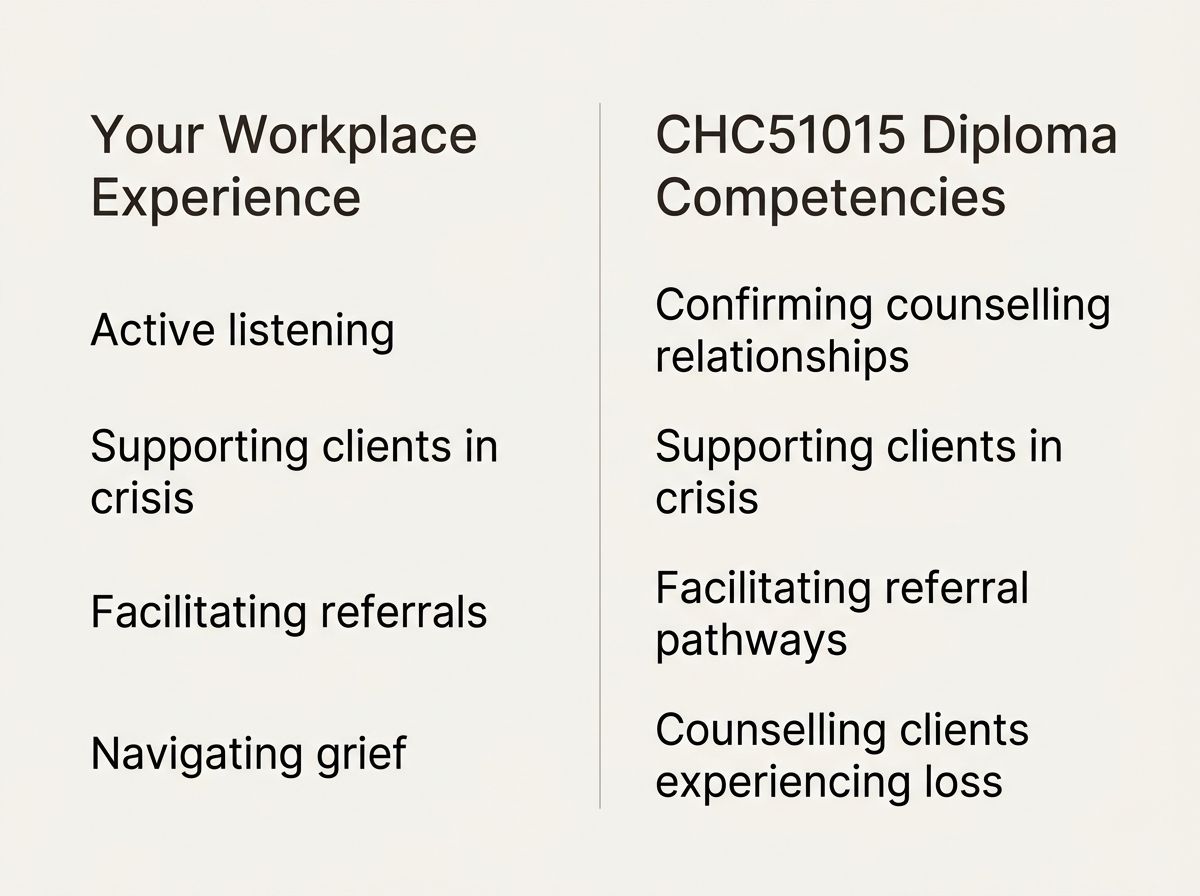
Think about what a typical week involves. You listen — genuinely, actively, without rushing to fix. You hold space for people who are frightened, overwhelmed, or in crisis. You help people identify what they need and navigate toward it. You know when a situation requires a referral, and you make it. You maintain professional boundaries while staying human. You work with people experiencing trauma, grief, mental health challenges, and substance use — often all at once.
These are not incidental skills. They are the core competencies of counselling practice. The CHC51015 Diploma of Counselling assesses things like establishing and confirming the counselling relationship, applying counselling techniques, facilitating the counselling relationship, and supporting clients in crisis. If you've been doing peer support or pastoral care work, you've been practising these competencies — often without the formal language to describe them.
The gap is not in your capability. The gap is between the form your experience takes and the form formal systems require it to be in. That is precisely the gap that Recognition of Prior Learning is designed to bridge.
Why starting over isn't the answer
When people discover they need CHC51015, the default assumption is that they'll have to go back to study. Enrol in a course. Sit in a classroom. Learn things they already know, alongside people who've never done the work.
Recognition shouldn't require starting over.
Recognition of Prior Learning — RPL — is a formal assessment pathway within Australia's national training system. It doesn't ask you to repeat what you already know. It asks you to demonstrate it. A qualified assessor from a registered training organisation (RTO) reviews the evidence of your existing competency and assesses whether it meets the standard required for the qualification.
RPL is not a shortcut. It is a rigorous, nationally recognised assessment process. The qualification you receive through RPL is the same CHC51015 Diploma of Counselling that anyone else receives — because the assessment standard is the same. What differs is the pathway: instead of completing coursework, you present evidence of what you've already learned through experience.
For peer support workers and pastoral carers with years of genuine practice, RPL is often the most appropriate pathway — not because it's easier, but because it's honest. It assesses what you actually know, not what you can memorise for an exam.
Traditional delivery of CHC51015 typically takes one to two years of part-time study. RPL timelines vary depending on the evidence available and whether any gap training is required, but the process is structured around your existing experience rather than a fixed academic calendar. Speak with an RTO about indicative timeframes for your specific situation — these will vary.
What RPL for the Diploma of Counselling actually involves
Understanding what the RPL process looks like can make it feel less daunting. Here is what it generally involves for CHC51015.
You'll work with a guide — at RPL it, that's us — to document your experience and identify the evidence that supports your application. That evidence is then assessed by a qualified assessor from a registered training organisation. The RTO conducts the assessment and issues the qualification. RPL it guides you through the process; we don't assess or award qualifications.
The types of evidence that typically support a CHC51015 RPL application include:
- Supervisor or manager references that describe the counselling or support work you've performed
- Records of client interactions, case notes, or support plans (appropriately de-identified)
- Letters from colleagues, managers, or clients that speak to your practice
- Evidence of professional development, training, or workshops you've attended
- Position descriptions from roles you've held that demonstrate counselling-related responsibilities
- Reflective statements describing how you've applied counselling skills in your work
It's important to be honest about this: not every unit in CHC51015 may be fully evidenced through informal work history. Some units — particularly those requiring supervised counselling practice in specific contexts — may require gap training. Where gap training is needed, it is provided at no additional cost through the RTO. This is not a failure of your experience; it is the assessment process working as it should, ensuring the qualification reflects genuine competency across all required areas.
Is your experience enough? A starting point.
Every situation is different, and suitability for RPL depends on the specific evidence you can provide. But here are some indicators that your background may be worth exploring:
- You have been working in peer support, pastoral care, AOD support, mental health support, community health, chaplaincy, or a related role for two or more years
- Your work has involved direct, ongoing support of people experiencing mental health challenges, grief, crisis, addiction, or family difficulties
- You have worked under some form of supervision or within an organisational framework, even if informal
- You have records — however informal — of the work you've done: case notes, position descriptions, performance reviews, or references from supervisors
- You have attended professional development, training days, or sector-specific workshops related to counselling or support practice
These are starting points, not guarantees. The only way to know whether your specific experience is likely to be sufficient is to have an honest conversation about it — one that looks at your actual background, not a generalised checklist.
Your work deserves to be counted
The people you've supported didn't care whether you held a diploma. They cared that you showed up, that you listened, that you helped them find a way through. That work was real. It counted then. It should count now.
Experience can be evidence. The Diploma of Counselling (CHC51015) is available through Recognition of Prior Learning for people whose experience genuinely meets the standard — and for many peer support workers, pastoral carers, and informal counsellors, it does. The process is rigorous, but it is designed to assess what you already know, not to make you repeat the journey.
Others who've spent years in caring roles without formal credentials have found that their experience translates more directly than they expected. The pathway exists. Whether it's right for you depends on your specific situation.
The decision is yours. If you're ready to find out whether your experience qualifies, the Free Skills Review is free and carries no obligation.
General information only, current at the date shown. Licensing rules change, so check the current requirements with the relevant regulator before you rely on them. RPL it Australia is a student support service, not a Registered Training Organisation; qualifications are assessed and issued by our partner RTOs.