The commercial cleaning progression framework: How to move from cleaner to supervisor
Stuck as a cleaner despite your experience? See how the Certificate III in Cleaning Operations validates your skills for a supervisory role.
Why experienced cleaners get passed over for supervisor roles
You know the site better than anyone. You cover shifts when the team leader calls in sick. You brief new starters, manage the chemical store, and sign off on the client walkthrough. You have been doing this work for years.
And yet, when the supervisor position becomes available, it goes to someone else.
This is not an issue of capability. The commercial cleaning sector has a structural qualification barrier between frontline staff and supervisory roles. Employers, particularly those managing major commercial and government contracts, increasingly demand formal evidence of competency before they place workers in supervisory positions. Your hands-on experience is real, and your workplace competence is genuine. However, in formal recruitment systems, experience that lacks official certification is experience that remains invisible.
We address this specific gap here. We do not suggest you return to the classroom. Instead, we show exactly where the Certificate III in Cleaning Operations (CPP30321) fits on the industry career ladder, and why this credential is what makes your practical skills visible to employers.
The four stages of the commercial cleaning career ladder
The commercial cleaning progression framework maps the four main career stages in the industry. Most experienced workers know these stages instinctively because they have lived them. Defining them matters because it makes the qualification requirements clear.
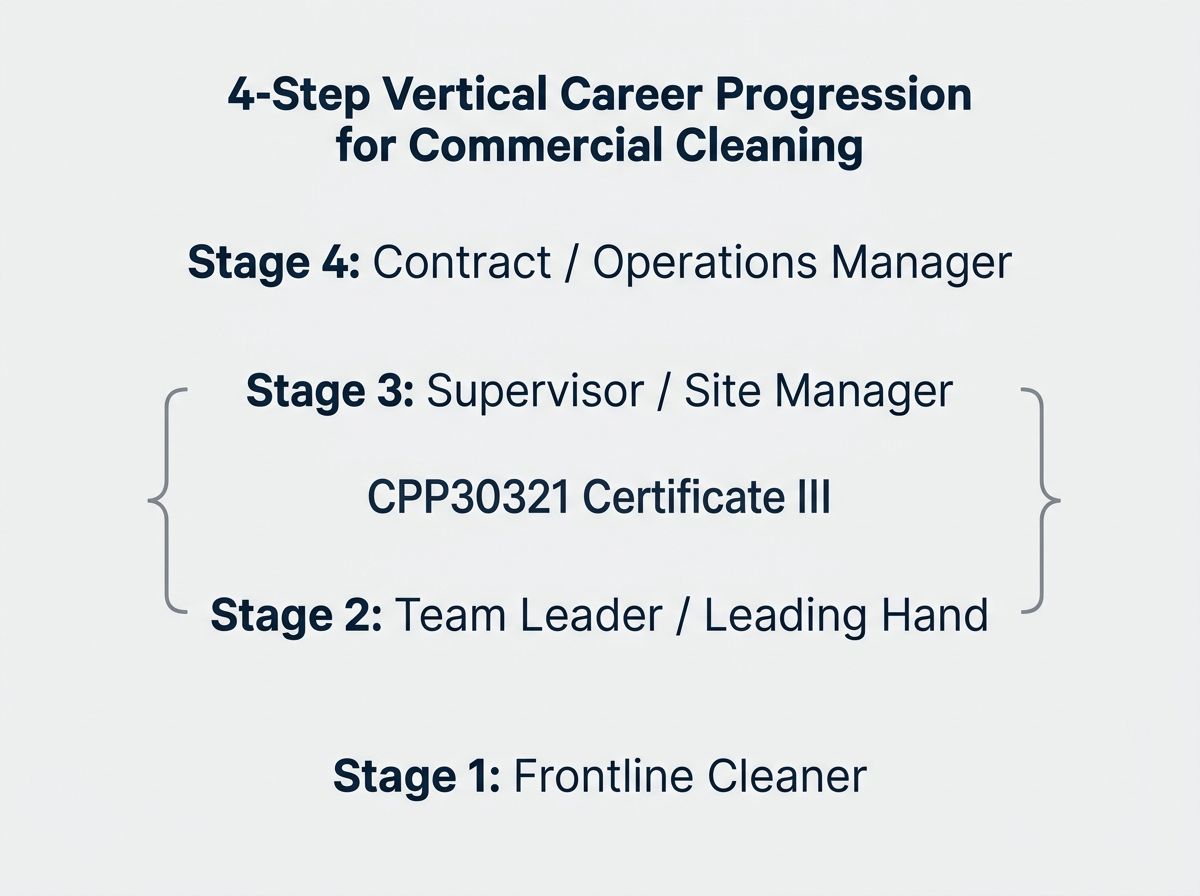
- Stage 1: Frontline cleaner. Carries out scheduled cleaning tasks under direct supervision. Responsible for completing assigned work areas to specification using approved methods and chemical products.
- Stage 2: Team leader or leading hand. Coordinates a small team on a single site or shift. Provides on-the-job guidance, manages task allocation, and reports to an operations supervisor. Often acts as the supervisor without the official title.
- Stage 3: Supervisor or site manager. Holds formal accountability for site performance, team management, WHS compliance, and client relationships. This is the stage where formal qualification evidence is typically required by contract clients.
- Stage 4: Contract manager or operations manager. Oversees multiple sites, manages client accounts directly, and holds complete commercial and compliance responsibility across a broad portfolio of service contracts.
The Certificate III in Cleaning Operations (CPP30321) is the specific qualification that formally bridges Stage 2 and Stage 3. Most workers who get stuck at Stage 2 do not lack capability. They lack the formal recognition that makes their skills visible to employers, clients, and procurement systems.
Where the Cert 3 in Cleaning Operations sits in this framework
The Certificate III in Cleaning Operations, qualification code CPP30321, is a nationally recognised vocational qualification within the Construction, Plumbing and Services (CPP) training package. It is not an entry-level program; it acts as a recognition credential for experienced workers.
The competency units within CPP30321 cover the exact tasks that experienced cleaners and team leaders already perform daily. These include managing cleaning operations across different environments, applying WHS requirements, handling and storing hazardous chemicals, communicating with clients and building managers, and supervising cleaning teams. These are not theoretical exercises. They represent the practical work of anyone operating at Stage 2 or above.
For experienced cleaning professionals, the qualification does not teach you new skills from scratch. It formally validates the skills you have already demonstrated, using an evidence-based assessment process conducted by an approved registered training organisation (RTO).
Five signs your commercial cleaning experience already meets the standard
This section is the diagnostic core of our commercial cleaning framework. Read each indicator below and consider whether it describes your daily working life. If it does, your current work is already evidence of the competencies assessed in the CPP30321 qualification.
- 1. You supervise or coordinate a cleaning team, even on an informal basis. You allocate daily tasks, brief team members at the start of each shift, or step in when the lead supervisor is absent. Coordinating teams and managing operational tasks are core supervisory skills. If you do this regularly, you are already demonstrating them.
- 2. You manage chemical handling and chemical storage on site. You know exactly which products must be used for different surfaces, how to interpret a Safety Data Sheet, and how to store hazardous substances correctly. If you have completed WHS inductions or chemical safety training, this experience maps directly to competency units within CPP30321.
- 3. You conduct or participate in site inspections and operational quality checks. You walk the property after a shift, spot areas that require attention, and report any maintenance issues. You might also complete shift sign-off sheets or joint client walkthrough checklists. Quality control and reporting are recognised competencies in this qualification.
- 4. You communicate directly with clients, building managers, or facility representatives. You handle customer feedback, respond to urgent cleaning requests, and manage on-site expectations. Client communication and relationship management are formal competency units, and your regular face-to-face interactions are practical evidence of this.
- 5. You manage rosters, work schedules, or commercial equipment. You know which machinery is assigned to which site, when it requires safety testing, and how to structure cleaning schedules around building tenancy. Operational planning and resource management are key competencies assessed within the CPP30321 course.
If you recognise your work in three or more of these descriptions, your current role is likely generating the evidence needed for an RPL assessment. The question is not whether you hold the skills, but whether they have been structured in a way the system can recognize.
Why cleaning companies require the Cert III for supervisor roles
The qualification matters beyond your personal career progression. Commercial cleaning companies, particularly those operating in healthcare, education, government, and large commercial facilities, face constant pressure to prove that their supervisory staff hold formal qualifications.
This pressure comes from several directions. Clients and facility managers conducting compliance checks on service providers now ask about the qualifications of on-site supervisors. Tenders for commercial contracts frequently require companies to demonstrate the credentials of their operational teams. Furthermore, WHS obligations require supervisors to have verified knowledge of safe work practices, and a national qualification is the most direct way to prove that.
For cleaning businesses, having supervisors with CPP30321 is a clear competitive requirement rather than an optional extra. For individual cleaning staff, holding this qualification makes you a far more valuable asset to your employer, and a highly competitive applicant when promotional supervisor positions are advertised.
Note: Specific qualification requirements vary across individual tenders and service contracts. If you are a cleaning business owner or manager looking to understand the exact requirements for an upcoming contract, review the tender specifications directly or seek advice from your relevant industry association.
What RPL means for a cleaning professional
Recognition of Prior Learning (RPL) is the formal process where your actual workplace experience is evaluated against the competency standards of a qualification. For CPP30321, an assessor from a registered training organisation reviews the evidence of your cleaning and supervisory work to determine if it meets the national standard.
RPL is a rigorous assessment pathway, not a shortcut. The difference between RPL and traditional classroom study is not the depth of the assessment, but the source of the evidence. Instead of generating evidence through theoretical coursework, you present documents from your actual working life.
The process begins with an initial skills review to check your suitability. This is followed by guided evidence collection, assessment by an RTO assessor, and the issuing of the qualification once competency is confirmed. If your current evidence does not fully cover all competency units, some gap training may be required. If gap training is needed, it is provided at no extra cost.
RPL it guides you through this process, helping you identify, compile, and present your evidence in the structured format assessors expect. The RTO conducts the official assessment and issues the national qualification. Our role is to make the pathway clear and straightforward.
To understand how this recognition pathway works across different industries and qualifications, our article on how RPL works as a formal recognition pathway in Australia provides a useful starting point.
The evidence you already have and probably do not realise counts
The paperwork requirements of RPL can feel difficult until you see that the necessary evidence already exists in your daily work. You do not need to draft new documents; you just need to locate what you already have.
For cleaning professionals, suitable evidence often includes:
- Payslips and official employment records that confirm the overall duration and type of cleaning work you have done.
- Rosters, schedules, and allocation sheets showing your active role in coordinating team tasks.
- WHS site induction records and chemical safety certificates demonstrating your safe work practices on the job.
- Client sign-off documents, completed inspection checklists, and audits proving your involvement in quality control.
- Workplace references from company supervisors, facility managers, or commercial clients confirming your daily leadership responsibilities.
- Photos of finished sites, master cleaning schedules, or machinery logs showing your operational involvement.
- Position descriptions, job advertisements, or duty statements confirming the official scope of your workplace duties.
Your daily timesheets, WHS site inductions, and client sign-off records are all valid evidence. The guided collection process is simply a matter of identifying these documents and organizing them into a format that an assessor can quickly review against the CPP30321 standards.
Is RPL the right pathway for you? Honest guidance before you commit
RPL is not suitable for every worker. Honest, upfront guidance before you commit is a fundamental part of how this process should work.
An RPL pathway for CPP30321 is highly suitable if you have consistent, relevant experience in the commercial cleaning industry, usually across several years, in roles that include coordination or supervisory duties. If your daily routine involves managing staff, overseeing safety compliance, and communicating with site clients, you are likely a very strong candidate.
RPL is rarely suitable if your cleaning background is limited to basic entry-level tasks without coordination, if your industry experience is very recent, or if you have worked in a single highly specialized setting without exposure to the wider competencies tested in CPP30321.
Work in similar settings, such as hotel cleaning, aged care cleaning, or school facilities, is highly relevant depending on the exact duties you performed. Regular casual or part-time experience also counts toward the requirements if it is consistent and verified.
The honest answer to whether RPL is right for you is not something we can write in an article. It requires a direct conversation about your specific work history, which is why we offer the Free Skills Review.
The next step: Find out where you stand
You have the experience. The question is whether it has been accumulated in a format that the training system can recognize, and whether the Certificate III in Cleaning Operations is the right qualification to formalise it.
A Free Skills Review is the most practical starting point. It is not an enrolment. It is a straightforward conversation about your specific experience to give you a clear answer before you proceed. If RPL suits your situation, we will tell you. If it does not, we will be equally direct.
The ultimate decision is yours.
Ready to Get Recognised?
Start with a free skills review to find out if RPL is right for you.