Carpentry RPL and joinery RPL are not the same: The difference that trips people up
Carpentry RPL and joinery RPL lead to different qualifications with different evidence requirements. Here's how to tell which pathway applies to your work.
By RPL it Australia7 min read
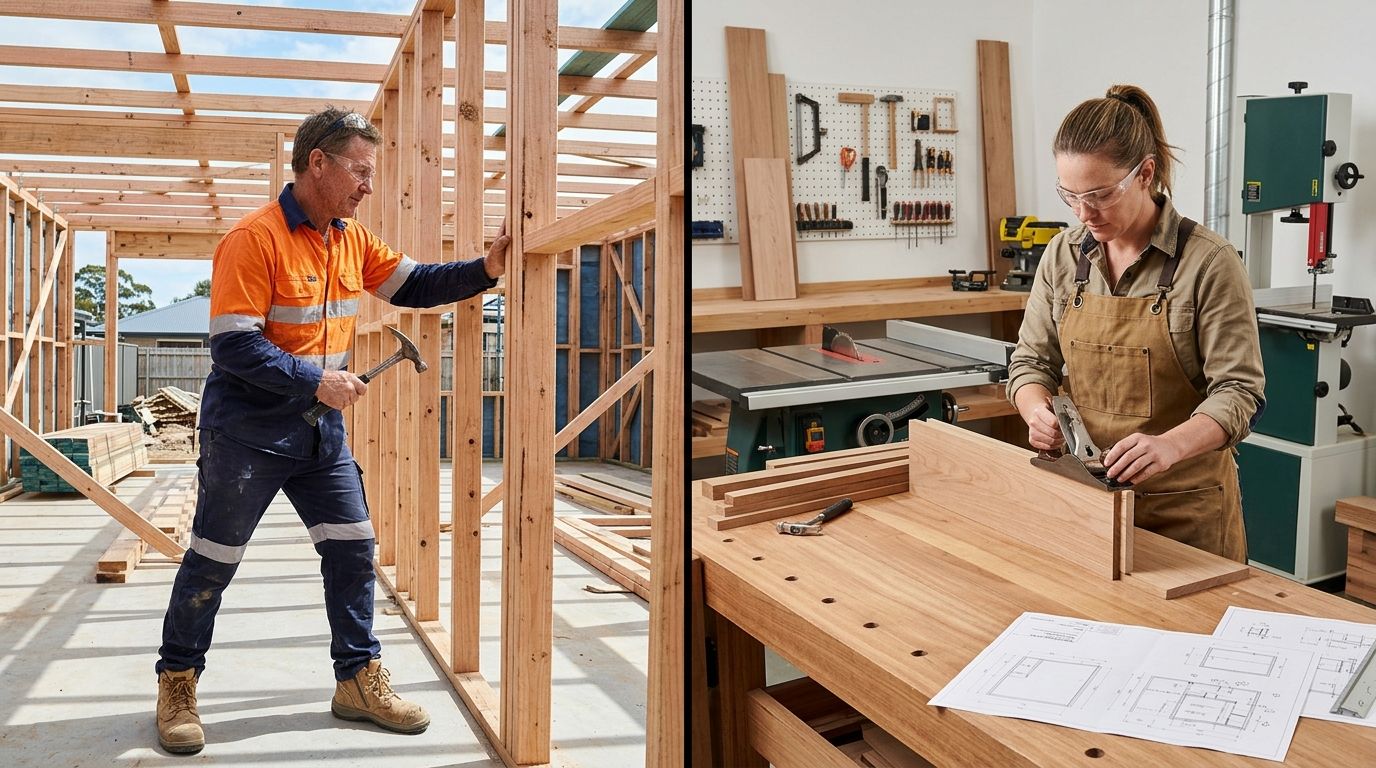
The myth: If you have worked with timber, carpentry RPL covers you
This is the assumption that frequently sends experienced tradespeople down the wrong path. If you have spent years working with timber, you know your trade. You hear that RPL, or Recognition of Prior Learning, allows you to convert your years of practical experience into a formal qualification. So you search for 'carpentry RPL,' locate a pathway, and begin compiling your evidence. Months later, you discover that the qualification you were assessed against does not actually match the work you do.
This misunderstanding is very common. Carpentry remains the dominant trade identity across the Australian construction sector. Joinery is often treated as a minor subset or a specialisation within carpentry rather than as a distinct trade qualification in its own right. However, under the national training framework, they are two separate qualifications with separate unit structures, distinct competency requirements, and different evidence standards. Applying for the wrong one is not just an administrative error; it is a mismatch that costs real time and money.
The Certificate III in Carpentry and the Certificate III in Joinery are distinct trade qualifications. Knowing which one matches your actual work is the first step toward a successful assessment.
What carpentry RPL actually covers
The Certificate III in Carpentry (CPC30220) is structured specifically around site-based timber work. This includes structural framing tasks like wall frames, roof structures, and timber floor systems, alongside concrete formwork. It also covers the site-based fixing and finishing work that occurs on active building projects, such as installing doors and windows into frames, fitting skirting boards, and working from structural plans.
If you have spent your working life on active construction sites reading site plans, framing timber walls, working alongside other trades, and managing structural timber, then CPC30220 is likely the qualification that matches your experience. Your RPL evidence must prove site-based competency, demonstrating your ability to interpret construction drawings, work safely on site, and deliver structural and finishing carpentry to the required building specifications.
Work that typically maps to carpentry RPL includes framing residential or commercial structures, installing roof trusses or rafters, building formwork for concrete pours, fitting pre-hung door sets, and installing structural timber flooring systems. The setting is the active site, the work is structural or finishing, and your assessment evidence needs to reflect that context.
What joinery RPL covers and why it is different
The Certificate III in Joinery (CPC31920) is a completely different qualification. It is built around workshop-based production and the manufacture and installation of detailed joinery products. Items like timber doors, windows, staircases, cabinetry, fitted furniture, and shopfronts are joinery products. The work required to produce them happens inside a workshop rather than on a construction site.
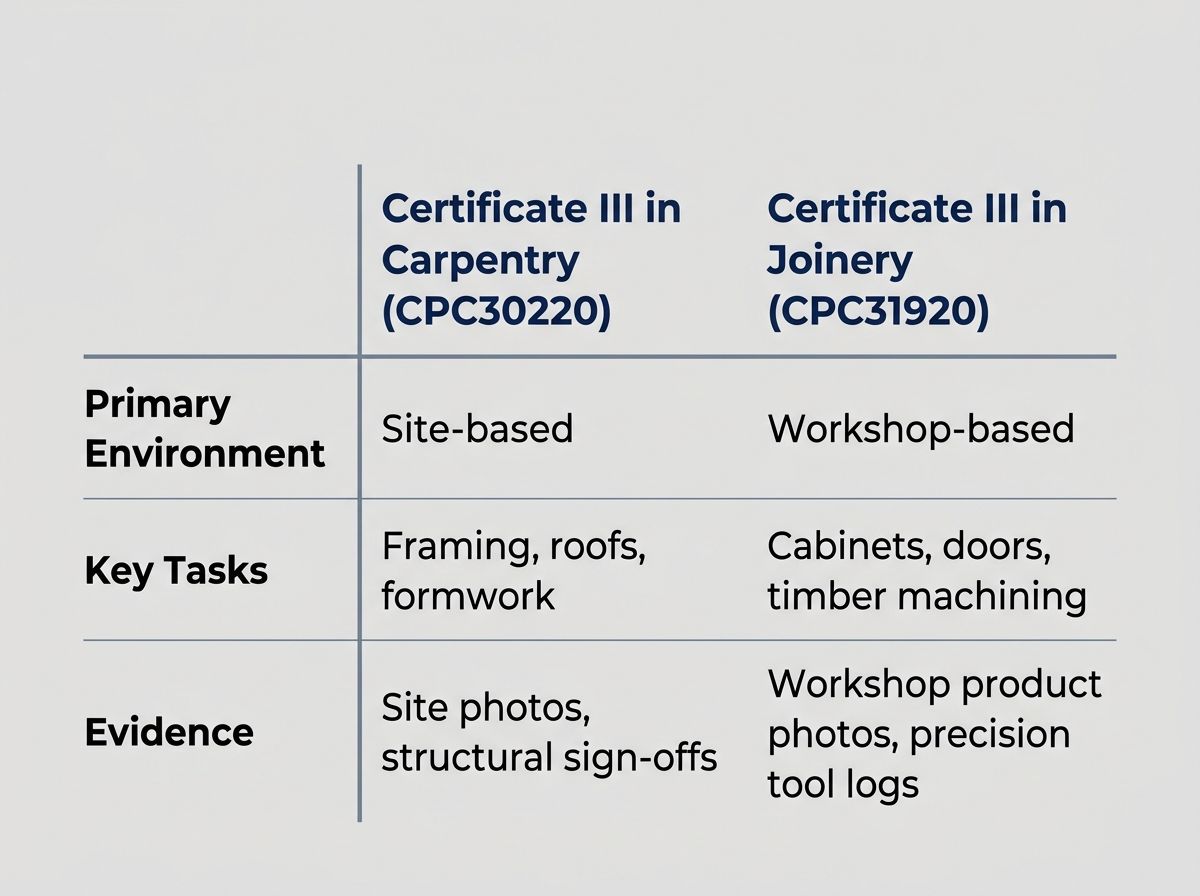
The competency requirements for joinery RPL reflect this workshop environment. This involves operating timber machining equipment, reading and interpreting joinery drawings, cutting and assembling timber components to precise tolerances, and finishing joinery products. These are demanding trade skills, but they differ significantly from the site-based competencies assessed in carpentry RPL.
A skilled site carpenter who has never worked in a joinery workshop will find it difficult to demonstrate competency against joinery units. This is not because they lack skills, but because their experience is in a different domain. The reverse is also true: an experienced bench joiner who has spent their career in a workshop cannot easily demonstrate the site-based, structural competencies required for a carpentry qualification.
Common work that typically maps to joinery RPL includes manufacturing door and window frames in a workshop, producing staircase components, constructing fitted cabinetry, making shopfront joinery, and building custom timber furniture. The setting is always the workshop, the work is focused on precision manufacture, and your assessment evidence must reflect this specific context.
The diagnostic question: Where does your work actually happen?
The fastest way to identify the correct pathway is to ask where the majority of your skilled timber work takes place.
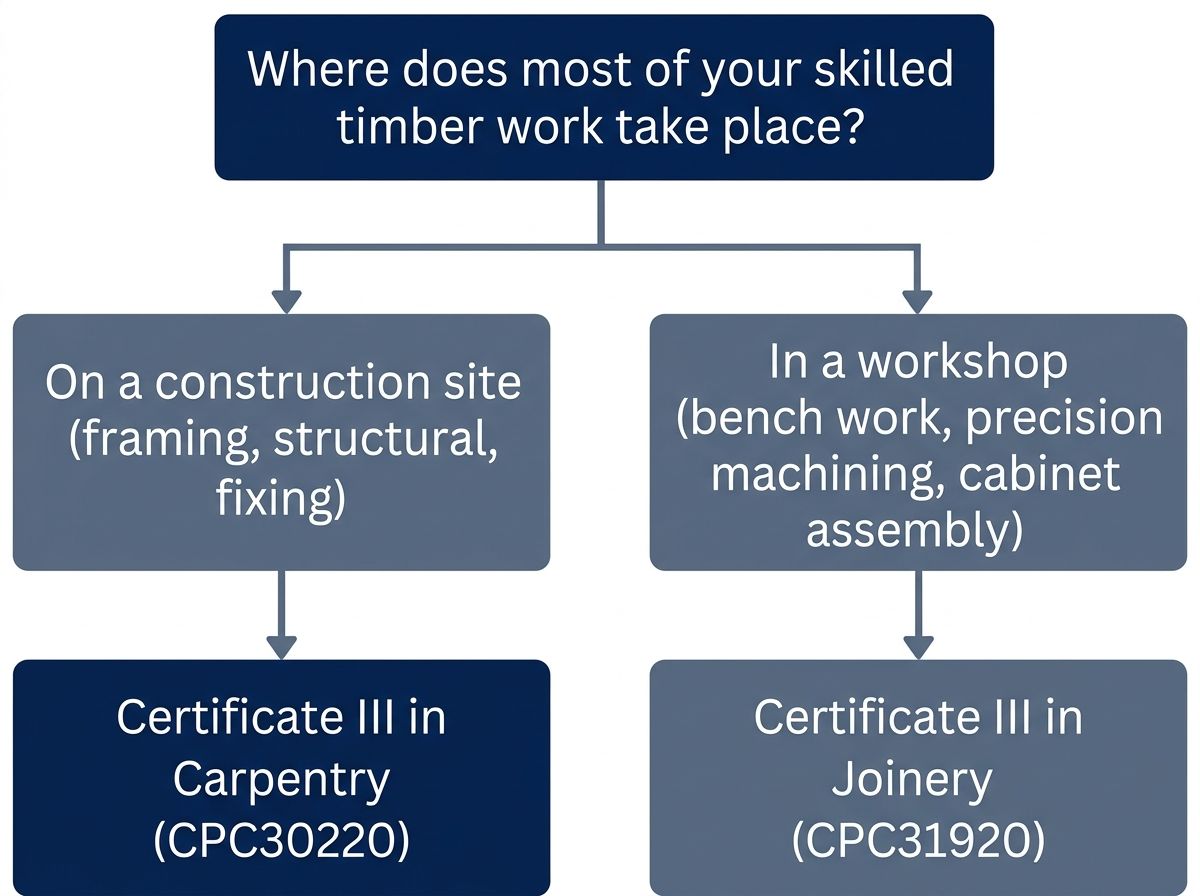
- On a construction site: framing, fixing, structural, and finishing work points toward the Certificate III in Carpentry (CPC30220).
- In a workshop: bench work, precision manufacture, machining, and assembly of joinery products points toward the Certificate III in Joinery (CPC31920).
- In both settings: if you have substantial, documented experience in both, this requires a detailed discussion before you select a pathway.
Some tradespeople have genuine experience across both domains. A carpenter who spent years on site before moving into a joinery workshop, or a joiner who does on-site installation work, may have experience that maps to both qualifications. Whether pursuing both separately is a practical option depends on the depth and documentation of your experience. It is worth exploring directly rather than making assumptions.
Grey areas are common in timber trades. Kitchen installation, for example, can involve both site-based fitting and workshop-produced cabinetry, so the decision depends on where the majority of your documented skill sits. Stair construction similarly spans both areas depending on whether you manufacture the components or install them on site. If you are unsure where your work fits, a suitability discussion is designed to resolve that uncertainty.
Why this confusion costs tradespeople real time and money
Applying for the wrong RPL pathway is a significant setback. It means you gather evidence for a qualification that does not reflect your actual daily work. You can go through the process of engaging with an RTO, completing a self-assessment, and undergoing a formal assessment, only to be found not yet competent. This happens not because you lack skill, but because your experience is in the wrong category for the qualification you selected.
The cost is real. You lose time gathering the wrong evidence and pay fees for an assessment that cannot succeed. It is a frustrating delay in a process that should have been straightforward, ultimately forcing you to start again from scratch with the correct qualification.
Selecting the correct pathway before you begin is not a minor detail. It is the difference between a straightforward, well-documented assessment and a wasted attempt. The qualification framework, the evidence requirements, and the work experience that satisfies them are highly specific. Matching your actual trade experience to the right qualification at the start is the most important step in the entire process.
This is not a criticism of tradespeople who have made this mistake. The system does not make the distinction obvious. Carpentry and joinery are often used interchangeably in job advertisements and daily trade conversations. However, the national qualification framework treats them as completely separate, and this distinction is critical when you are submitting evidence for assessment.
What evidence joinery RPL actually requires
For the Certificate III in Joinery (CPC31920), your RPL evidence must demonstrate workshop production skills across the required competency units. Assessors need to see that you can perform the work described in the units, and your evidence must be clear, verifiable, and mapped directly to those units.
The types of evidence that typically support a joinery RPL application include photographs of completed joinery projects showing the quality of your work, written employer or supervisor references confirming your role and experience, project records like drawings and specifications, and third-party verification from trade colleagues, clients, or industry contacts who can confirm your technical skills.
This evidence must focus specifically on workshop tasks, including precision manufacture, timber machining, assembly, and joinery installation. General carpentry evidence, no matter how substantial, does not satisfy joinery units. The assessment is conducted unit by unit, and your documentation must address the specific competency requirements of each unit.
Gap training may be required if your evidence does not fully cover every unit in the qualification. This is a standard part of the RPL process rather than a failure. Reputable RTOs will identify these gaps honestly and provide a pathway to address them, ensuring your assessment is genuine and fully compliant.
For details on the Certificate III in Joinery and the RPL process, visit the qualification page.
If you are unsure which pathway fits your work, use the Free Skills Review
Carpentry RPL and joinery RPL are not interchangeable. They lead to completely different qualifications, require different evidence, and represent different types of skilled timber work. Selecting the correct pathway from the beginning is the key to a successful RPL application.
If your experience is in workshop-based production, precision timber manufacture, and bench work, then the Certificate III in Joinery (CPC31920) is the right qualification to explore. If your experience is site-based and structural, the Certificate III in Carpentry (CPC30220) is the correct option. If you are genuinely unsure, or if your experience spans both areas, that uncertainty is best resolved through an honest conversation before you commit to a pathway.
The Free Skills Review helps resolve this question. This is a complimentary, no-obligation discussion designed to match your actual work history with the right qualification. We will direct you to CPC31920 for joinery, CPC30220 for carpentry, or assess how to handle experience in both. If neither pathway is suitable, we will let you know directly, because enrolling someone in the wrong qualification serves no one.
General information only, current at the date shown. Licensing rules change, so check the current requirements with the relevant regulator before you rely on them. RPL it Australia is a student support service, not a Registered Training Organisation; qualifications are assessed and issued by our partner RTOs.