The Salon Income Ceiling: How to Move Past It
Fully booked but hitting an income ceiling? Learn the pattern blocking beauty therapists from high-margin treatments and the qualification that changes it.
You have the clients. Your appointment book is full. You are skilled at your work and your clients know it. Why, then, does your revenue feel like it has hit a wall?
This pattern is familiar to experienced beauty therapists across Australia. It is not caused by a lack of skill or low demand. Instead, a structural ceiling is built directly into your treatment menu. This barrier exists because of a gap in your formal credentials, not a gap in your actual competence.
This article outlines that pattern across three distinct stages, showing how each stage reinforces the next, and highlights the single structural change that alters what you are permitted to offer.
The fully booked trap: when busy stops meaning profitable
Being fully booked does not mean you are earning at your true potential. You can run a packed schedule with back-to-back appointments and a long waitlist, yet remain capped at a revenue level that fails to reflect your actual skill or the demand your clients bring through the door.
The process is straightforward. A beauty therapist builds a loyal client base over years of practice. They develop strong skills, learn to read skin, adapt techniques, and build lasting trust. Clients refer friends and the schedule fills. Growth stops not because demand dries up, but because the treatment menu itself cannot expand.
Standard beauty services like waxing, basic facials, manicures, and tinting have a natural revenue limit per session. Advanced clinical treatments command much higher fees per appointment. The difference between these tiers is substantial. However, offering these advanced treatments is not just about learning the technique; it depends entirely on what the formal regulatory system permits you to perform.
This ceiling does not reflect your effort or your level of skill. It is determined solely by what your formal credentials unlock.
Stage one: the treatment menu gets capped
The first stage of this income ceiling is a restricted treatment menu. Without a diploma-level qualification in beauty therapy, practitioners in Australia face clear limitations on the advanced clinical treatments they can offer. This restriction does not exist because they lack hands-on ability, but because their formal scope of practice and insurance eligibility are tied directly to their qualification level.
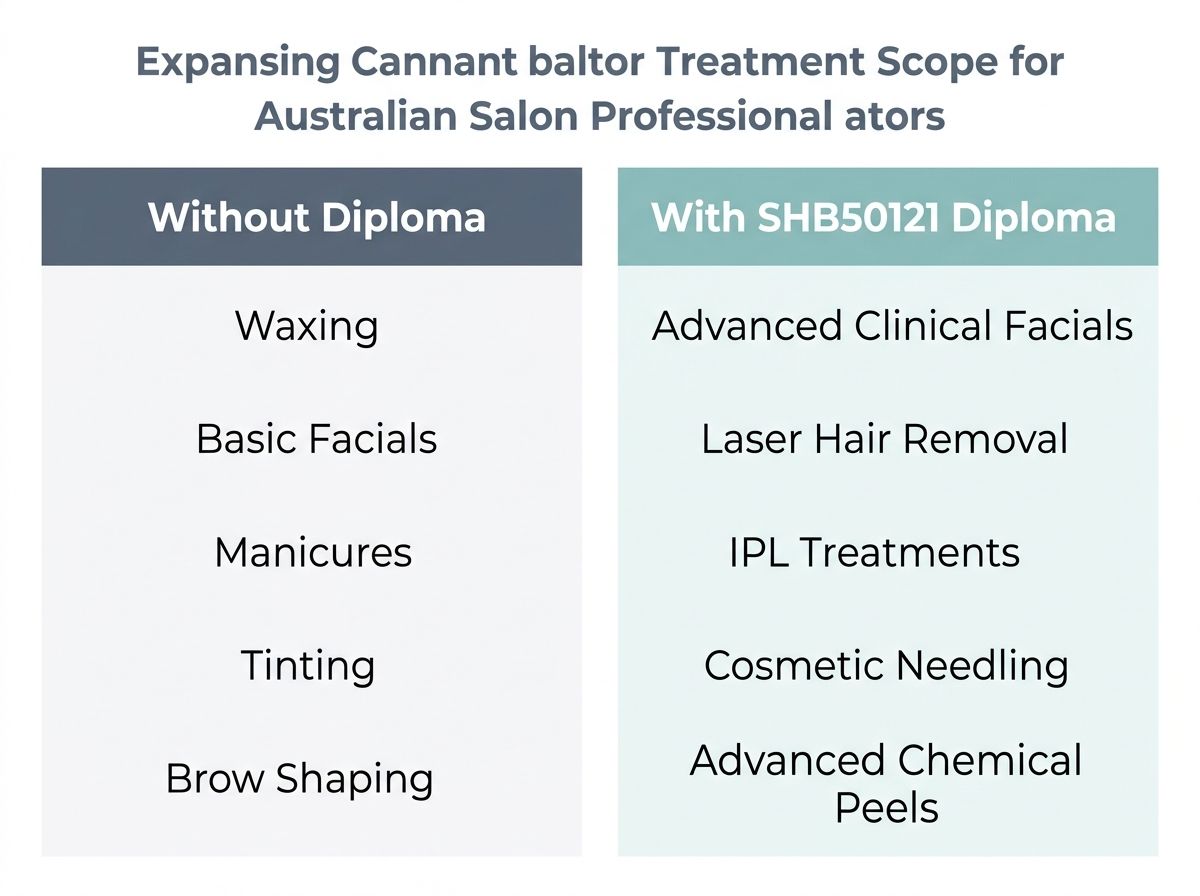
The advanced treatments that clients are increasingly requesting — including laser hair removal, intense pulsed light (IPL) therapies, cosmetic needling, chemical peels, and clinical skin treatments — belong to a category requiring demonstrated and formally assessed competency. The Diploma of Beauty Therapy (SHB50121) is the nationally recognised qualification that covers these advanced competencies within the Australian vocational education and training framework.
This is not a gap in skill. A therapist may have watched these treatments performed hundreds of times, assisted with them, or practised them informally under supervision. However, the formal system does not recognize informal experience. It looks only for units of competency that have been formally assessed and certified.
As a result, your treatment menu remains limited by regulatory structures rather than choice. When clients ask for advanced services, you must refer them to other clinics, and that revenue goes elsewhere.
Stage two: insurance draws the line
The second stage of the pattern involves insurance limitations. Professional indemnity insurance for beauty therapists in Australia is tied directly to the treatments you declare and the qualifications you hold. Performing treatments outside your declared scope, or beyond the competency level your qualification supports, can invalidate your coverage.
This is a practical business risk rather than a bureaucratic technicality. If an issue arises during an advanced treatment you are not formally qualified to perform, your professional indemnity insurance provider may decline the claim. Many policies for Australian beauty therapists link coverage levels directly to your qualification tier. You should always verify these specific details with your insurer before offering any service outside your current scope of practice.
This insurance barrier is a hidden vulnerability that many therapists only discover after a client incident or a close call that prompts them to check their policy documents. Holding the correct qualification is about business protection. It ensures your professional indemnity insurance remains valid and active when unexpected issues occur during advanced clinical procedures.
This protection is essential because operating without valid coverage leaves your salon exposed to major financial and professional risks if a treatment goes wrong.
Stage three: high-margin treatments stay out of reach
The third stage of this pattern is the financial consequence. Advanced clinical treatments command premium fees, but they remain out of reach for therapists who do not hold the required qualification. Consumer demand for these services is growing. Indeed, the Australian clinical beauty and medical aesthetics market continues to expand steadily, driven by strong interest in non-invasive procedures like laser, IPL, and deep skin therapies.
Qualified competitors with the diploma can offer these high-value services, building a menu that expands alongside client demand. Therapists without the qualification must send clients to other businesses, keeping their own revenue ceiling firmly in place no matter how busy their calendar remains.
The clients and the demand are present in your market, but you cannot capture the revenue, which keeps the cycle repeating.
If you are fully booked but unable to offer high-margin treatments, this is the bottleneck. It is a structural issue that requires a structural solution.
Why the pattern repeats and why skill alone cannot change it
This income ceiling is not a reflection of your skills, but a challenge of official recognition. You may have years of hands-on experience performing or assisting with advanced treatments. You might have trained under a senior therapist, worked in a clinic where the owner held a diploma, and mastered the required techniques, contraindications, client care, and aftercare protocols.
However, the formal education system does not recognize practical experience on its own. It requires skills to be formally assessed and documented. While this does not always reflect what an experienced therapist actually knows, it is how the credential system operates in Australia.
Getting your skills recognised should not mean starting your education over from the beginning, and for experienced practitioners, it does not have to.
The solution to this cycle is Recognition of Prior Learning (RPL). This is a formal assessment pathway that evaluates your current salon experience against national qualification standards, allowing you to avoid repeating training you have already completed through years of work.
What the Diploma of Beauty Therapy unlocks
The Diploma of Beauty Therapy (SHB50121) is the nationally recognised qualification that certifies competency in advanced beauty therapy practice in Australia. It is positioned at diploma level within the Australian Qualifications Framework and is delivered by registered training organisations (RTOs) nationwide.
The SHB50121 covers advanced treatment competencies that extend past certificate-level qualifications. The course contains units on advanced facial treatments, body therapies, clinical skin analysis, and specialised treatment areas. These specific units correspond directly to the advanced clinical services that require a diploma-level qualification for insurance coverage and professional scope of practice.
In practical terms, the diploma allows you to offer an expanded treatment menu, obtain insurance for advanced services, qualify for clinical aesthetician or advanced skin therapist roles, and operate at the higher-revenue end of the market. This process is not about relearning your trade, but about getting formal recognition for what you already do daily.
How RPL converts your salon experience into a qualification
Recognition of Prior Learning (RPL) is the formal pathway designed to assess your current skills and knowledge against the SHB50121 competency units. It allows you to obtain the qualification without repeating training for skills you have already developed through years of salon work.
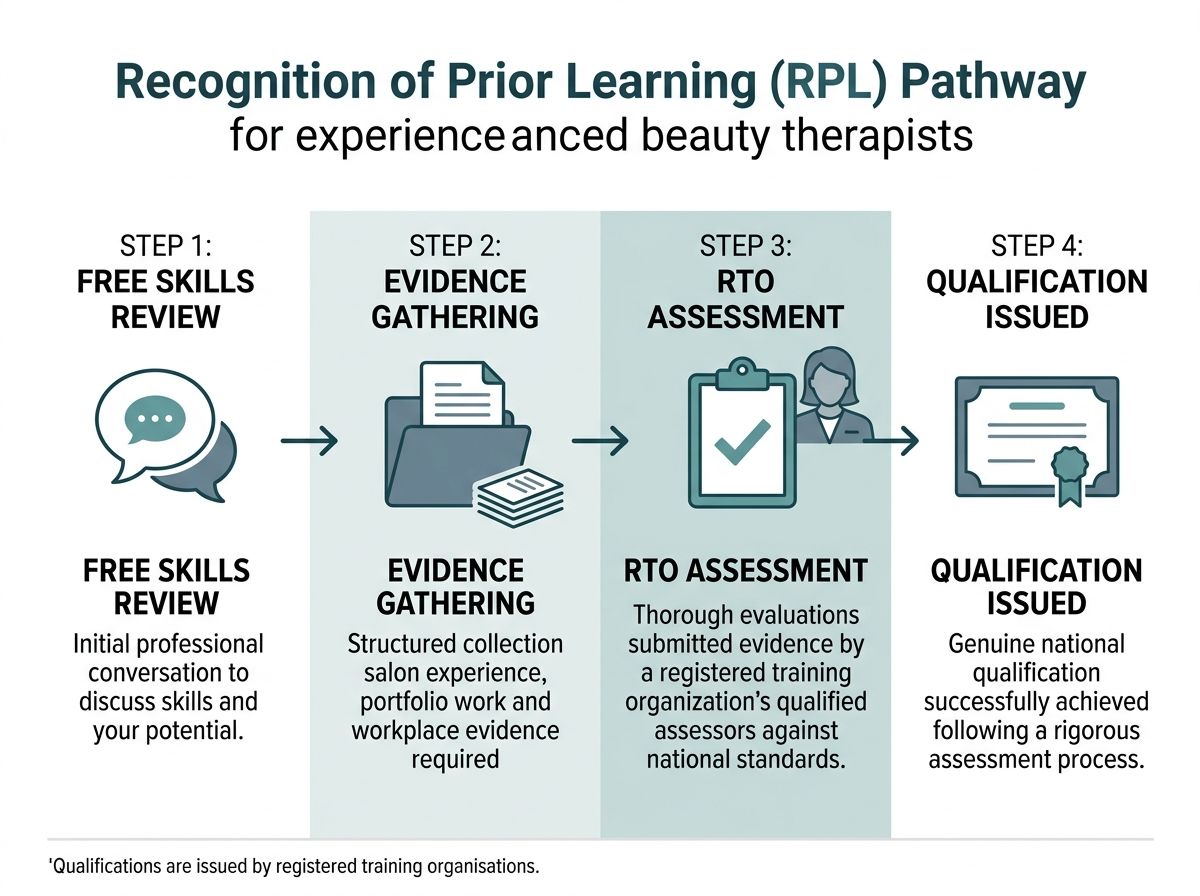
This process is a rigorous, genuine assessment rather than a shortcut. A qualified assessor from a registered training organisation reviews your submitted evidence of competency to ensure it meets the required standard for each unit. If any gaps are found, gap training is provided to help you complete the qualification.
Common evidence types accepted for beauty therapy RPL include treatment logs and salon client records showing your volume of work, detailed photographs of your clinical treatment setup, supervisor or employer reference letters, infection control and hygiene compliance records, and practical demonstrations of your skills. The exact evidence required will depend on the registered training organisation conducting your assessment.
The structured process follows several clear steps. First, a skills review identifies which units your experience covers and where gaps might exist. Next, you gather and document your evidence with professional support. An RTO assessor then evaluates this evidence against national competency standards. Units are marked as competent where your evidence meets the requirements, and targeted training is arranged for any remaining gaps. The RTO issues your qualification once all units are completed.
Your daily salon hours are already generating the necessary evidence. The next step is organizing and presenting this documentation in a format that meets formal assessment standards.
Is your experience enough? What the assessment covers
Not every beauty therapist will qualify for RPL immediately. Practical, honest guidance on your suitability is more valuable than automatic promises. The assessment process looks closely at the depth and range of your work history, rather than just counting the years you have spent in the industry.
Your relevant experience should ideally include hands-on treatment delivery across multiple beauty services, client consultations, skin analysis, infection control protocols, and exposure to the clinical treatments covered by the SHB50121 units. Experience gained under the supervision of a diploma-qualified therapist is also highly relevant, provided it is properly documented and demonstrates your practical competence.
Whether your experience is sufficient depends entirely on what treatments you have performed, how your work is documented, and how it aligns with the qualification units. A skills review is designed to clarify this alignment before you make any commitment.
If any gaps are identified, they do not prevent you from qualifying. They simply show where targeted gap training is required to complete your diploma. This training is a standard, integrated part of the RPL pathway.
The decision to proceed is yours. The first step is simply understanding where your current experience stands under the national standards.
Ready to Get Recognised?
Start with a free skills review to find out if RPL is right for you.