The subbie ceiling: why you can't grow working under someone else's trade licence in SA
Working under another contractor's trade licence in SA caps your income and independence. Here is how to break through that ceiling.
The arrangement that felt like freedom
You did the work. Someone else signed off. It worked, until it stopped working.
Sub-contracting under another licence holder felt like a sensible move. Steady work. No regulatory headaches. No paperwork chasing you on a Friday afternoon. You showed up, delivered the job, and got paid. For a while, that felt like freedom.
But there is a structural cost to that arrangement, and it compounds quietly over time. The work is yours. The skill is yours. The hours are yours. However, the client relationship, the contract, the margin, and the licence belong to someone else.
That is the subbie ceiling. If you have been working in the trades long enough in South Australia, you have probably already felt it, even if you have not named it yet.
What the ceiling actually looks like
Working under another contractor's trade licence in South Australia means every dollar you earn passes through someone else's margin first. That is not a metaphor; it is the structural reality of the arrangement.
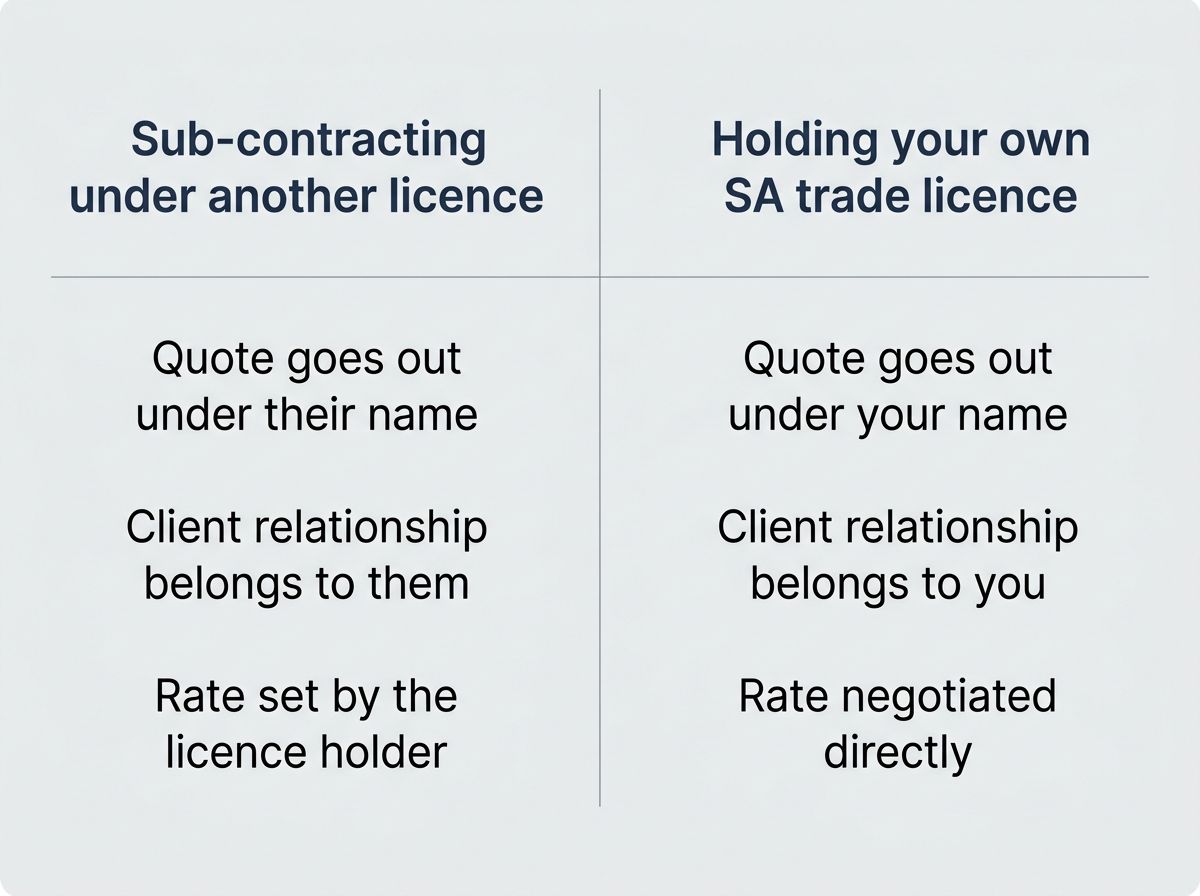
The ceiling shows up in concrete ways:
- You cannot quote directly to clients because the quote goes out under the licence holder's name, not yours.
- You cannot win contracts in your own name. Tenders, commercial jobs, and government work require a licensed contractor.
- You cannot set your own rates. Your rate is negotiated with the licence holder, not with the client who is paying for the job.
- Every compliance certificate, sign-off, and piece of paperwork that makes the job legal carries someone else's name.
- The client relationship belongs to the licence holder. When the job is completed, they call back the licence holder, not you.
The licence holder quotes the job. You do the work. The difference between what the client pays and what you receive does not reflect your skill; it is simply the cost of not holding your own SA trade licence.
The moment it becomes a crisis
The ceiling does not announce itself. It builds quietly, and then it becomes impossible to ignore.
A client calls you directly because they want you specifically. They have seen your work, they trust you, and they are ready to go. You must explain that you cannot take the job in your own name. That specific moment makes the ceiling visible.
Or a tender comes up for commercial work, the kind of job that would change your year. You have the skills and the experience, but the tender requires a licensed contractor. Since you are not licensed, you watch someone else win it.
Or you are standing next to a colleague on the same job. Same trade, same tools, and same hours. Their name is on the licence, while yours is not. The difference in what you each take home does not reflect who is better at the work.
In South Australia, trade licensing is regulated. The specific requirements vary by trade type, and Consumer and Business Services SA (CBS SA) and the Office of the Technical Regulator (OTR) set the rules for what work requires a licence and who can legally carry it out. The threshold for mandatory licensing depends on the trade and the nature of the work. What is consistent across all trades is that without your own licence, there is a category of work you simply cannot access.
Why the arrangement persists, and why it is a problem
Sub-contracting under another licence persists because it feels like a lower risk. There is no licensing exam, no regulatory engagement, and no application process. Steady work flows through the licence holder, and you stay busy. That is a real benefit.
But the arrangement is not neutral. It is a structural dependency, and it serves the licence holder far more than it serves you.
The licence holder controls the client relationship, the rate, and the jobs you receive. If they decide to bring in someone else, or if the arrangement ends, you have no client base, no direct relationships, and no independent standing in the market. You have been building their business instead of your own.
There are also practical risks that sub-contractors working under another licence may not fully consider. Insurance arrangements can become complicated; what is covered, and under whose policy, is not always clear. In South Australia, carrying out licensed trade work without the appropriate licence or authorisation carries regulatory consequences. While the specifics depend on the trade and the circumstances, the risk is real. Consumer and Business Services SA enforces licensing requirements, and the consequences of non-compliance fall on the individuals involved, not just the licence holder.
The arrangement works. It just works much better for the person whose name is on the licence.
The experience gap that keeps tradespeople dependent on another licence holder's credentials is a common pattern across Australian states.
What a South Australian trade licence actually unlocks
A trade licence in SA is more than a compliance document; it is the tool that converts your skill into business autonomy.
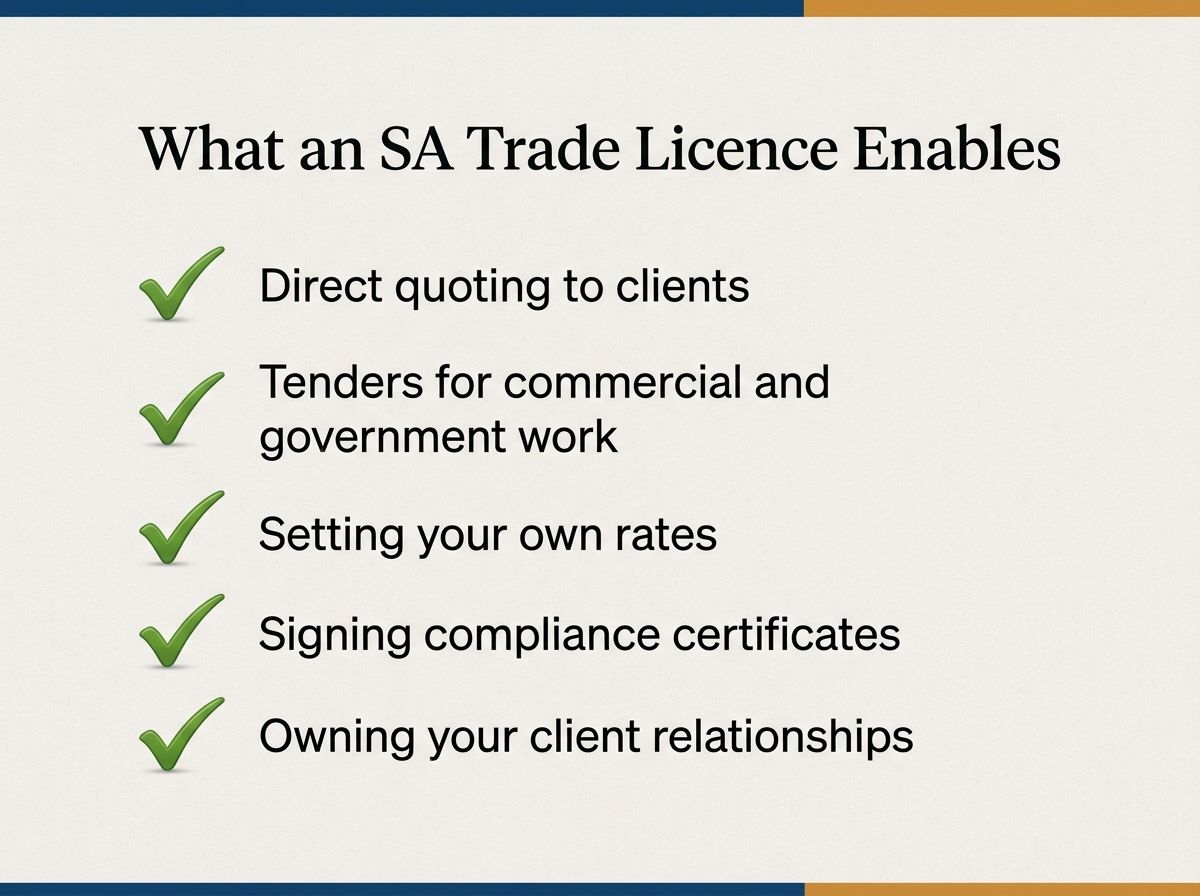
With your own SA trade licence, the situation changes:
- Your name is on the quote, letting you deal directly with the client.
- You own the client relationship, meaning they call you back instead of the licence holder.
- You set your own rate, negotiating directly without a margin being taken off the top.
- You gain the ability to tender, making commercial contracts, government work, and larger jobs accessible.
- You handle your own compliance sign-off, carrying the authority to certify the work you do.
- You build your own business, so the client base belongs to you.
In South Australia, trade licensing covers a range of industries, including building work, plumbing, gas fitting, and electrical work. The specific licence categories and what each permits are set by Consumer and Business Services SA and the Office of the Technical Regulator. The requirements vary by trade, but holding your own licence is consistently what makes independent practice possible.
Your experience already counts, but it needs to be presented
The subbie ceiling is not caused by a lack of skill. You have the practical skills, and you have demonstrated them across years of work. The barrier is not competence; it is the formal documentation of that competence.
Recognition of Prior Learning (RPL) is a formal assessment process that evaluates your existing skills and experience against the requirements of a qualification, without requiring you to repeat training you have already completed. It is a nationally recognised pathway under the Australian Qualifications Framework, allowing experienced tradespeople to have their practical knowledge formally assessed.
RPL is not a shortcut; it is a rigorous assessment of what you already know. The difference is that you are not starting from zero. Your years on the tools, your documented work history, and your demonstrated competency become the evidence assessed against the qualification standard.
In South Australia, the qualification requirements for a trade licence depend on the trade and the licence type. Eligibility requirements vary, and some trades require an underlying qualification as a prerequisite for the licence application. Whether RPL-assessed qualifications are accepted depends on the specific licensing pathway. The correct starting point is understanding where your experience sits against those requirements, which is what a Free Skills Review is designed to establish.
The first step is knowing whether you qualify
Before committing to any pathway, you need to know if your experience maps to the qualification requirements. You do not have to answer that question alone.
What happens when you stop working for someone else's margin
The subbie ceiling is not a permanent condition. It is a structural arrangement, and structural arrangements can change.
The difference between sub-contracting under another licence and holding your own goes beyond regulatory compliance. It is the difference between building someone else's business and building your own. It is the difference between a client relationship that belongs to the licence holder and one that belongs to you. Finally, it is the difference between a rate someone else sets and one you negotiate directly.
Your skills are real. Your experience counts. An SA trade licence is the tool that opens up the clients, contracts, and opportunities that are currently out of reach.
Working under someone else's licence means working for their profit margin. You have to decide if that is still the arrangement you want.
If you are ready to find out what your own SA trade licence requires, start with the Trade Licence SA page.
Ready to Get Recognised?
Start with a free skills review to find out if RPL is right for you.