Three Myths About RPL That Are Stopping Overseas Plumbers From Getting Their ACT Licence
Overseas plumbing experience counts. Three common myths about RPL keep skilled migrants stuck. Here is what the ACT licence pathway actually requires.

You Have the Experience. The Myths Are the Problem.
You have the experience. Years of it. Residential, commercial, drainage, hot water systems — you have done the work. But in the ACT, your overseas plumbing qualification does not automatically open the door to a trade licence, and the advice you have received about what to do next may have made things harder, not easier.
Overseas-trained plumbers working in Australia face a recognition system that is genuinely complex. Government reports have long acknowledged the gap between the ideal of skilled migrants arriving job-ready and the reality of multi-step assessment processes that can leave experienced tradespeople in limbo.
The problem is rarely a lack of competence. More often, it is one of three persistent myths about how Recognition of Prior Learning works — myths that cause overseas plumbers to pursue the wrong pathway, wait too long, or give up entirely. Naming them is the first step to moving past them.
If you have already encountered the licensing wall and want to understand why it keeps appearing, this article on the same pattern repeating for overseas plumbers across the ACT is worth reading first.
Myth 1: 'My Overseas Qualification Should Transfer Automatically'
Overseas plumbing qualifications do not transfer automatically to an ACT licence. This is the most common and most costly myth — and it is entirely understandable. If you hold a formal trade qualification from your home country, it is logical to assume Australia will recognise it directly. The word 'qualification' implies transferability. It does not work that way.
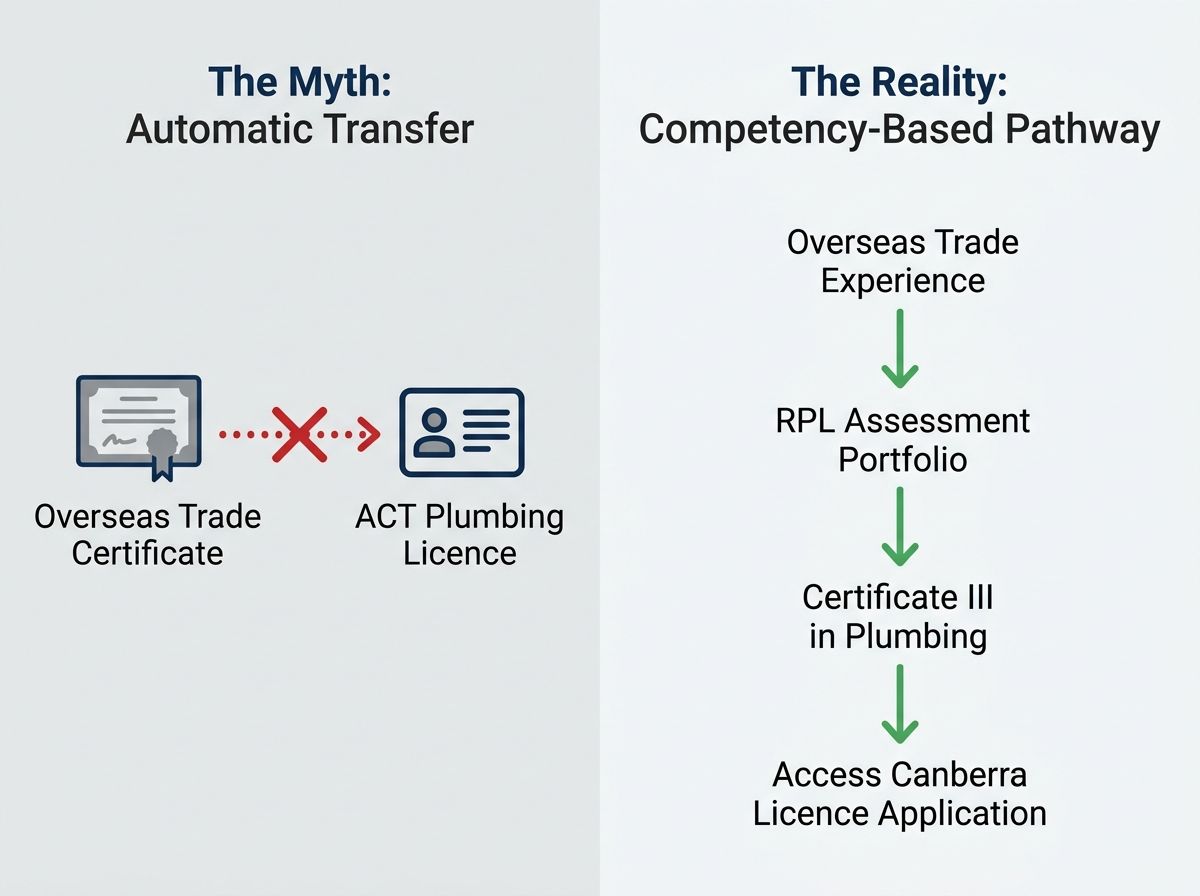
Mutual recognition in Australia is a process that allows someone who already holds a licence in one Australian state, territory, or New Zealand to apply for an equivalent licence elsewhere. It is not available to overseas-trained plumbers who do not yet hold an Australian licence.
The Queensland Building and Construction Commission, for example, explicitly separates interstate and New Zealand applicants — who can use mutual recognition — from overseas applicants, who must follow a different process entirely.
Trades Recognition Australia (TRA) is the government body that provides skills assessments for people with trade skills gained overseas, primarily for migration purposes. A positive TRA assessment can support a visa application — but it does not grant an ACT plumbing licence. State and territory licensing bodies impose their own requirements, and a TRA assessment is only one step in a longer process.
TRA is an authorised assessing authority under the Migration Regulations 1994, operating programs including the Offshore Skills Assessment Program and the Job Ready Program — but its scope is skills assessment for migration, not trade licensing.
The ACT plumbing trade licence is issued by the Construction Occupations Registrar of Access Canberra. The qualification pathway that underpins it is the Certificate III in Plumbing (CPC32420). RPL assesses demonstrated competency against the units of that qualification — not credential origin. Your overseas qualification is useful evidence that competency exists. It is not, by itself, the same as demonstrated competency in the Australian framework.
For a deeper look at why a formal overseas qualification can sometimes complicate the pathway rather than simplify it, this article explains the distinction between credential equivalence and competency assessment.
Myth 2: 'RPL Is Only for People Who Never Studied'
Your overseas qualification is evidence, not a disqualifier. Many overseas-trained plumbers assume that RPL is a consolation pathway — something designed for people who learned entirely on the job without any formal study. If you hold a trade certificate or diploma from your home country, this assumption can lead you to believe RPL is not for you, and that you should be pursuing a different route.
This is wrong. RPL is the primary recognition pathway for people with existing expertise — including people who hold overseas formal qualifications. The assessment measures whether you can demonstrate competency against specific units of the Certificate III in Plumbing. Your overseas qualification is one form of evidence that you have developed that competency. It does not disqualify you from the RPL pathway; it supports your case.
The confusion arises partly because RPL is often marketed to people without any formal study background, which can make it appear to be a pathway of last resort. It is not. It is a rigorous, evidence-based assessment process that is used regularly by skilled migrants and by people who hold qualifications from other countries or industries.
The Department of Employment and Workplace Relations describes Trades Recognition Australia as a skills assessment service provider specialising in assessments for people with trade skills gained overseas or in Australia — explicitly including those with overseas qualifications, not only those without formal study.
Skills Recognition (RPL) is available for the Certificate III in Plumbing at registered training organisations in the ACT. Your overseas qualification, work records, employer references, and documented experience all form part of the evidence portfolio that an assessor will evaluate.
Myth 3: 'I Will Have to Go to TAFE and Re-Do Everything'
The fear of being sent back to a classroom to repeat years of training is the myth that most often causes overseas plumbers to delay or abandon the licensing pathway entirely. It is an understandable fear. If you have ten years of plumbing experience, the idea of sitting through units covering material you have been applying on site for a decade is not just frustrating — it is financially and practically impossible for most people.
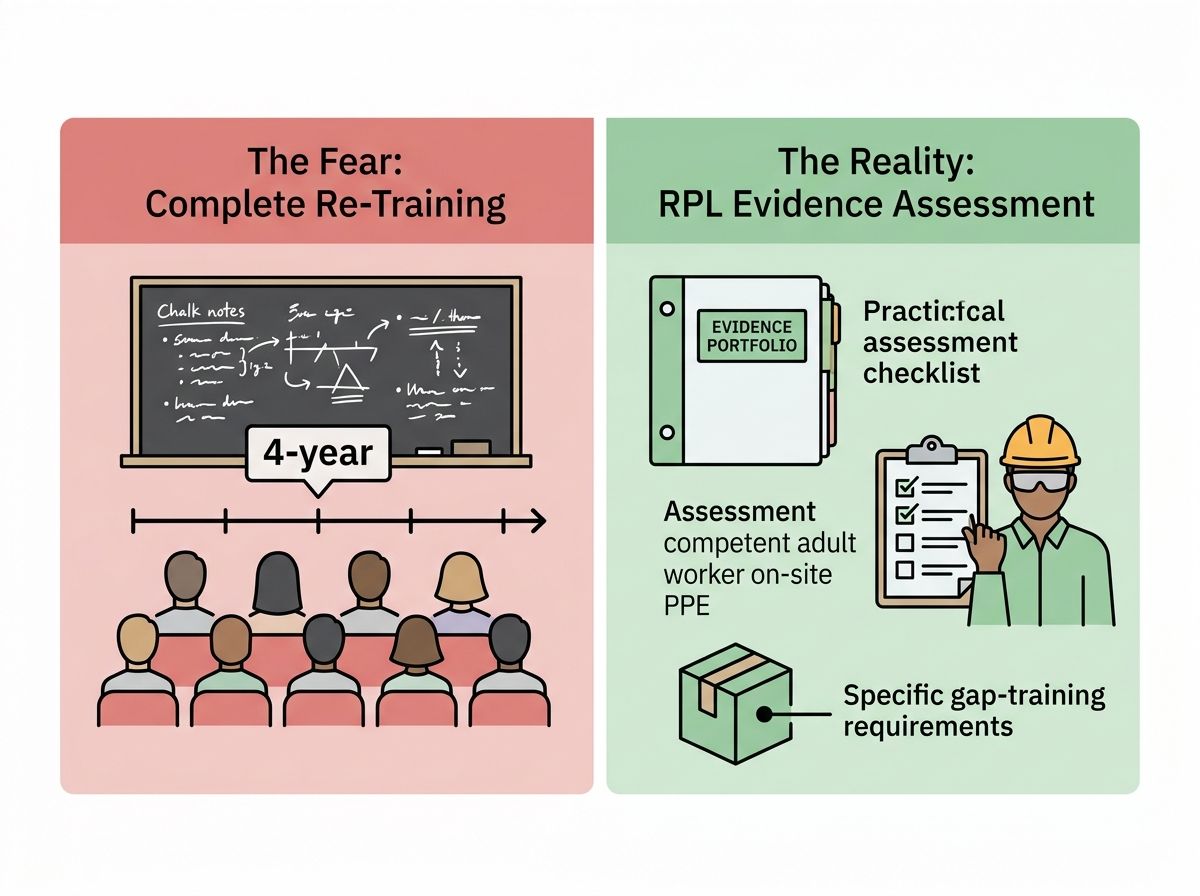
RPL is assessment, not training. You are not going back to TAFE to re-learn what you already know. The process measures whether you can demonstrate competency against specific units of the Certificate III in Plumbing, using evidence drawn from your existing experience. Recognition, not repetition.
What does that evidence typically look like? RPL assessment for the Certificate III in Plumbing (CPC32420) may include a structured interview, a portfolio of work evidence, practical observation or demonstration, and written assessments. Evidence commonly includes a detailed resume, photographs or videos of completed work, statutory declarations, work samples such as job specifications or invoices, and third-party reports from supervisors or employers.
It is important to be honest about one aspect of this process: gap training may be required. If there are specific units of competency that your evidence does not adequately cover — gas fitting, backflow prevention, on-site wastewater management, and similar specialist areas are commonly identified — targeted training in those areas may be needed before the full qualification can be awarded.
This is not the same as repeating the entire qualification. Gap training is targeted. It addresses specific competency gaps, not the full scope of what you already know. The RPL pathway is structured to assess what you have, identify what is missing, and address only that — not to make you start from scratch.
Indicative timeframes for RPL vary by provider. One registered training organisation lists a typical RPL duration of around three months, compared to twelve months for the full training and assessment pathway.
For a direct comparison of the RPL pathway against the apprenticeship route — and why re-doing an apprenticeship is not the right answer for experienced plumbers — this article covers the practical and financial case clearly.
What RPL actually assesses — and why your experience is the point
Having corrected the three myths, here is what the pathway actually involves. The ACT plumbing trade licence is issued by the Construction Occupations Registrar of Access Canberra. The qualification that underpins it is the Certificate III in Plumbing (CPC32420). According to the Canberra Institute of Technology, on successful completion of this qualification, graduates may apply for a Plumbers licence (Journeyperson) in the ACT.
RPL for this qualification is conducted by a registered training organisation (RTO). The RTO's assessors evaluate your evidence against the competency standards for each unit. They determine whether your existing experience demonstrates the required competency. If gaps are identified, targeted gap training is provided. The RTO issues the qualification. Access Canberra issues the licence. RPL it guides you through the process — we do not conduct assessments or issue qualifications.
Your years of overseas plumbing experience are not a problem to be overcome. They are the primary source of evidence. The assessment is designed to see what you already know — not to test whether you have studied a particular course in a particular country.
The Western Australian Government's mutual recognition guidance illustrates the broader principle clearly: the Australian licensing system is built around demonstrated competency and recognised qualifications, not credential origin — which is precisely why RPL exists as a pathway for experienced workers.
The ACT plumbing licence page: where to start if you now understand what RPL is
Reading this article is not the same as knowing whether RPL is suitable for your specific situation. Every plumber's experience is different. The units you can demonstrate, the evidence you have available, and the specific requirements of the ACT licensing framework all affect what the pathway looks like for you.
The ACT Plumbing trade licence page is the starting point for people who now understand what RPL actually is and want to understand whether their experience maps to the pathway.
Visit the ACT Plumbing trade licence page to understand the specific pathway for your situation.
The decision is yours. If the three myths in this article were part of what was holding you back, you now have a clearer picture of what the pathway actually involves. Your skills speak. The next step is finding out whether they can be heard.
Ready to Get Recognised?
Start with a free skills review to find out if RPL is right for you.