Why your overseas plumbing qualification might work against you in the ACT
An overseas plumbing qualification can lead to the wrong ACT licensing pathway. Here is why RPL via Certificate III in Plumbing is often a better route.

You have years of plumbing experience and hold a formal qualification from your home country. You arrived in Australia expecting that credential to open doors, but instead you are stuck in a process that feels designed for someone else's situation. If that sounds familiar, you are not alone. The reason for this delay is structural rather than personal.
The assumption that sends skilled plumbers down the wrong path
The assumption is logical: you have a formal plumbing qualification, so it should help you get licensed in Australia. Migration agents, settlement workers, and online forums often reinforce this by pointing overseas-trained plumbers toward mutual recognition or skills assessments. These pathways exist, and they do work for some people. But for many overseas-trained plumbers seeking an ACT plumbing trade licence, they are the wrong starting point. Pursuing them can cost months of time and significant frustration before the mismatch becomes clear.
The problem is not your qualification itself. The issue is that the ACT licensing framework does not evaluate your overseas credential the way you might expect. Understanding how the framework actually works changes how you should approach your licensing pathway from the start.
How the ACT plumbing licensing framework works
To obtain an ACT plumbing trade licence, you must hold an Australian qualification, specifically the Certificate III in Plumbing (CPC32420). This licence is issued by the Construction Occupations Registrar of Access Canberra, which is the ACT Government's licensing authority.
The key point is that the ACT licensing system does not compare your overseas qualification to an Australian standard to decide whether they are equivalent. Instead, it requires evidence that you hold, or can demonstrate competency against, the specific units of competency that make up CPC32420. These units cover Australian plumbing practice, including water supply, sanitary and drainage systems, gas services, roof plumbing, and compliance with Australian standards. The entire framework is built around demonstrated competency, not credential equivalence.
This is a structural difference, not a bureaucratic technicality. Your overseas qualification may represent genuine, deep expertise, but it was assessed against a different set of standards in a different regulatory environment. The ACT system has no mechanism to simply accept it as equivalent, because equivalence is not what the licensing system is designed to assess.
It is also worth noting that for certain ACT licence classes, including the journeyperson plumber, drainer, and gas fitter licence, the roofing stream of CPC32420 is a specific, mandatory requirement. This is an ACT licensing condition that applies regardless of how you obtain the qualification.
Why mutual recognition and skills assessments often fail overseas plumbers
Mutual recognition applies between Australian states and territories, not to international qualifications. If you hold a plumbing licence from Queensland, mutual recognition allows you to work in the ACT without repeating the licensing process. If your plumbing licence was issued in the Philippines, the United Kingdom, or another country outside Australia, mutual recognition does not apply. Your overseas licence is outside the scope of this system.
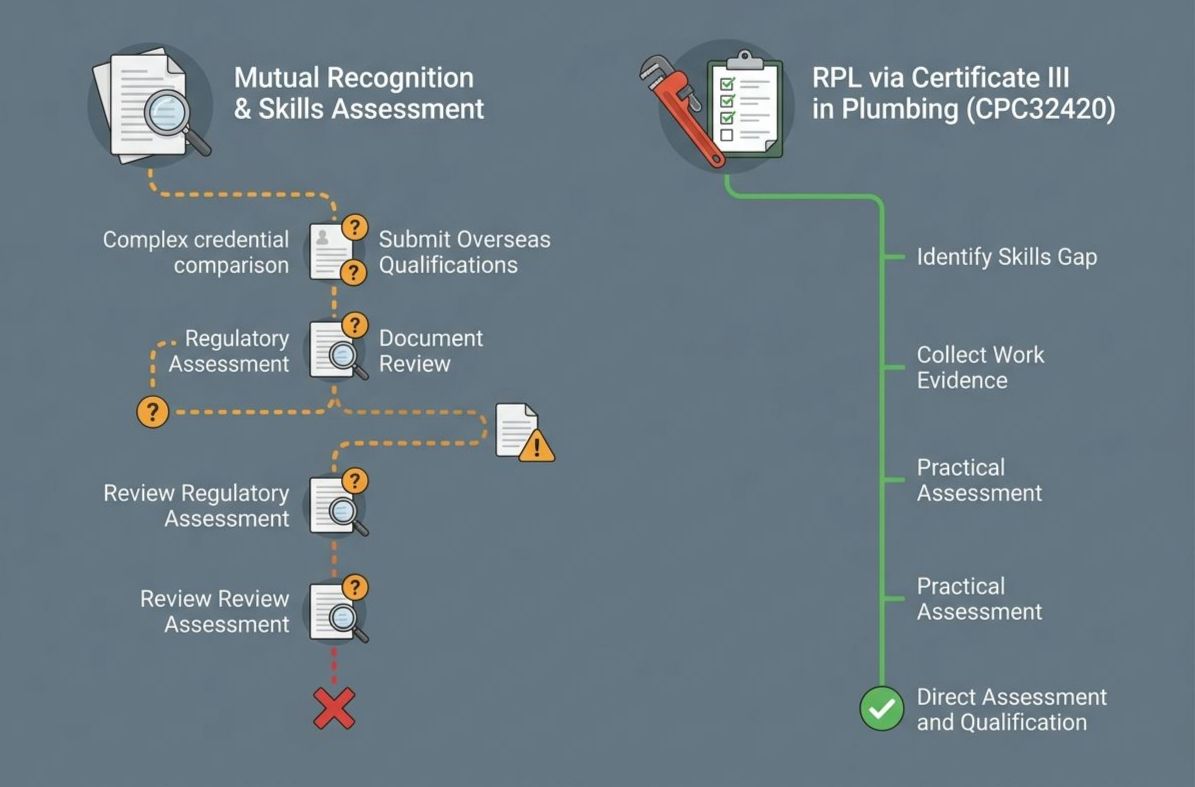
A skills assessment is a different pathway, and it does apply to overseas-trained tradespeople. Trades Recognition Australia (TRA) is the relevant body for overseas plumbers seeking trade recognition in Australia. TRA assesses whether your overseas training and experience align with Australian trade standards. However, the TRA assessment is a comparison of credential structures rather than a direct practical test of competency. When your overseas qualification maps cleanly onto Australian standards, the process works. When it does not, as is common for many overseas plumbing qualifications, the assessment may result in a partial outcome, a requirement for further training, or a lengthy process that does not deliver the ACT licence you need.
Trades Recognition Australia outlines the plumbing assessment pathway on its website, including the assessment criteria and the process for overseas-trained tradespeople.
The deeper issue is that both mutual recognition and skills assessments are designed to compare credentials on paper. Neither is designed to assess what you can actually do on the tools. If your practical competency is real but your qualification does not map neatly onto Australian standards, these pathways may not serve you well, regardless of your actual experience.
The real benefit: RPL assesses what you know, not where you learned it
Recognition of Prior Learning (RPL) for the Certificate III in Plumbing (CPC32420) takes a different approach. RPL does not compare your international qualification to an Australian standard. Instead, it measures whether you can demonstrate competency against specific Australian units, regardless of where or how you learned the trade.
Your overseas qualification is useful evidence in an RPL portfolio. Other key evidence includes your employment history, references from supervisors and colleagues, photos and videos of your work, and in some cases a practical skills demonstration. The assessor, a qualified professional from a registered training organisation (RTO), is evaluating what you know and what you can actually do, not where your certificate was issued.
This is why experienced, overseas-trained plumbers who go straight to RPL often find the process better suited to their situation than those who try credential-based pathways first. The pathway is not easier; RPL involves genuine assessment and the assessor's judgement is independent. But it is designed to recognise real, practical competency, wherever it was developed.
RPL for CPC32420 is available through registered RTOs across Australia. Evidence requirements vary by provider, but typically include proof of identity, a White Card, referee statements confirming your relevant experience, and direct documentation of your work, such as photos, videos, or a portfolio. Some providers also include a practical skills demonstration as part of the assessment process.
What this means for your ACT plumbing licence application
The most direct route for an overseas-trained plumber seeking an ACT plumbing trade licence is usually RPL for the Certificate III in Plumbing (CPC32420), followed by a licence application to the Construction Occupations Registrar of Access Canberra.
Your overseas qualification acts as evidence in your RPL portfolio; it does not directly secure your licence. The credential that qualifies you is the Australian Certificate III issued after a successful RPL assessment. Understanding this distinction is important because it determines which pathway you pursue from the outset and how you present your experience.
If you are ready to explore the ACT plumbing trade licence pathway, the RPL it ACT plumbing page outlines exactly what is involved and how to take the next step.
The national register at training.gov.au confirms that CPC32420 Certificate III in Plumbing is a current qualification and notes that licensing requirements vary by state and territory. This is why checking with Access Canberra directly is always the right step for ACT-specific requirements.
Is RPL the right pathway for you?
RPL is not suitable for everyone. It requires genuine, demonstrable competency across the units of the Certificate III in Plumbing. If your overseas experience is deep and recent, RPL is likely a strong fit. If there are gaps, particularly in areas covered by Australian plumbing standards that differ from your home country's regulatory environment, gap training may be required as part of the process.
The Certificate III in Plumbing covers a broad range of areas: water supply systems, sanitary and drainage, gas services, roof plumbing, and compliance with Australian standards including AS/NZS 3500 and AS/NZS 5601. Where an RPL assessment identifies that your prior learning does not fully cover a particular unit, gap training addresses that shortfall. This is a normal part of the RPL process, not a failure, and is typically provided as part of the overall pathway.
Non-apprenticeship pathways for CPC32420, including RPL followed by gap training where needed, are a recognised route to the qualification. The practical first step is finding out whether your specific experience and background make RPL a strong fit for your situation before you commit to any pathway.
TAFE NSW's course information for CPC32420 confirms that non-apprenticeship pathways including RPL and gap training are available for this qualification, providing a useful reference point for understanding how the pathway is structured.
You have the hands-on experience. The question is whether RPL is the best method to document it. A Free Skills Review is designed to answer that question.
Ready to Get Recognised?
Start with a free skills review to find out if RPL is right for you.