I Was Laying Bricks for Seven Years Before Anyone Asked to See My Certificate
Seven years on the tools. Then a tender document changed everything. If you've been laying bricks without a Cert III, this is the moment you'll recognise.
The Day the Tender Document Changed Everything
The form arrived on a Tuesday.
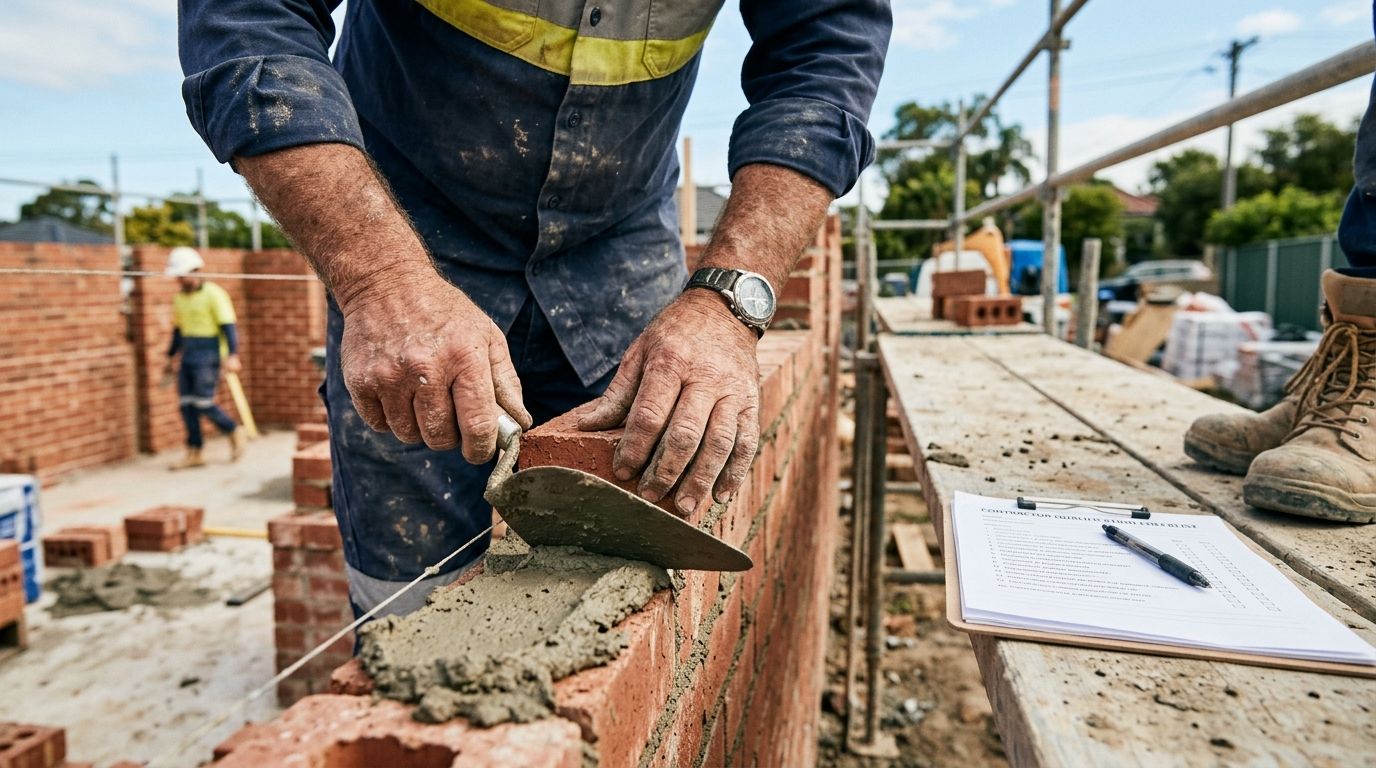
It was a subcontractor qualification checklist — the kind that comes through before a larger commercial job. I'd filled out dozens of them. Insurance details, ABN, public liability. Standard stuff. Then I hit a line I hadn't seen before, or at least hadn't noticed: 'Proof of trade qualification — Certificate III in Bricklaying and Blocklaying or equivalent.' The site manager was apologetic when I called. He'd worked with me before. He knew what I could do. But the head contractor had a compliance requirement, and the form was the form.
Seven years. Residential builds, commercial projects, heritage restoration work. I'd trained under a bloke who'd been laying bricks for thirty years. I'd taught apprentices myself. I knew mortar ratios, bond patterns, cavity wall construction, structural brickwork. I knew it in my hands. And none of that — not a single day of it — appeared anywhere on that form.
That was the moment I understood that the system and I were speaking different languages.
Seven Years of Work, Invisible in an Instant
I want to be clear about something: I'm not complaining about the site manager. He was right to follow the process. And I'm not saying the qualification requirement is wrong. What I'm describing is a structural gap — the distance between how competence is built and how it is formally recognised.
In Australia's construction industry, the workforce has grown substantially over recent decades, yet apprentice enrolments have not kept pace. That gap has to be filled somehow — and it is filled by people like me. Experienced workers who learned on the job, who developed real skill through real work, but who never sat in a classroom to get the paper that says so.
According to the Australian Bureau of Statistics, the construction industry employs around 1.3 million people, with construction services — trades and subcontracting — making up a significant share of that workforce.
The work is real. The skill is real. But in a formal system, invisible expertise is no expertise at all. The tender document didn't question my ability. It questioned my evidence. Those are two very different things — and for years, I hadn't understood the distinction.
What the System Was Actually Asking For
Once I got past the frustration, I started asking a different question. Not 'why does the system work this way?' but 'what is the system actually asking for?'
The answer, it turns out, is specific. The Certificate III in Bricklaying and Blocklaying — qualification code CPC33020 — is a nationally recognised vocational qualification. According to the official training package, it requires completion of 28 units of competency: 20 core units and 8 elective units. There are no formal entry requirements.
The core units cover the full range of what a competent bricklayer actually does: work health and safety, setting out and constructing brick and block walls, veneer and cavity construction, arches, curved work, structural brickwork systems, scaffolding, working at heights, reading plans, and communicating on site. The elective units allow for specialisation — traditional and heritage bricklaying, refractory work, or paving.
The qualification structure and packaging rules for CPC33020 are published on the national training register at training.gov.au.
When I read through the competency descriptions, I recognised every single one. Not because I'd studied them — because I'd been doing them. For seven years. The system wasn't asking me to learn something new. It was asking me to demonstrate, in a format it could read, what I already knew.
Experience is not less than education. It is a different form of evidence.
Recognition of Prior Learning: Not Starting Over — Getting Credit
Recognition of Prior Learning — RPL — is an assessment pathway within Australia's national vocational education and training system. It allows a registered training organisation (RTO) to assess whether a person's existing skills and knowledge meet the requirements of a qualification, without requiring them to complete the full training program.
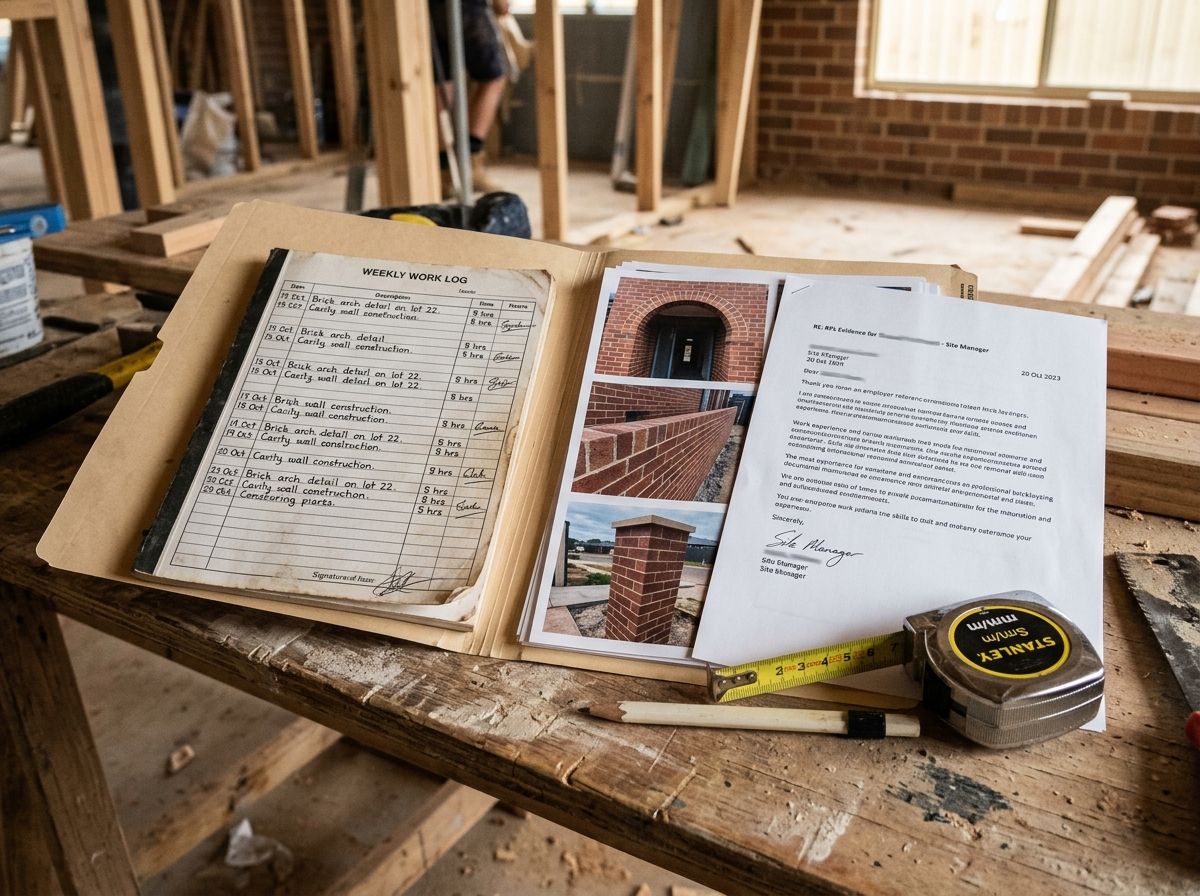
That's the formal definition. Here's what it means in practice: instead of sitting through units you already know, you gather evidence that demonstrates you already know them. The evidence is real — it takes work to compile — but it draws on what you've already done, not what you're about to learn.
For a bricklayer with years of on-site experience, that evidence typically includes things like: third-party reports from supervisors or employers, photographs of completed work, job records and logbooks, employer declarations, and structured interviews with a qualified assessor. The assessor's job is to determine whether your evidence demonstrates competency against the units of the qualification.
It's worth being honest about what RPL is not. It is not a rubber stamp. It is a genuine assessment process, and the outcome depends on the evidence you can provide. In some cases, an assessor may identify gaps — areas where additional training or assessment is needed before the qualification can be issued. That's part of the process, not a failure of it.
RPL is available for CPC33020 through registered training organisations. Darwin Institute of Trade, for example, explicitly states that RPL is offered to all students enrolling in the Certificate III in Bricklaying and Blocklaying, and recommends it for those with at least two years of relevant work experience.
The qualification, once issued by a registered RTO, is nationally recognised. It carries the same standing as a qualification earned through a traditional apprenticeship — because the assessment standard is the same. The pathway is different. The destination is not.
For a detailed look at what the RPL assessment process actually involves for bricklayers, including what evidence is typically gathered and how the process works in practice, see our guide for those considering this pathway.
The Moment I Understood What the Certificate Was Actually For
I went back to that tender form in my head a few times after I learned about RPL.
The site manager wasn't questioning whether I could lay bricks. He knew I could. The head contractor's compliance team wasn't questioning it either — they'd never met me. What they needed was a document that translated seven years of on-site competence into a format their system could process. A certificate isn't proof of skill. It's proof that skill has been formally assessed.
I didn't need to learn how to lay bricks. I needed to learn how to show what I already knew.
That reframe changed how I thought about the whole situation. The system wasn't broken. It just didn't have a way to see me — until I gave it one. Recognition shouldn't require starting over. And for experienced bricklayers, it doesn't have to.
If You've Been Laying Bricks Without a Certificate — This Is What to Do Next
If you recognised yourself in this, the Certificate III in Bricklaying and Blocklaying through RPL is the pathway worth understanding. It's not a training program for people who don't know the trade. It's a recognition process for people who do.
The first step — before any commitment — is finding out whether your experience is likely to support an RPL application. That's what the Free Skills Review is for. It's a no-obligation conversation about your background and whether this pathway makes sense for your situation. Honest guidance, before you decide anything.
The decision is yours.
Ready to Get Recognised?
Start with a free skills review to find out if RPL is right for you.