Cert III Bricklaying: What Career Changers Actually Need to Know (No Apprenticeship Required)
Thinking about a career change into bricklaying? The Cert III doesn't require an apprenticeship. Here's what RPL covers, which skills transfer, and what evidence you'll need.

The apprenticeship assumption — and why it's wrong
Most people researching Cert III bricklaying assume the only path is a multi-year apprenticeship. That's understandable — the trades system has historically worked that way. But it is not the only path, and for career changers with hands-on experience from other industries, it may not be the right one at all.
The Certificate III in Bricklaying and Blocklaying (CPC33020) can be obtained through Recognition of Prior Learning — RPL. RPL is a nationally recognised assessment pathway under the Australian Qualifications Framework. It assesses what you can demonstrate, not how or where you learned it. The qualification you receive is the same. The assessment is rigorous. The difference is that RPL starts with your existing competence rather than assuming you have none.
If you have spent years working in a hands-on industry — hospitality, landscaping, manufacturing, or any field that required physical precision, working to specifications, or operating on construction-adjacent sites — you may already hold more relevant competency than you realise. The question is whether that competency can be documented and assessed.
What the Certificate III in Bricklaying and Blocklaying actually covers
Before you can judge whether your experience is likely to count, you need to understand what the qualification actually assesses. The Certificate III in Bricklaying and Blocklaying (CPC33020) is a nationally recognised qualification that covers the core competencies of the trade.
Those competencies broadly include: reading and interpreting construction drawings and specifications; laying bricks, blocks, and masonry materials to plan; working safely on construction sites in compliance with work health and safety requirements; understanding materials, mortar mixes, and structural requirements; and applying finishing techniques to masonry work. The qualification also covers communication and documentation requirements typical of a construction site environment.
For a career changer, the key framing is this: RPL does not ask whether you have done bricklaying. It asks whether you can demonstrate competency against each unit. Some of those units may align closely with skills you already have. Others may require gap training — and that is a normal, expected part of the RPL process, not a failure.
For more on the qualification itself and how RPL applies to it, see the
Which industries produce transferable skills — and why
RPL assesses competency regardless of how or where it was developed. That is a foundational principle of the Australian Qualifications Framework. What matters is whether you can demonstrate the required skills — not whether you learned them in a bricklaying context specifically.
Career changers from certain industries are often better positioned than they expect. Here is why specific backgrounds may be relevant:
- Landscaping and horticulture: Working to site plans and specifications, physical precision with materials, outdoor site safety awareness, and experience with ground preparation and structural elements are all competencies that may map to bricklaying units. If you have held a White Card (general construction induction), that is also potentially relevant evidence — though whether it satisfies specific safety units within CPC33020 should be confirmed with an assessor.
- Hospitality and food service: Physical stamina, precision under time pressure, working to exacting standards, and managing materials and equipment are transferable in principle. The overlap is less direct than landscaping, but years of professional discipline in a demanding physical environment is not irrelevant — it speaks to the broader competency profile an assessor considers.
- Manufacturing and production: Reading specifications and technical drawings, quality control, compliance with safety procedures, and working with materials to precise tolerances are skills that can translate meaningfully. If your manufacturing role involved construction-adjacent environments or materials, the overlap may be more direct.
- Other construction trades: If you have worked in tiling, concreting, plastering, or any trade that involved site work, reading plans, or working with masonry-adjacent materials, your transferable evidence base is likely to be substantial.
The honest caveat: transferability is not automatic. The question is whether your specific experience, in your specific role, produced competency that maps to specific units in CPC33020. That mapping is what an RPL assessor evaluates. Claiming general transferability without that specificity is not enough — which is why the evidence-gathering process matters.
may help clarify the framing.
What evidence do you actually need to gather?
RPL assessment is evidence-based. Before you begin the formal process, it helps to understand what types of evidence are typically accepted and to start gathering what you already have. The stronger and more specific your evidence, the more clearly an assessor can evaluate your competency against each unit.
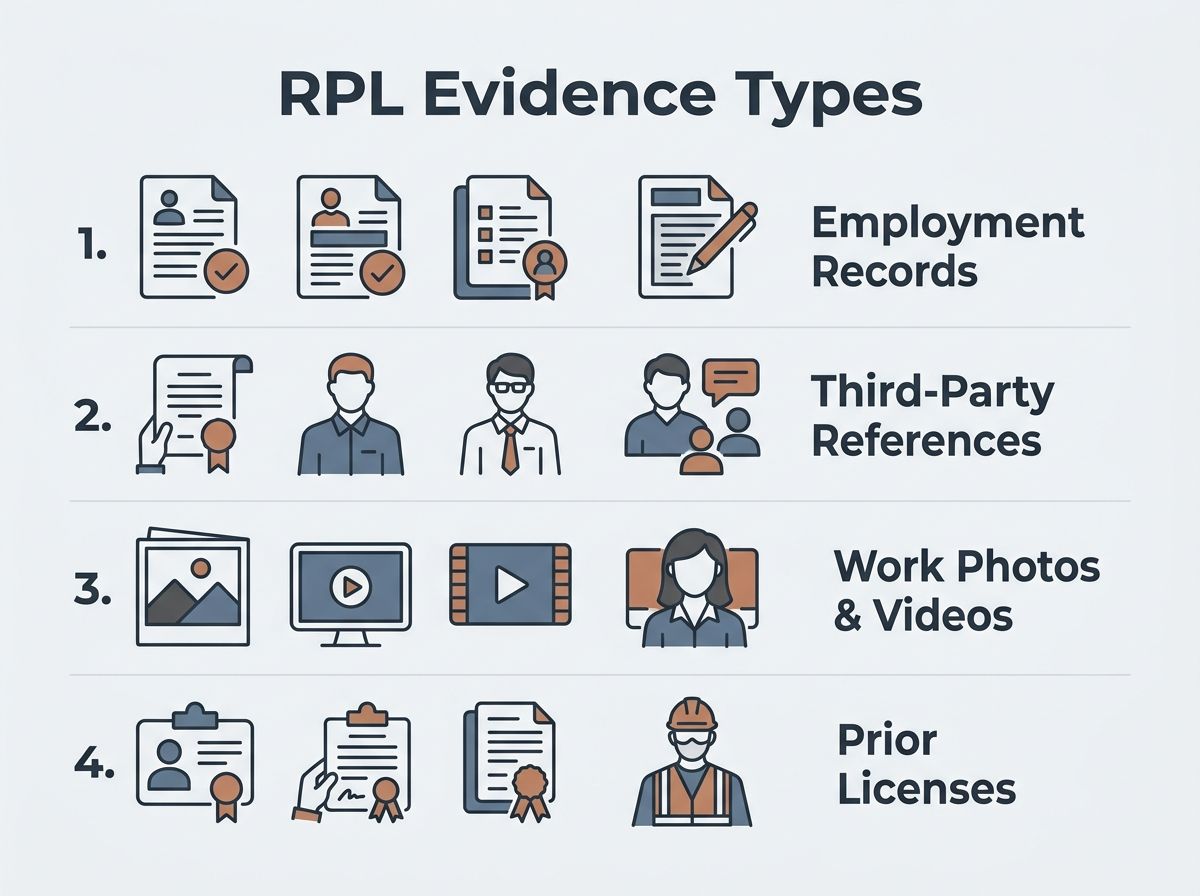
Common evidence types for an RPL application include:
- Employment records: Payslips, contracts, or letters of employment that confirm your role, duration, and responsibilities. These establish the context for your claimed experience.
- Third-party reports or references: Written statements from supervisors, site managers, or clients who can speak to your competency in specific tasks. The more specific these are to the skills being assessed, the more useful they are.
- Work samples and photographs: Photos of completed work, project documentation, or records of specific tasks you have performed. For construction-adjacent roles, site photos or project records can be particularly valuable.
- Prior certificates and licences: Any formal training you have completed — including safety inductions, trade-specific tickets, or short courses — may be relevant as supporting evidence.
- Statutory declarations: A formal written statement, signed before a justice of the peace, attesting to your experience. These are used when other documentary evidence is limited.
- Logbooks or work diaries: If you have kept records of tasks performed, materials used, or projects completed, these can serve as contemporaneous evidence of your competency.
One important consideration for career changers: some units within CPC33020 may require practical demonstration rather than documentary evidence alone. This is particularly likely for units that involve hands-on masonry skills where an assessor needs to observe you working. If practical demonstration is required for units where you have no direct bricklaying experience, gap training would typically be arranged to address those gaps. This is not unusual — it is a standard part of the RPL process.
The honest part: what RPL can and can't do for career changers
RPL is not a shortcut. It is a rigorous assessment pathway that requires you to demonstrate genuine competency against each unit of the qualification. For career changers, that means some units may be fully assessable through your existing experience and evidence — and others may not be, because the competency genuinely has not been developed yet.
Where gaps are identified, gap training is the standard response. It addresses the specific units where your evidence is insufficient or where practical demonstration is required. It does not mean starting the qualification from scratch — it means filling the specific gaps that exist. For career changers with strong transferable backgrounds, the gap training component may be relatively limited. For those with less direct overlap, it may be more substantial. An honest assessment of your specific situation is the only way to know.
The timeline for RPL assessment varies depending on the RTO delivering the qualification, the quality and completeness of your evidence, and whether gap training is required. It is not possible to give a reliable timeframe without knowing your specific situation — and any provider who promises a specific outcome or timeline before reviewing your evidence is not giving you honest guidance.
For experienced bricklayers navigating the same qualification wall from a different angle, the article on
why experienced bricklayers without formal credentials face a similar recognition problem
covers the same territory from a different starting point.
How to start: the practical next step for career changers
The first step is not gathering evidence or enrolling in anything. It is finding out whether your specific background is likely to be recognised against the units of CPC33020. That is what a Free Skills Review is for.
A Free Skills Review gives you an honest picture of your suitability before you invest time or money in the process. If RPL is the right pathway for you, you will be guided through the evidence-gathering process with support. If it is not — or if significant gap training would be required — you will know that too, and you can make an informed decision about whether to proceed.
For a fuller picture of what the career change into bricklaying actually looks like from the inside, the article on
what the career change into bricklaying actually looks like from the inside
is worth reading alongside this one. And when you are ready to find out where your experience stands, the qualification page is the right place to start.
Ready to Get Recognised?
Start with a free skills review to find out if RPL is right for you.