The Skills Assessment Letter: The Moment Every Overseas Plumber Discovers Australian Licences Work Differently
The form has no field for overseas credentials. The employer apologises. The visa requires Australian recognition. Here's what this moment means — and what to do next.
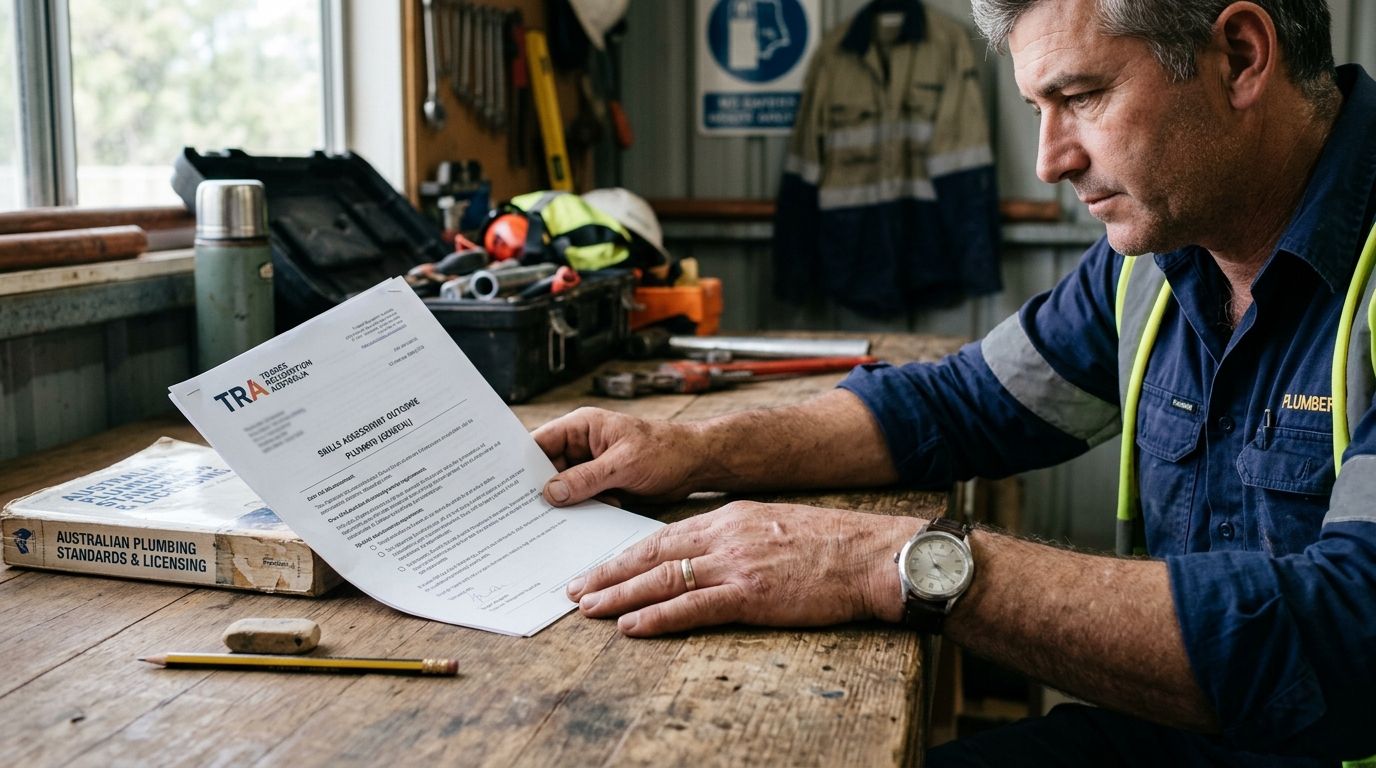
The letter arrives — and nothing makes sense
You have been a plumber for over a decade. Residential builds, commercial fit-outs, drainage systems, gas lines. Back home, your licence was current. Your work was respected. You knew what you were doing, and so did everyone around you.
Then the letter arrives. Or the visa form. Or the employer's apologetic phone call. And something shifts.
The skills assessment notification asks for evidence of Australian qualifications. The visa application has a field for your nominated occupation — Plumber (General) — and a requirement for a positive skills assessment from a recognised authority. The employer who wanted to hire you explains, carefully, that they cannot process your engagement without a valid local licence. They are sorry. They can see you know what you are doing. But the system does not yet see it.
This is the moment. Not a failure. Not a dead end. The specific, disorienting discovery that Australian plumbing licences work differently from what you assumed — and that the credential you carried across the world does not automatically translate.
Three moments when the system becomes visible
For most overseas-trained plumbers, the discovery does not happen all at once. It arrives in one of three specific moments — each a different version of the same realisation.
- The immigration skills assessment. Trades Recognition Australia (TRA) is the designated assessing authority for plumbers seeking Australian visa points. Plumbers are assessed under the Offshore Skills Assessment Program (OSAP) — not the standard Migration Skills Assessment pathway. The OSAP process requires specific evidence aligned to Australian standards. An overseas licence or qualification is not automatically sufficient.
- The visa application form. Certain skilled visa subclasses require a positive skills assessment as part of the points test. The form asks for Australian recognition. There is no field for overseas credentials. The gap becomes visible in the space where your qualification should fit — and does not.
- The employer conversation. A contractor, a builder, a site manager wants to bring you on. They have seen your work. They trust your competence. But they cannot engage you without a valid ACT plumbing licence. The law requires it. They apologise. You are qualified in every meaningful sense. The system does not yet have the paperwork to prove it.
Each of these moments is a different door into the same room. And the room has a way out.
This is not a failure. It is a design feature.
The Australian licensing system is built around Australian qualifications. It is not designed to be hostile to overseas workers. It is built around a different assumption — that the person applying for a licence has been assessed against Australian competency standards, in Australia, under the Australian Qualifications Framework.
You are not unqualified. You are qualified in a form the system does not yet recognise. That distinction matters enormously for what comes next.
Your overseas qualification is not worthless. It is evidence — real, meaningful evidence of training and experience. But it is not the same as demonstrated competency assessed against Australian standards. The system is not asking whether you can do the work. It already knows you can. It is asking whether your competency has been formally assessed in a way it can read.
That is the gap. And it is a gap with a specific, legitimate pathway through it.
Understanding why an overseas qualification is useful evidence but not the same as demonstrated competency is the key insight that changes how you approach the pathway.
What the ACT system is actually looking for
In the ACT, plumbing licences are issued by the Construction Occupations Registrar, administered through Access Canberra. To apply for a journeyperson plumber licence, an applicant must provide evidence of an approved Certificate III in Plumbing — including completion of the Water, Sanitary, and Roofing streams — along with practical experience.
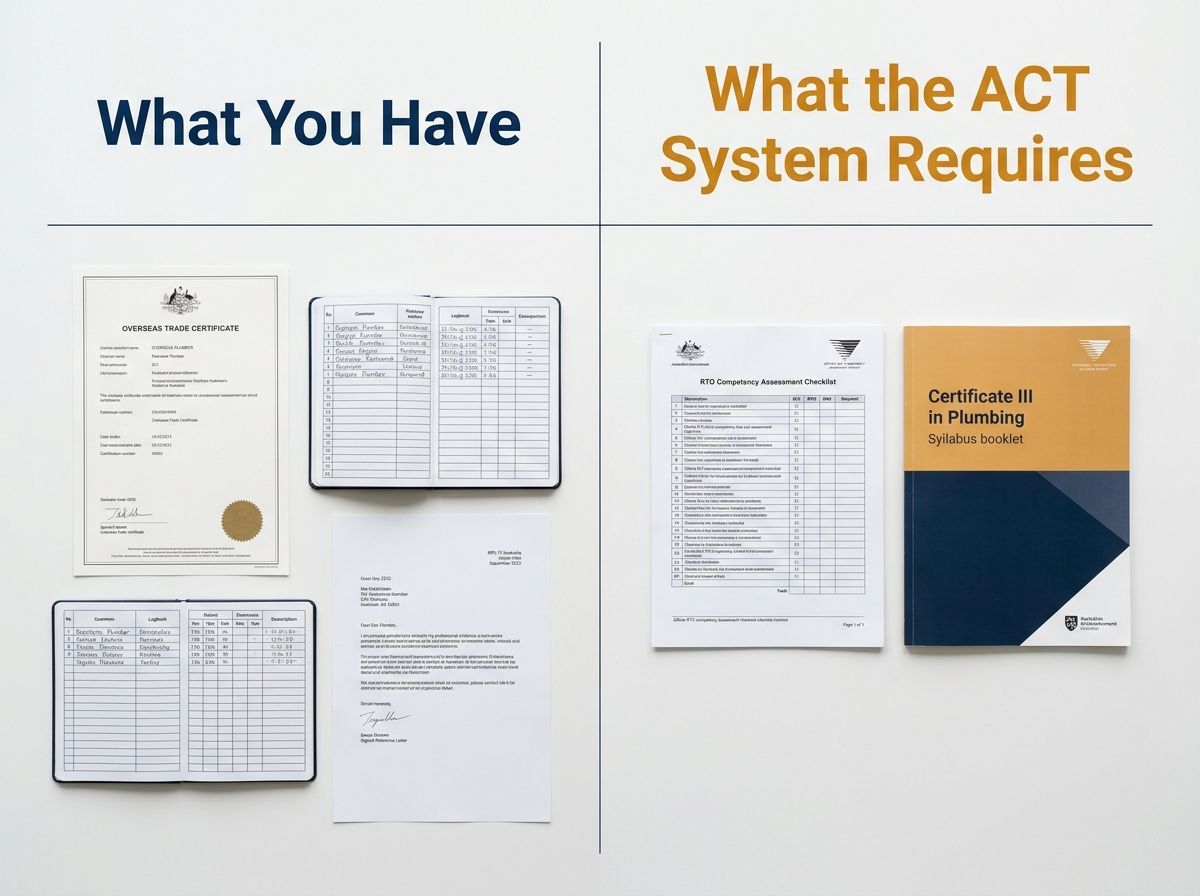
The application requires a training certificate and transcript from a registered training organisation. Access Canberra prioritises applications submitted promptly after the training certificate is received.
For visa purposes, Trades Recognition Australia (TRA) is the designated assessing authority for plumbers. Plumbers are assessed under the Offshore Skills Assessment Program (OSAP). TRA publishes specific evidence requirements for OSAP applications, which applicants should verify directly with TRA before applying.
The system is not asking whether you can do the work. It is asking for evidence that your competency has been assessed against Australian standards. That is the specific gap — and Recognition of Prior Learning (RPL) is the pathway designed to close it.
Understanding what the ACT plumbing licence process actually assesses — and why years on the tools is the whole point — changes how you approach the pathway.
This moment is also a decision point
The moment of realisation is not the end of the story. It is the beginning of a clear pathway.
Recognition of Prior Learning (RPL) is a formal assessment pathway under the Australian Qualifications Framework. It does not require you to re-train in skills you already have. It assesses your existing competency against the units of a qualification — using evidence drawn from your real work history: employment records, references from supervisors, documentation of completed projects, and your overseas qualifications as supporting evidence.
For overseas-trained plumbers in the ACT, the RPL pathway through an approved Certificate III in Plumbing is the recognised route to meeting the licensing requirement. It is not a shortcut. It requires genuine effort — gathering evidence, working with an assessor, demonstrating competency against Australian standards. But it is designed precisely for people in your situation: experienced, capable, and qualified in a form the system needs to see differently.
The construction industry in Australia is growing. Technicians and trades workers are among the occupation groups with the largest employment increases in recent years. The demand for qualified plumbers is real. The pathway to meet it exists.
According to Jobs and Skills Australia, the construction industry workforce is projected to grow from approximately 1.35 million in 2025 to over 1.5 million by 2035 — and overseas-trained tradespeople are part of that picture.
For overseas-trained plumbers specifically, Trades Recognition Australia (TRA) is the designated assessing authority for visa skills assessments, with plumbers assessed under the Offshore Skills Assessment Program.
In the ACT, plumbing licences are administered through Access Canberra's Construction Occupations Registrar, with specific qualification requirements set out in the licensing framework.
You were qualified before you arrived. The pathway exists to prove it.
You are not starting from zero. You are converting existing competency into a form the Australian system can recognise. Your skills are real. Your experience counts. The recognition pathway exists to demonstrate that — honestly, rigorously, and on your terms.
The decision is yours. The pathway is there.
Read more about why this pattern repeats — and how others have moved through it.
Explore the ACT Plumbing recognition pathway and what it involves.
Ready to Get Recognised?
Start with a free skills review to find out if RPL is right for you.