You're Not Just a Guard Anymore: Making the Shift to Strategic Security Risk
Already doing threat assessments and site audits? You may qualify for a Certificate IV in Security Risk Analysis through RPL. Here's what that looks like.

The job title that doesn't match the work
You have been doing this work for years. Walking a new site and identifying where the gaps are. Writing up incident patterns and briefing management on emerging threats. Assessing whether a venue's security posture is adequate for the crowd it expects. Recommending changes to access control, CCTV coverage, or staffing deployment based on your read of the risk environment.
The job title on your contract might say Security Officer, Supervisor, or Patrol Manager. But the work you have been doing — systematically identifying threats, assessing vulnerabilities, and advising on risk treatment — is the work of a security risk analyst. The credential gap is not about skill. It is about how the work has been labelled.
That gap matters. When a corporate security consultancy advertises a Security Risk Adviser role, or a government agency specifies a formal qualification for a risk-adjacent contract, the credential becomes the filter. Your decade of practical experience becomes invisible to the people making decisions — not because it lacks value, but because it lacks the formal recognition that makes it legible to hiring systems and procurement processes.
The Certificate IV in Security Risk Analysis (CPP41519) is the nationally recognised qualification that names what you already do. Recognition of Prior Learning — RPL — is the pathway that may allow your existing experience to be formally assessed against that qualification, without repeating work you have already done.
What the Certificate IV in Security Risk Analysis actually covers
The CPP41519 Certificate IV in Security Risk Analysis is a nationally recognised vocational qualification for security risk analysts who apply technical security and operational knowledge within a risk management framework. Training providers describe it as covering current threat environments, risk assessment methodology, and advising clients on protecting people, property, and electronic security systems.
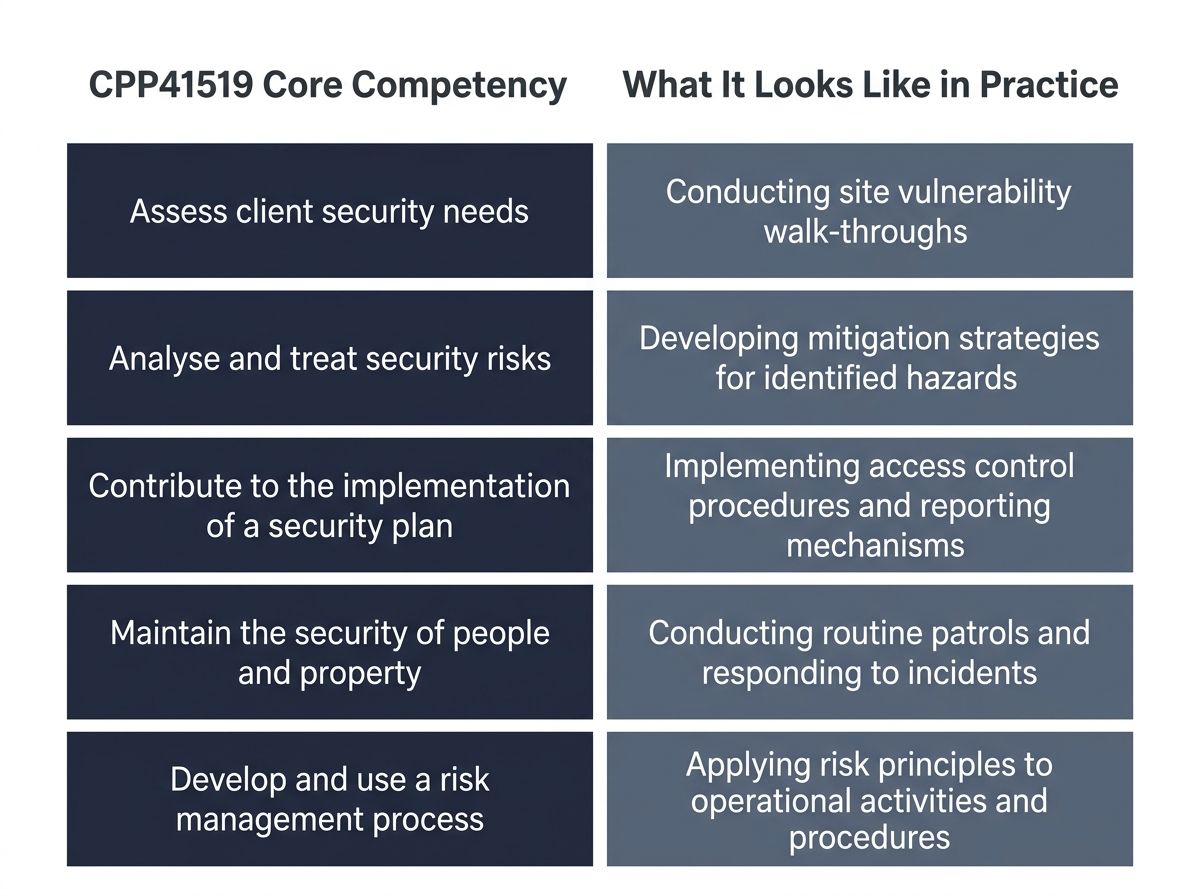
The qualification includes five core units. Based on provider descriptions — and pending verification against the official training.gov.au qualification page — those core units cover the following areas of competency:
- Assessing and advising on client security needs — understanding a client's operating environment and recommending appropriate security measures
- Conducting security risk assessments of client operations — the structured process of identifying threats, vulnerabilities, and consequences
- Identifying security threats and assessing their impact on client operations — threat intelligence and impact analysis
- Assessing the security vulnerabilities of assets — site surveys, access point analysis, and asset protection review
- Establishing and implementing ethics and governance arrangements for security businesses — professional standards and accountability frameworks
If you have been conducting site vulnerability walk-throughs, writing risk assessment reports, briefing clients or management on threat environments, or recommending security controls — these unit descriptions will feel familiar. That familiarity is worth paying attention to. It suggests your existing work may already map to the competency framework this qualification assesses.
The qualification also includes elective units, which allow learners to specialise. Providers describe two common elective streams: one focused on advanced technology security systems (such as interpreting electronic information from CCTV and access control systems), and another oriented toward security in crowded places. The elective structure means the qualification can reflect the specific environment you have been working in.
Note that unit counts and elective packaging rules vary slightly between providers, and the definitive structure should be confirmed on the national training register. What matters for this article is the substance of the competencies — and whether your work experience reflects them.
You can explore the qualification in more detail on the RPL it product page.
The work you've already done is the evidence
This is the core of the RPL proposition: the process does not ask you to learn new skills. It asks you to demonstrate that you already have them — through evidence drawn from your working life.
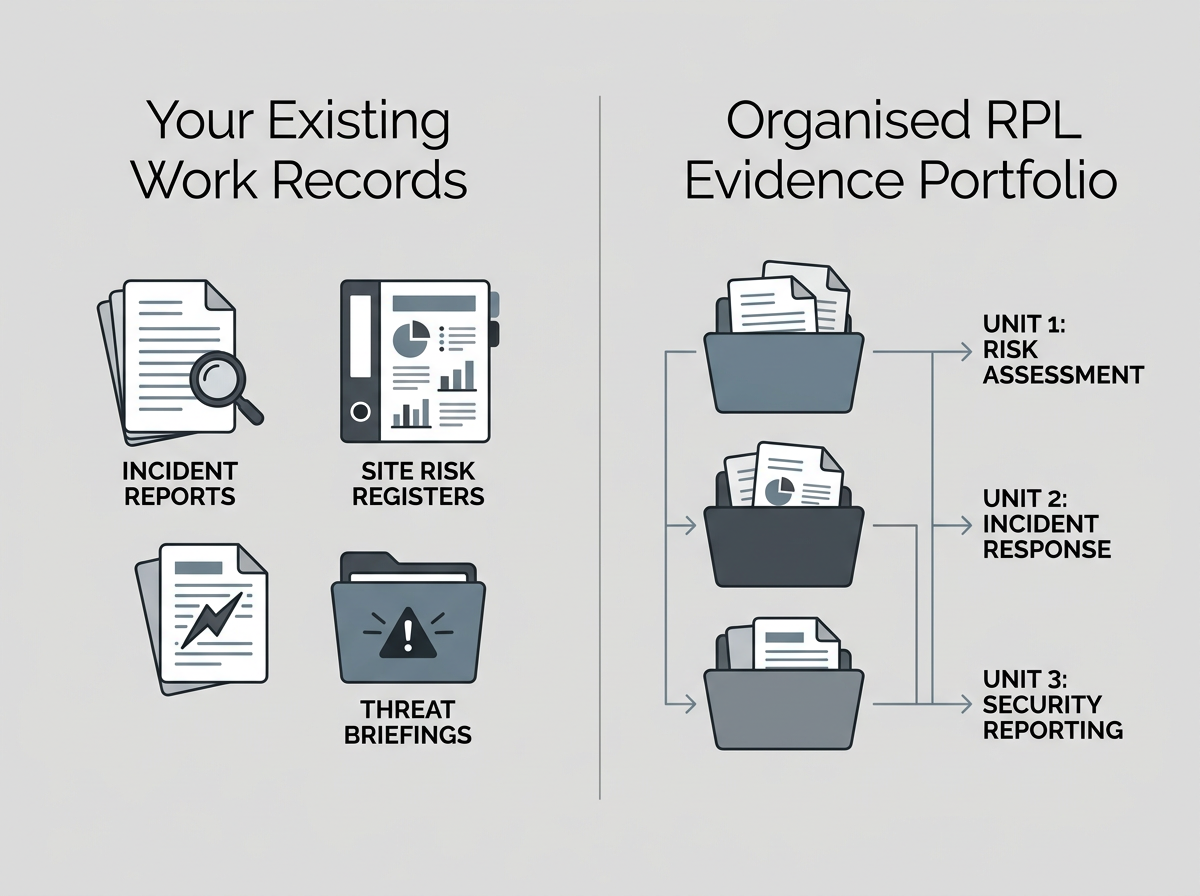
For security professionals, that evidence already exists. It is sitting in your files, your email history, your employer's records. The types of documentation that typically map to CPP41519 competencies include:
- Security risk assessment reports you have authored or contributed to
- Threat and vulnerability assessments prepared for clients or internal stakeholders
- Site survey reports documenting access points, CCTV coverage gaps, or perimeter vulnerabilities
- Incident reports that demonstrate your pattern analysis and risk identification process
- Risk registers or risk treatment plans you have developed or maintained
- Briefing documents or presentations delivered to management or clients on security risk
- Standard operating procedures you have written for security operations
- Third-party statements from supervisors, clients, or colleagues who can attest to your competency
RPL assessment at Certificate IV level requires evidence that is valid, sufficient, authentic, and current. A qualified assessor from a Registered Training Organisation (RTO) reviews your evidence against each unit's competency requirements and determines whether it meets the standard. This is a genuine assessment process — not a rubber stamp. If gaps are identified, gap training may be required, and this is typically provided at no additional cost through the delivering RTO.
The distinction that matters here is between having experience and presenting it as evidence. Years of security work are valuable — but they need to be organised, documented, and mapped to specific competencies before an assessor can recognise them. That is where guided support makes a difference.
Who this qualification is — and isn't — for
Honest suitability guidance matters here. RPL for CPP41519 is most likely to suit security professionals who have been performing risk analysis functions as a substantive part of their role — not those whose work has been primarily access control, patrol, or crowd management without a risk assessment component.
The qualification is designed for security risk analysts who apply technical security and operational knowledge within a risk management framework. If your work has involved assessing threats, identifying vulnerabilities, advising on security controls, or reporting on risk to clients or management — there may be a strong evidence base to draw on.
If your experience has been predominantly operational — monitoring access points, conducting patrols, responding to incidents — the CPP41519 may not be the right fit at this stage. There are other security qualifications that may better reflect that experience profile. We would rather tell you that now than enrol you in a pathway that does not suit your background.
It is also worth noting that requirements for providing security solutions, strategies, protocols, and procedures vary between Australian states and territories. In some jurisdictions, certain consulting activities may require a security licence in addition to formal training. The qualification itself does not automatically confer a licence or satisfy any specific licensing requirement — those rules are set by state and territory regulatory authorities, and you should check with the relevant authority for your location.
Training providers consistently note that legislative, regulatory, or certification requirements may apply in some states and territories to the provision of advice on security solutions, strategies, protocols, and procedures. Source: requirements vary by state and territory.
What the RPL process looks like for security professionals
The RPL pathway for CPP41519 follows a structured process. Understanding what is involved helps you make an informed decision about whether to proceed.
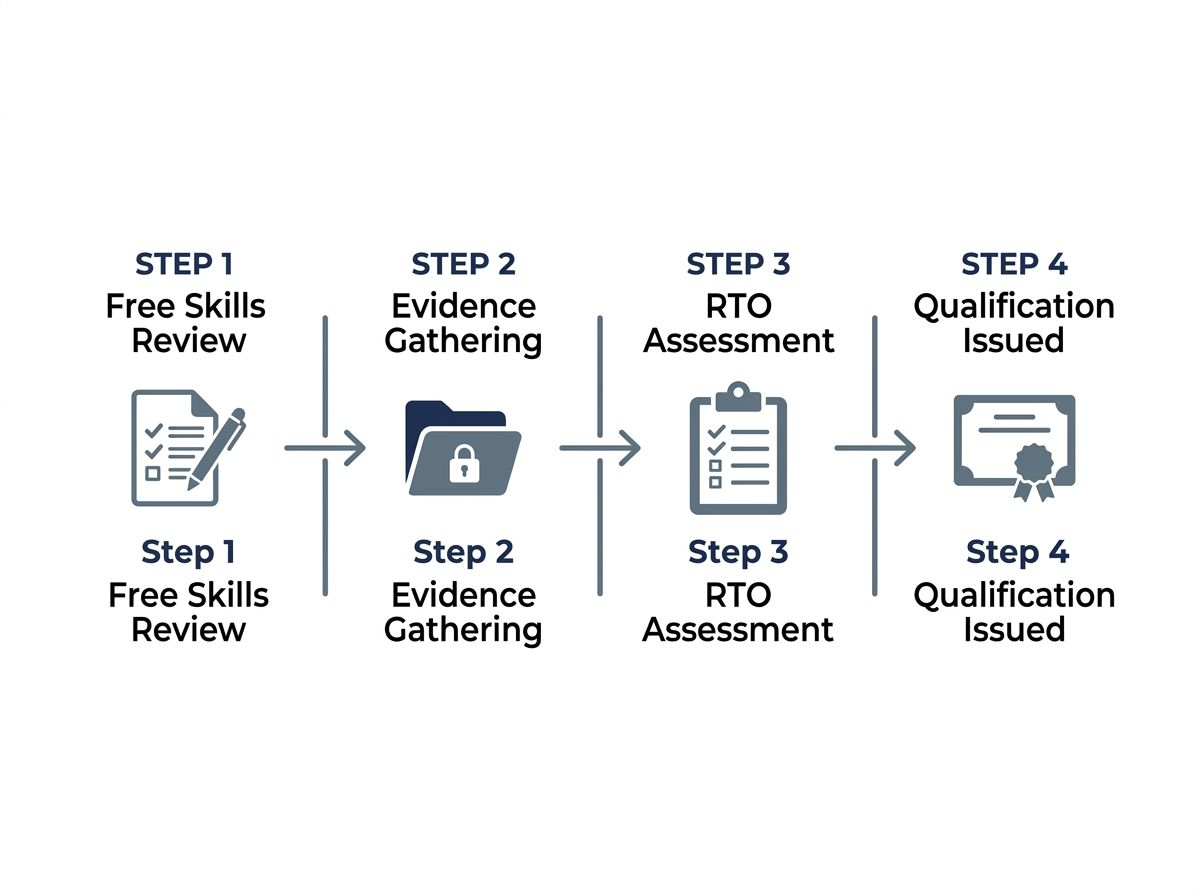
- Skills Review: An initial assessment of your background against the qualification's competency requirements. This is the starting point — and it is where you find out whether your experience is likely to support an RPL application before committing to anything.
- Evidence Gathering: Working through your existing documentation — reports, assessments, references, records — and organising it against the relevant competency units. This is the most time-intensive part of the process, and guided support makes it more manageable.
- RTO Assessment: A qualified assessor from the delivering Registered Training Organisation reviews your evidence against each unit's requirements. The assessor determines competency — not the RPL guide. If gaps are identified, gap training is provided.
- Qualification Issued: If the assessor determines that all competencies have been demonstrated, the RTO issues the qualification. The Certificate IV in Security Risk Analysis is a nationally recognised AQF Level 4 qualification.
Timeframes vary by provider and by the individual applicant's circumstances. One RTO publishes an RPL course duration of up to 12 months for a comparable Certificate IV security qualification, while the same provider states it aims to have RPL assessments finalised within 12 weeks — noting that the actual timeframe depends on the applicant's individual situation. These figures are indicative only and specific to that provider's published information. Confirm current timeframes directly with your chosen delivering RTO.
RPL it guides candidates through this process — helping you organise your evidence, understand the competency requirements, and navigate the assessment pathway. The assessment itself is conducted by a qualified assessor from the delivering RTO. The qualification is issued by the RTO, not by RPL it.
The value of the credential — beyond the paper
The Certificate IV in Security Risk Analysis does not change what you know. It changes what the market can see.
Training providers describe the qualification as relevant to roles that may include Security Risk Analyst, Security Risk Adviser, and Event Security Manager. These are roles that sit above the operational tier — positions that involve advising clients, managing risk frameworks, and contributing to security strategy rather than executing it.
The salary difference between operational security roles and analyst-level positions is meaningful. According to SEEK Salary Insights, Security Analyst roles in Australia carry an average advertised salary range of approximately $94,910 to $110,730 — with roles in the Information and Communication Technology sector averaging around $124,545 and Government and Defence roles averaging around $108,266. These are advertised salary ranges, not guaranteed earnings, and actual pay varies by employer, location, experience, and role definition.
For context on the operational security baseline, indicative figures from a training provider blog suggest security guards in Australia typically earn between $50,000 and $60,000 annually, with more experienced or qualified personnel earning more — though these figures are indicative only and actual pay depends on state, award, shift arrangements, and employer.
SEEK Salary Insights reports that Security Analyst roles in Australia show an average advertised salary range of $94,910 to $110,730, with variation across industries.
The credential also matters for career progression. Security professionals with formal risk qualifications may be better positioned for roles in security consulting, corporate risk advisory, and government security contracts — areas where procurement processes and client expectations increasingly specify formal qualifications. The qualification does not guarantee access to any of these pathways, but it removes a barrier that currently makes your experience invisible to the systems that filter for it.
Start with a free skills review — no commitment required
You have the experience. The question is whether it maps to the competency framework of the Certificate IV in Security Risk Analysis — and the only way to find out is to have it reviewed.
The Free Skills Review is the honest, low-commitment starting point. It is designed to give you a clear picture of whether your background is likely to support an RPL application before you commit to anything. If your experience maps to CPP41519, we will tell you. If it doesn't — or if a different qualification would be a better fit — we will tell you that too.
Recognition shouldn't require starting over. If you have been doing this work, your experience deserves to be counted.
Ready to Get Recognised?
Start with a free skills review to find out if RPL is right for you.