You've run recruitment, onboarding, and IR for years. BSB40420 is how that gets recognised.
If you have run recruitment, onboarding, and IR for years without a formal cert, BSB40420 may match your existing work. Here is how RPL recognises it.
By RPL it Australia9 min read

The HR generalist pattern: doing the work without the paper
You have the experience. You are the person managers call when they need to fill a role, when a new starter needs to be set up properly, when a performance conversation has gone sideways, or when someone raises a grievance and nobody else knows what to do next. You have handled it all quietly, competently, and without a formal qualification to show for it.
This is a common path. Across Australian workplaces, particularly in small and mid-sized businesses, there are HR coordinators and generalists running the full spectrum of people operations without the Certificate IV in Human Resource Management (BSB40420). They entered the profession through administration, payroll, or operations roles. They grew into the HR function through necessity and capability. Nobody handed them a study plan, and nobody told them they would eventually need a formal credential to prove what they already know how to do.
The pattern becomes visible at a specific moment: a promotion is advertised, a job description is reviewed, or a manager asks about qualifications, and the Certificate IV appears as a requirement. Not a suggestion, but a requirement. Suddenly, years of demonstrated competence are invisible on paper.
That is the credential gap. It is not a skills gap. The work is real, the capability is real, and the formal qualification is the only piece that is missing.
What BSB40420 covers and why it matches your job description
The Certificate IV in Human Resource Management (BSB40420) is a nationally recognised qualification on the Australian Qualifications Framework. It is delivered by registered training organisations (RTOs) and assessed against a defined set of competency units covering the core functions of an HR generalist role.
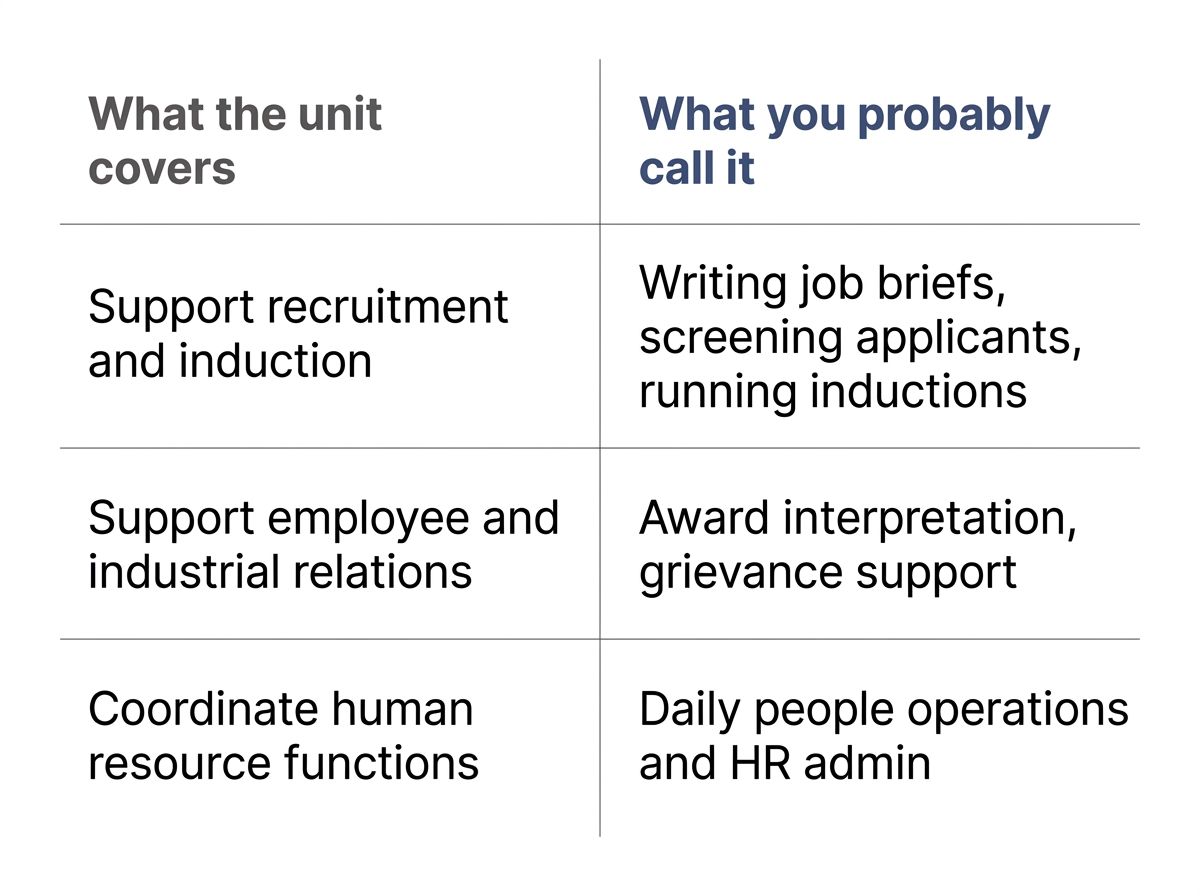
The qualification covers areas including: supporting staff recruitment and induction; supporting team learning and development; supporting employee and industrial relations; coordinating human resource functions; and supporting workforce planning. The specific unit codes and titles are published on training.gov.au, the official Australian government training register, and should be verified there for the current version of the qualification.
Think about what you did last week. If you wrote a job brief, screened applications, coordinated an interview panel, or ran an induction session, that is recruitment and induction. If you supported a manager through a performance conversation, documented the outcome, or managed a probation review, that is performance management. If you interpreted an award, responded to a grievance, or helped a manager understand their obligations before a disciplinary meeting, that is employee and industrial relations.
The qualification does not describe a theoretical HR function. It describes the actual work of an experienced HR generalist. For many practitioners, the gap between what BSB40420 assesses and what they do every day is smaller than they think.
The recruitment cycle you have run many times
Recruitment is often the most visible part of an HR coordinator's role, and it is one of the most straightforward areas to document for Recognition of Prior Learning assessment.
You have written the job brief, posted the advertisement, screened the applications, and shortlisted candidates. You have coordinated interview panels, managed the offer process, completed reference checks, and issued employment contracts. You have also set up new starters in the system to ensure their first day goes smoothly.
Each of those steps corresponds to assessed competencies within BSB40420. The qualification does not ask whether you can describe recruitment theory; it evaluates whether you can demonstrate that you have supported staff recruitment and induction in a real workplace context. If you do this work, you have the experience. The question is whether you have the records to demonstrate it.
Job advertisements you have written, interview guides you have prepared, offer letters you have drafted, and onboarding checklists you have used are all potential evidence. The work you have already done is the starting point.
Onboarding, induction, and the work that often goes unnoticed
Onboarding is the kind of work that becomes invisible when it works. When a new employee settles in quickly, feels welcomed, understands their role, and completes compliance training on time, nobody credits the HR coordinator who managed the process. It simply looks like a smooth start.
But designing and delivering induction programs, managing probation processes, coordinating compliance training, and ensuring new starters have what they need to perform is skilled work. It requires planning, coordination, communication, and systematic follow-through. It maps directly to assessed competencies in BSB40420.
If you have built induction schedules, created onboarding documents, managed the probation review process, or coordinated WHS inductions for new staff, that work is evidence. The induction checklists you created, the probation templates you developed, and the onboarding schedules you ran are the documents that demonstrate competency in an RPL assessment context.
The work is real and it counted for the organisation. It should count toward the qualification.
Performance management and the conversations that do not show up on a resume
Performance management is demanding work for any HR generalist. It involves managing real people in difficult situations and requires objective judgment, precise documentation, process knowledge, and the ability to support managers who are often uncomfortable with these conversations.
You have sat in those conversations, written those records, and managed the process from the first informal discussion through to a formal outcome—whether that was a performance improvement plan, a formal warning, or a successful turnaround. You have advised managers on their options and made sure the process was fair, documented, and defensible.
BSB40420 assesses competency in supporting performance management processes. This is an active, hands-on role that experienced HR coordinators play every time a performance issue arises. The qualification recognises that this is skilled work, and the RPL process asks you to demonstrate it through evidence: performance improvement plan templates, meeting records, and outcome documentation.
If you have managed this work, you have the experience. The main task is demonstrating that you have kept the records.
Basic IR: work that requires judgment, not just administration
Industrial relations work is where many HR coordinators feel most exposed, and where their capability is often underestimated. Interpreting a modern award, responding to a grievance, supporting a manager through a disciplinary process, or advising on notice periods and entitlements requires genuine knowledge of the Australian employment framework. It is analytical judgment work, not simple administration.
You have read the award, advised the manager, and documented the outcome. You have made sure the process was consistent with the Fair Work Act and the organisation's policies. You have done this without formal IR training because the organisation needed someone to do it, and you were the person who could.
BSB40420 includes competency units covering employee and industrial relations at the coordinator level. This is distinct from specialist IR work at the Diploma level. It covers the practical, day-to-day IR responsibilities of an experienced HR generalist, including award interpretation, grievance handling, disciplinary process support, and basic enterprise agreement administration.
If you have handled these matters in your role, that work is within scope for BSB40420 RPL assessment. The documentation you have retained, including correspondence, records of process, and policy documents you have applied, is potential evidence.
Why the credential gap persists and why it is not about skill
The pattern of experienced HR practitioners lacking a formal Certificate IV is common. It reflects how professionals enter and grow within HR roles in Australia.
Many HR coordinators did not start in HR. They started in administration, payroll, reception, or operations. They were competent, trusted, and when the organisation needed someone to help with recruitment or handle a people issue, they stepped up. Over time, that work became their primary role. They built capability through experience, not through a classroom.
The system rarely tells you that you need a formal qualification until the moment it becomes a barrier, such as a job advertisement, promotion criteria, tender requirement, or a conversation with a manager who asks about credentials. This is when the gap becomes visible—not because your capability has changed, but because the formal system requires a credential that your informal pathway did not provide.
The qualification barrier is not a measure of your capability. It is a reflection of how you entered the profession. Recognition of Prior Learning exists precisely for this situation—to provide a pathway that validates the work you have already done instead of requiring you to repeat it in a classroom.
If you are unsure whether RPL fits your situation, the evaluation process is straightforward.
How RPL converts your HR experience into BSB40420
Recognition of Prior Learning (RPL) is a formal assessment pathway within the Australian vocational education and training system. It allows a qualified assessor from a registered training organisation to evaluate your existing skills and experience against qualification requirements, without requiring you to complete the full course.
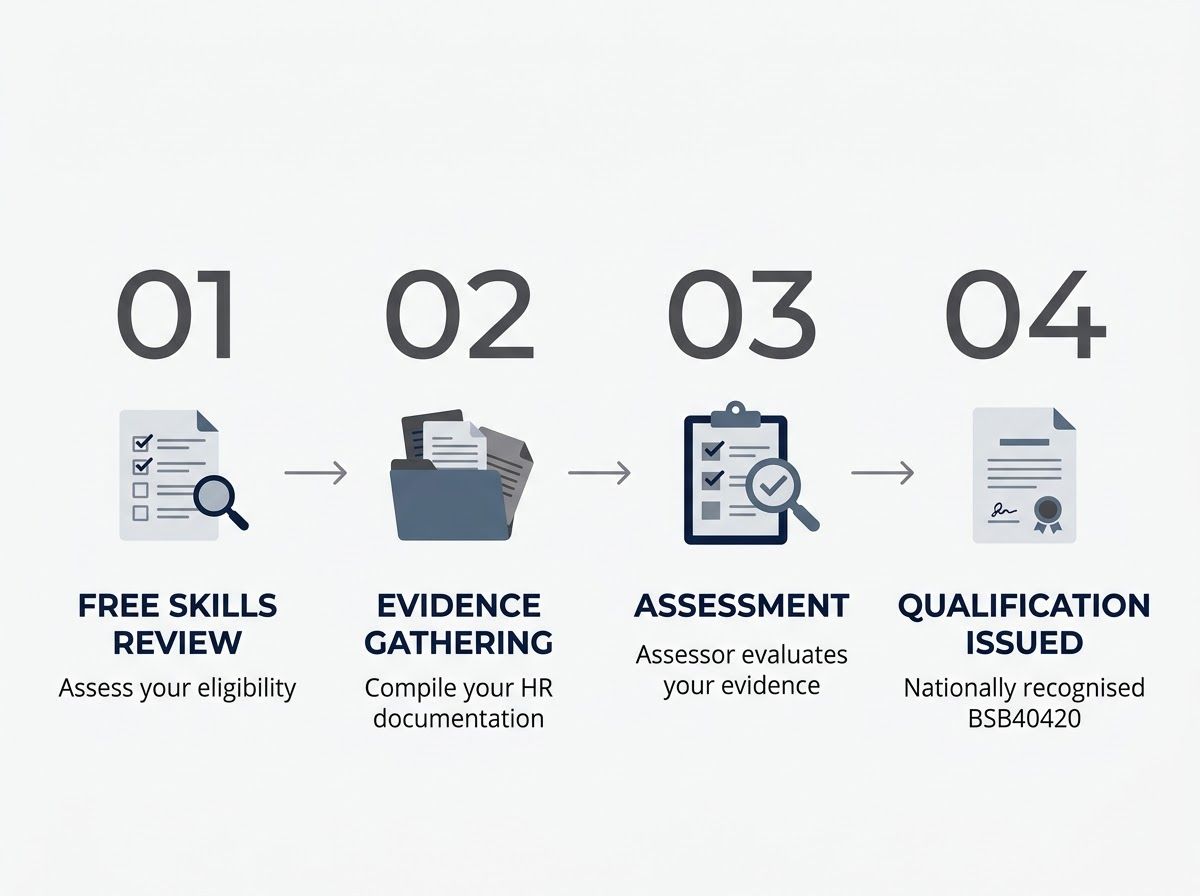
For BSB40420, the RPL process typically involves: an initial skills review to assess whether your experience meets the qualification requirements; an evidence-gathering phase where you compile documentation of your HR work; a formal assessment by a qualified assessor who evaluates your evidence; and, where gaps are identified, targeted gap training to address specific areas before the qualification is issued.
This is not a shortcut; it is a recognition pathway. The assessment is genuine, and the qualification, when issued, is the same nationally recognised Certificate IV in Human Resource Management that any student holds. The difference is that the evidence comes from your work history rather than a classroom.
If gaps are identified during assessment, gap training is provided to address them. The process is designed to be transparent about what you can and cannot demonstrate, ensuring your completed qualification holds genuine professional value.
What counts as evidence for BSB40420: a practical starting point
One of the most common barriers to starting an RPL process is not knowing where to begin. Most experienced HR coordinators have more evidence than they realise; they simply have not thought of their daily work documents as qualification evidence before.
The following types of documentation are commonly relevant to BSB40420 RPL assessment. Your specific evidence requirements will depend on the assessor's evaluation of your individual situation:
- Job advertisements and position descriptions you have written or contributed to
- Interview guides, assessment matrices, or selection criteria documents you have prepared
- Offer letters, employment contracts, and onboarding paperwork you have managed
- Induction programs, checklists, and starter guides you have designed or delivered
- Performance improvement plans or completed templates you have administered
- Records of performance conversations, formal warnings, or disciplinary files you have documented
- Grievance documentation or employee relations correspondence you have handled
- Award interpretation notes or policy documents you have applied or drafted
- WHS induction logs or compliance training records you have coordinated
- Referee statements or manager confirmation verifying your HR responsibilities
Digital records, including emails, HRIS exports, and shared documents, are generally acceptable as evidence, provided they demonstrate your active involvement in the work rather than simply your access to it. Where personal information is included, documents should be de-identified before submission.
The evidence-gathering phase is guided. You will not be expected to know exactly what to compile before you start, as the skills review process identifies what is needed and what you are likely to already have.
The next step: a free skills review with no obligation
You have the experience. The question is whether that experience maps to BSB40420 and whether you have the evidence to demonstrate it.
The Free Skills Review is designed to answer that question honestly before you commit to anything. It is not a sales call. It is a genuine assessment of your eligibility, and if RPL is not the right pathway for your situation, we will tell you directly.
If you want to explore the qualification itself first, the Certificate IV in Human Resource Management (BSB40420) product page has details on what the qualification covers and how the RPL pathway works through RPL it.
Learn more about the Certificate IV in Human Resource Management (BSB40420) and the RPL pathway.
The decision is yours. But if you have been doing this work for years and the qualification is the only thing that does not match, it is worth finding out.
General information only, current at the date shown. Licensing rules change, so check the current requirements with the relevant regulator before you rely on them. RPL it Australia is a student support service, not a Registered Training Organisation; qualifications are assessed and issued by our partner RTOs.