The hidden cost of unlicenced subcontractors for NT builders
Think unlicenced subbies save money on NT builds? One compliance breach can void your insurance and shut your site. Here is what NT builders need to know.
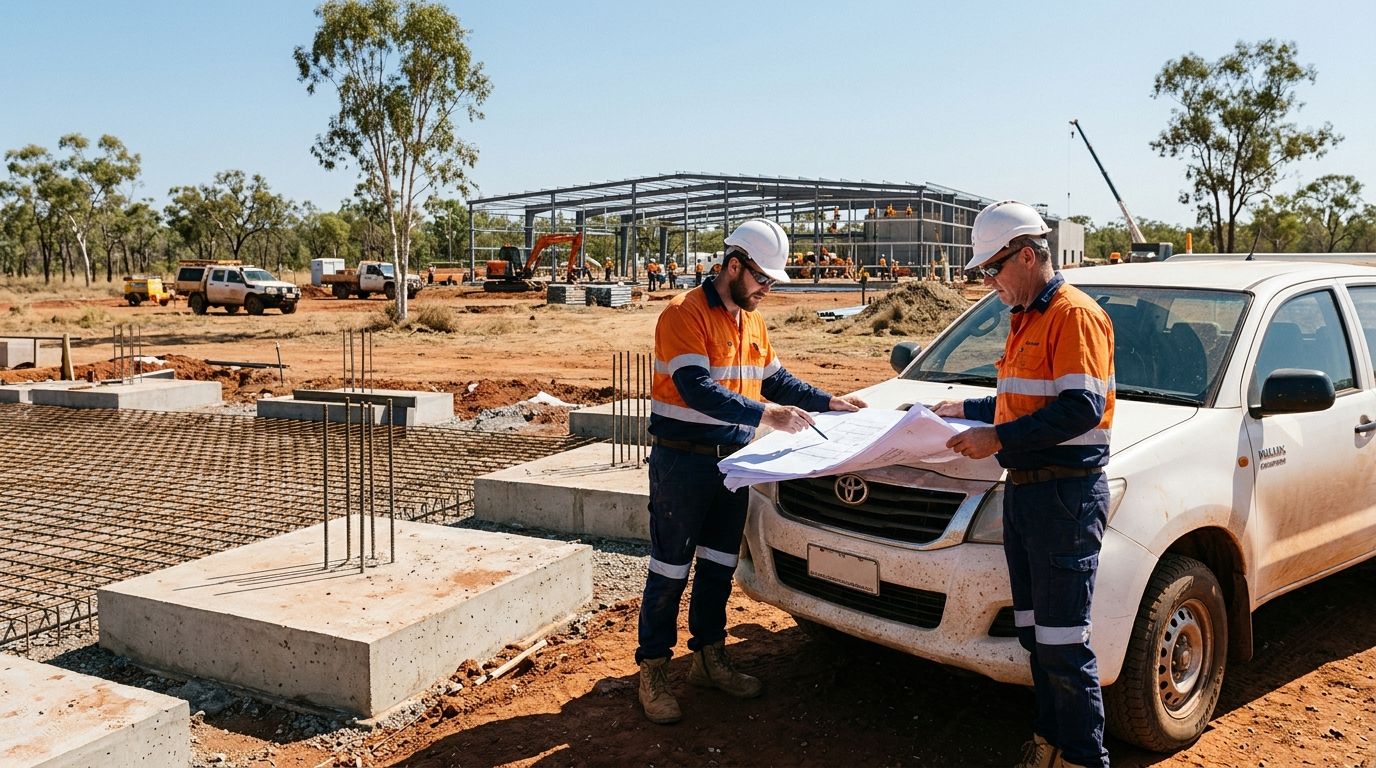
The 10% labour saving that could cost you everything
You have the experience to read a subcontractor. You know who turns up on time, who does clean work, and who you can trust on a remote NT site. So when a reliable tradesperson offers to do the job for less, and you know they are capable, the decision to engage them feels straightforward. The maths looks simple: lower labour cost, same quality outcome.
The maths is not simple. In the Northern Territory, engaging a subcontractor who does not hold the required registration with the NT Building Practitioners Board exposes you, the principal contractor, to consequences that have nothing to do with the quality of the work. Insurance disputes, regulatory action, and site shutdowns can each cost far more than the margin you saved on the subcontract.
This is not a theoretical risk. Across Australia, regulators pursue both the unlicensed worker and the principal who engaged them. In October 2024, the Supreme Court of Victoria issued a total of $759,674 in penalties to five companies and three directors for unlicensed labour hire operations in construction. The Labour Hire Authority described this as its first construction-industry prosecution and the highest total penalty for breaches of labour hire law in Australia at that time. Rocktown Pty Ltd was penalised $101,774 specifically for engaging two unlicensed subcontractors to supply workers for prefabricated concrete work. While that case was decided under Victorian law, the principle remains the same: the principal contractor carries exposure for the subcontractors they engage.
The Labour Hire Licensing Commissioner noted that while subcontracting can be lawful, it can also be used to conceal worker exploitation and the involvement of people who are not fit and proper. Licensing provides necessary checks and balances, with significant penalties for operating without one.
In the NT, the regulatory framework differs from Victoria's labour hire licensing scheme, but liability flowing up the contracting chain remains a consistent feature of Australian construction law. NT WorkSafe guidance notes that under section 127 of the Return to Work Act 1986 (NT), where a principal contracts with a contractor to perform work for the purpose of the principal's normal trade or business, and the contractor further subcontracts that work, all parties (principal, contractor, and subcontractor) may be liable for compensation to workers employed by the subcontractor.
What the NT builders licence framework actually covers
The NT Building Practitioners Board is the regulatory body responsible for registering building practitioners in the Northern Territory. Registration requirements, covering qualifications, experience, and insurance, are set out in Ministerial Determination No. S57, which was gazetted on 5 September 2025. Requirements can change, and the Board's published list of categories and conditions should be checked directly for current details.
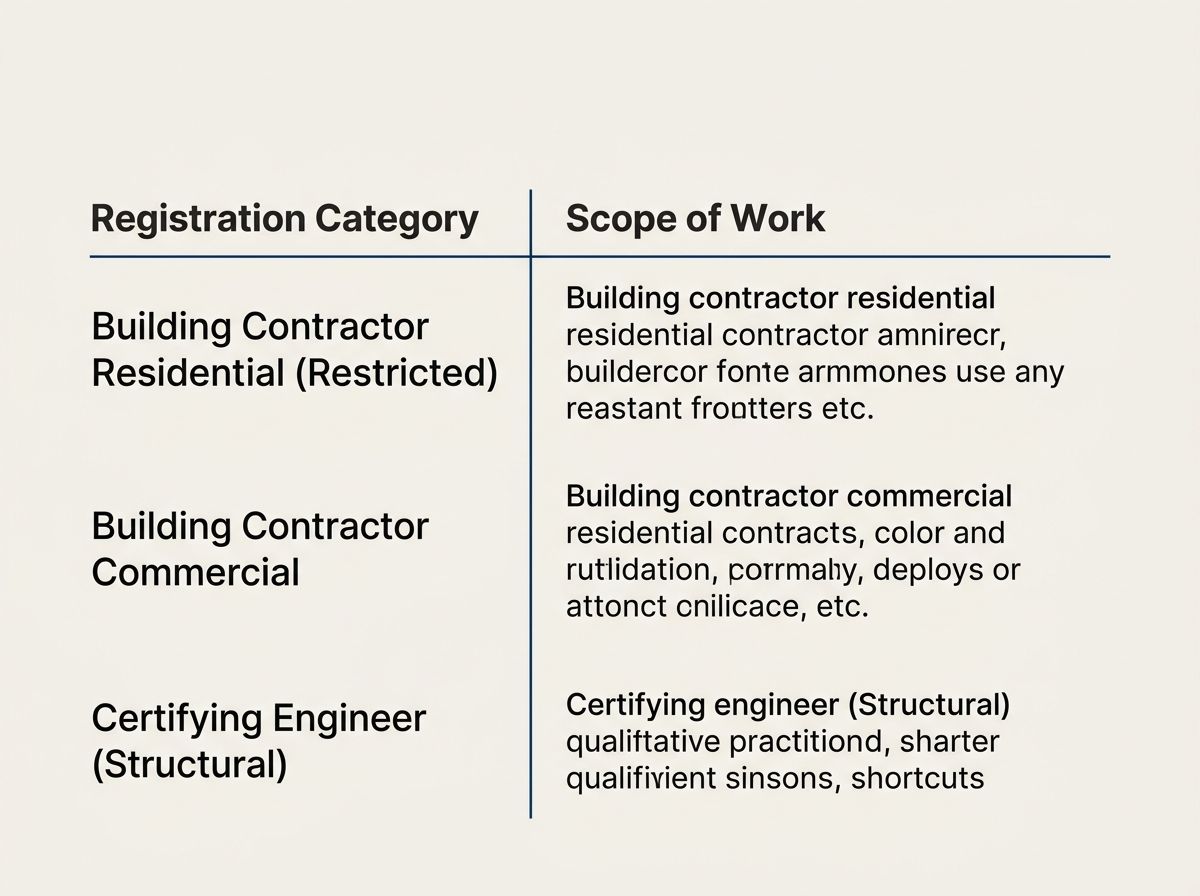
A significant change took effect on 15 April 2025: from that date, commercial building contractors who undertake building works in class 1b and classes 3 to 9 must hold NT building contractor commercial registration before performing any prescribed commercial building works in the Northern Territory. This is a material expansion of the registration requirement for commercial work, affecting both the subcontractors you engage on those project types and your own business.
The Board's registration framework covers multiple categories. One example is the Certifying Engineer (Structural) category, which allows a registered engineer to certify the design and construction of all classes of buildings or structures in accordance with the structural provisions of the Building Code of Australia. This illustrates the specificity of NT registration. The category, the scope of work it covers, and the conditions attached all matter when you are assessing whether a subcontractor's registration is appropriate for the work you are asking them to perform.
Education providers list the Certificate IV in Building and Construction (CPC40120) as a qualification that may be required as part of the NT builder registration pathway, alongside experience and other requirements. Applicants should confirm the current qualification prerequisites directly with the NT Building Practitioners Board, as requirements vary by registration category and may change.
The Australian Government's business guidance confirms that contractors are generally responsible for any licences or qualifications they need. However, that responsibility does not insulate the principal contractor from the consequences of engaging someone who does not hold the required registration.
Three ways an unlicenced subcontractor costs you more than you saved
The financial case against engaging an unlicenced subcontractor in the NT is not moral, it is arithmetic. There are three distinct cost vectors, each capable of exceeding the labour saving many times over.
1. Insurance disputes
Most standard builder's public liability policies contain conditions relating to lawful and licensed work. When an unlicenced subcontractor performs regulated building work, the circumstances of the claim may trigger a coverage dispute with your insurer. Whether a specific policy responds or declines to respond depends on the policy wording, the nature of the work, and the specific licensing breach involved. This is not a certainty in either direction, but it is a risk that is entirely avoidable by verifying registration before you engage.
NT WorkSafe advises principals and contractors to ask to see a copy of a current workers' compensation insurance policy rather than relying on being told a policy exists or on a policy clause in a contract. The same principle applies to registration: sighting the registration, not accepting an assurance, is the standard that protects you.
If you are unsure how your current policy treats subcontractor licensing, the right step is to read the policy conditions and speak with your broker before the next subcontract is signed, not after a claim is lodged.
2. Regulatory action
In Queensland, the QBCC states it has a zero-tolerance policy towards unlicensed contracting, and that some breaches can result in the courts imposing a period of imprisonment. The NT operates under its own regulatory framework, but the direction of travel across Australian jurisdictions is consistent: regulators are treating unlicensed contracting as a serious compliance matter, not an administrative technicality.
In South Australia, the Statutes Amendment (Building and Construction Industry Review — Penalties) Act 2025 (SA), which is South Australian legislation and does not apply in the NT, sets maximum penalties of $100,000 for a natural person for certain licensing offences as an illustrative comparator of the scale of penalties being introduced across Australian jurisdictions. NT penalty provisions are set out in the relevant NT legislation and should be confirmed directly with the NT Building Practitioners Board or NT legal counsel.
Where a licensed contractor's licence is suspended or cancelled, that contractor cannot continue to carry out building work, and an employee of that contractor may be committing an offence if they continue to work during the period of suspension or cancellation. The exposure is not limited to the unlicenced individual; it can extend to those who directed or enabled the work.
3. Project shutdown and delay
A compliance investigation or enforcement action on an active NT construction site can stop work while the matter is resolved. In the NT, where remote project environments, supply chain constraints, and workforce availability already create cost pressure, any unplanned shutdown compounds quickly. Preliminaries continue to run, plant may sit idle, and contract milestones are missed. Liquidated damages provisions in your contract may also be triggered.
No verified NT-specific benchmark for shutdown day-rate costs was available for this article. The appropriate reference point is your own project's preliminary costs, contract terms, and any liquidated damages exposure, which are specific to your project and contract. The point is not the precise number; it is that the cost of a shutdown on any mid-size NT project will substantially exceed the labour saving from an unlicenced subcontract.
How NT builders verify subcontractor registration before they sign
Verification is straightforward once you know where to look. The NT Building Practitioners Board maintains a Register of Building Practitioners that publishes details of practitioners registered in each category. If the register cannot be accessed online, the Board's licensing officer can be contacted on 1800 193 111 (prompt 2).
Before signing any subcontract for regulated building work in the NT, use this process:
- Identify the registration category required for the specific work scope. Registration categories are specific, and registration in one category does not cover work in another.
- Search the NT Building Practitioners Board's Register of Building Practitioners to confirm the subcontractor holds current registration in the relevant category.
- Check that the registration is current and is not expired, suspended, or subject to conditions that affect the work you are engaging them to perform.
- Retain a record of the verification, including the date you checked, what you found, and any documentation provided by the subcontractor.
- Confirm that the subcontractor holds current workers' compensation insurance by sighting the policy, rather than relying on an assurance.
- Check your own insurance policy conditions regarding subcontractor licensing before executing the subcontract.
The Board also provides downloadable registration forms for each registration category, which show what a registered practitioner is required to hold and maintain.
Practitioners who are currently registered in certain categories in other states or territories may be eligible to apply for registration in the NT under mutual recognition. If a subcontractor holds an equivalent interstate registration, eligibility for mutual recognition should be confirmed with the Board before the subcontract commences, rather than assumed.
What if your best subcontractor is not registered yet?
Many NT builders have long-term relationships with experienced tradespeople who have never formalised their registration. The work is good and the relationship is trusted. The issue is not competence; it is the absence of formal recognition.
This is exactly the situation that Recognition of Prior Learning (RPL) is designed to address. RPL is a formal assessment pathway, conducted by a registered training organisation (RTO), that evaluates a person's existing skills and experience against the requirements of a nationally recognised qualification. It is not a shortcut or a rubber stamp. It is a rigorous process in which the assessor determines whether the evidence of prior learning and experience is sufficient to demonstrate competency.
If your subcontractor's experience is sufficient, RPL can be a pathway to the qualification required for NT builder registration, such as the Certificate IV in Building and Construction (CPC40120) that education providers list as a possible prerequisite. The qualification alone does not grant registration; the subcontractor must still meet the Board's full application requirements, including experience, insurance, and character criteria. However, the qualification is often the missing piece, and RPL helps experienced tradespeople prove they already have the competency it represents.
Your role as the principal contractor is not to manage the RPL process; that remains between the subcontractor and the RTO. However, you can encourage a valued subcontractor to explore whether RPL is a realistic pathway for them. A Free Skills Review is the starting point: it is a no-obligation assessment of whether RPL is likely to be suitable, based on the individual's experience and background.
The NT builder's subcontractor compliance checklist
Before you sign the next subcontract for regulated building work in the NT, work through this checklist. It takes far less time than resolving a compliance problem after the fact.
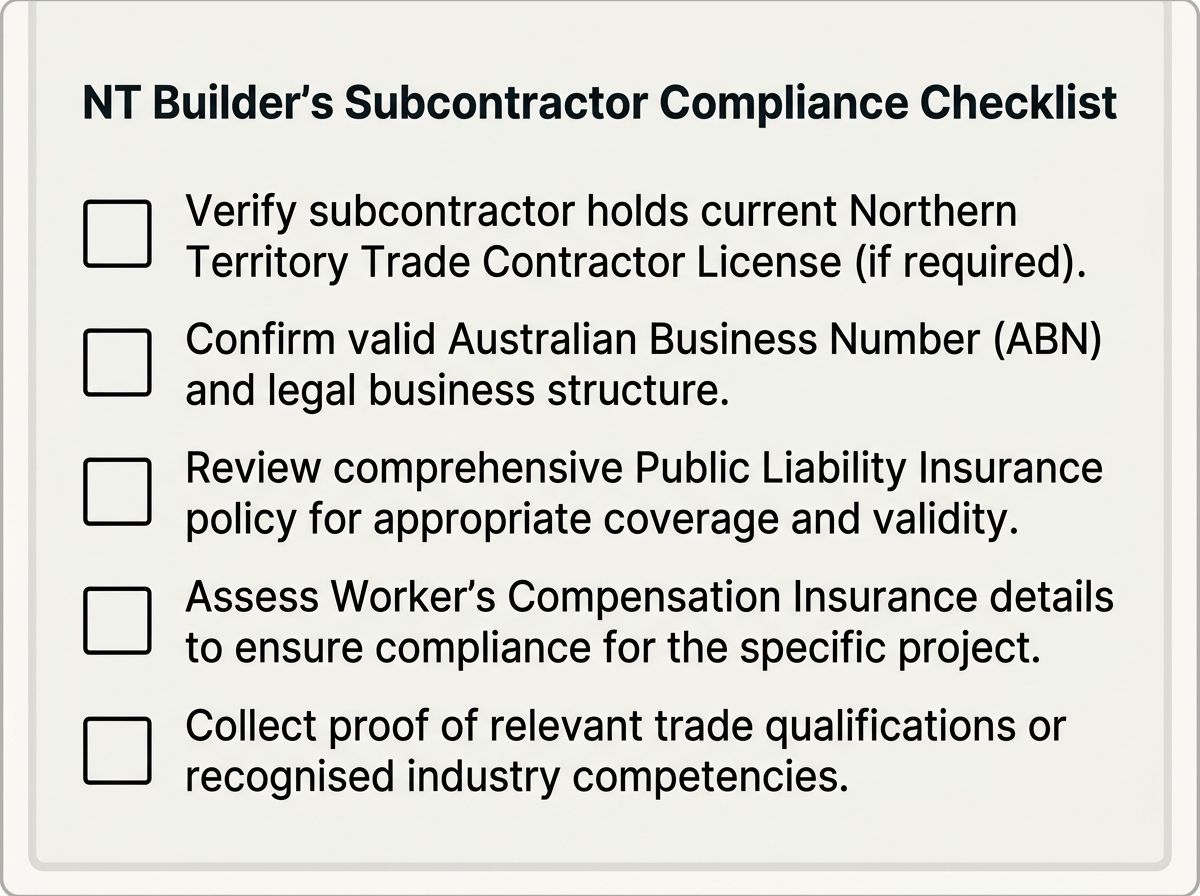
- Confirm the registration category required for the work scope. Do not assume a general building registration covers specialist work.
- Search the NT Building Practitioners Board Register of Building Practitioners to verify current registration in the correct category.
- Check registration currency to confirm it is not expired, suspended, or subject to conditions affecting the work.
- Sight the subcontractor's current workers' compensation insurance policy, rather than accepting a verbal assurance or a contract clause.
- Retain a written record of your verification, including the date, outcome, and any documents sighted.
- Review your own insurance policy conditions regarding subcontractor licensing before executing the subcontract, and speak with your broker if the position is unclear.
- If a valued subcontractor is not yet registered, explore whether RPL is a realistic pathway to the required qualification before continuing to engage them on regulated work.
The decision is yours. The risk is real, and the cost of getting it wrong through insurance disputes, regulatory action, or project delays will almost certainly exceed whatever you saved on the subcontract rate.
Ready to Get Recognised?
Start with a free skills review to find out if RPL is right for you.