Your Boss Just Said You Need a Cert III in Bricklaying — Here's What That Actually Means
Been told you need a Cert III in Bricklaying? You don't have to stop working or start over. Here's what the requirement means — and how RPL works.

The moment it lands
The site meeting. The HR email. The new clause in the contract. However it arrived, the message was the same: you need a Certificate III in Bricklaying and Blocklaying to keep working here.
You have been laying bricks for years. You know the work. And now someone is telling you that you need a piece of paper to prove it. The immediate questions are obvious — do I have to stop working? Go back to school? Start an apprenticeship at 38? The panic is understandable. But the answer to all three questions is almost certainly no.
Here is what the requirement actually means.
What your employer is actually asking for
The Certificate III in Bricklaying and Blocklaying (CPC33020) is a nationally recognised qualification under the Australian Qualifications Framework. It formally certifies that a person is competent across the full range of bricklaying and blocklaying work — including residential, commercial, and industrial contexts, as well as specialist areas like heritage bricklaying and paving.
The qualification is current and active. It covers 20 core units and 8 elective units, and occupational titles associated with it include Bricklayer, Blocklayer, and Paver.
What your employer is asking for is the certificate — the formal evidence that your competency has been assessed by a qualified assessor from a registered training organisation (RTO). They are not asking you to acquire new skills. They are asking for documented proof that you already have them.
Why this is happening now
Your employer is not questioning your ability. They are responding to external pressure — and that pressure is structural, not personal.
Subcontracting is the dominant model in Australian construction. According to a SafeWork NSW literature review, subcontractors are responsible for between 80 and 85 per cent of all construction work undertaken in Australia. As the industry has grown and regulatory scrutiny has increased, main contractors and project owners have become more rigorous about documenting the competency of workers on their sites.
Licensing requirements vary across Australian states and territories, and the specific obligations depend on where you work and the type of work you do. What is consistent across jurisdictions is that formal qualification is increasingly the baseline expectation — not just for licensing purposes, but for insurance, contract compliance, and site access. When a main contractor requires proof of qualification from a subcontractor, they are managing their own liability as much as anything else.
This shift has been building for years. If your employer has now made it a formal requirement, they are catching up to where the industry is heading — not inventing a new standard from scratch.
For a deeper look at the industry-wide forces driving this change, see our article on why more construction sites are requiring formal bricklaying qualifications.
The part nobody tells you: you don't have to learn what you already know
This is the part that changes everything.
Recognition of Prior Learning — RPL — is an assessment process that recognises skills and knowledge acquired through previous training, work, or life experience. According to the Australian Skills Quality Authority (ASQA), RPL allows a registered training organisation to assess existing competency against the requirements of a qualification. Part or all of a unit of competency can be granted through RPL.
ASQA defines RPL formally as a process that assesses an individual's formal, non-formal, and informal learning to determine the extent to which the individual meets the requirements specified in the training package.
In plain terms: if you have been doing the work, RPL is the mechanism that turns that experience into a formally assessed qualification. You are not going back to school. You are not starting an apprenticeship. You are presenting what you already know to a qualified assessor, who determines whether it meets the standard.
RPL does not create competency. It recognises it.
Registered training organisations are required to offer RPL to students, unless course rules or licensing requirements prevent it.
If you want to understand how experienced bricklayers turn years of site work into formal recognition — and what the process actually looks like — this article covers it in detail.
What you actually need to do
The RPL pathway for the Certificate III in Bricklaying and Blocklaying involves three broad stages. None of them require you to stop working.
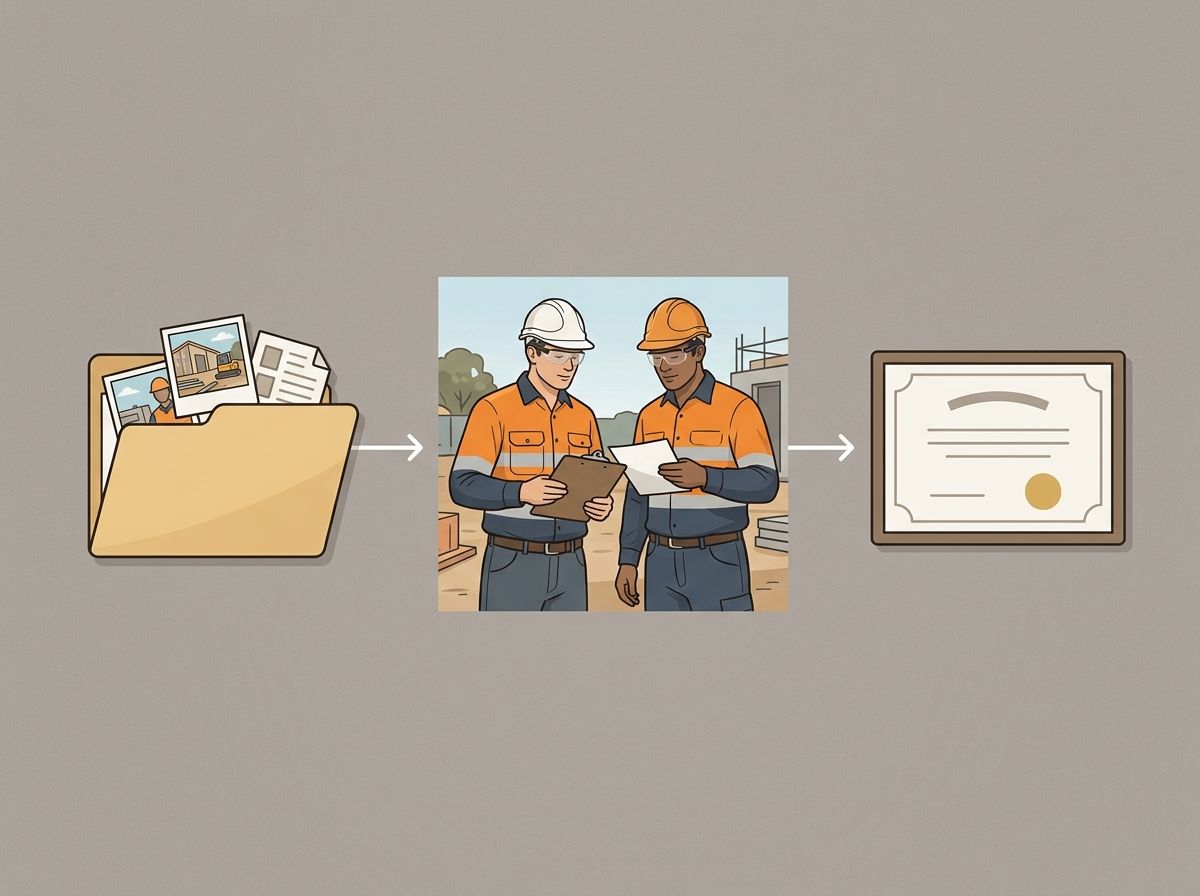
- Document your existing bricklaying work. This typically includes photos of completed work, references from employers or supervisors, job records, payslips or contracts that confirm your experience, and any relevant safety certificates or tickets you hold. The goal is to build a picture of your competency across the units in the qualification.
- Have your evidence assessed by a qualified assessor from a registered training organisation. The assessor reviews your evidence against the requirements of the Certificate III. In some cases, a practical demonstration or structured conversation may also be part of the assessment. RPL it guides you through this process — the assessment itself is conducted by the RTO.
- If any gaps are identified, gap training is provided. This is a normal part of the process, not a failure. It means there are specific units where your evidence does not yet fully meet the standard, and targeted training fills those gaps. Gap training is included as part of the RPL pathway through RPL it's partner RTOs.
How long does this take? For construction trade qualifications, the timeframe is typically longer than for other industries. The Master Builders Association of NSW, which runs its own RPL program for Certificate III trades including bricklaying, indicates that the process can take from 6 months to 12 months to complete. Timeframes vary depending on how complete and well-organised your evidence is, assessor availability, and whether gap training is required.
The Master Builders Association of NSW also cautions that fast-tracked RPL programs promising a trade qualification in less than 4 to 6 weeks should be treated with caution, as they often require minimal evidence and may not reflect a legitimate assessment process.
A rigorous assessment takes time because it is genuine. That is what makes the qualification nationally recognised and meaningful to your employer.
Is RPL right for you?
RPL suits workers with substantial, relevant, and reasonably recent experience in bricklaying and blocklaying. If you have been doing the work — laying bricks, blocks, and pavers across residential, commercial, or industrial sites — RPL is likely the right pathway.
If your bricklaying experience is limited, or if you have been working in a related trade but not specifically in bricklaying and blocklaying, RPL may not be the right fit. The assessment is against specific competency standards, and the evidence needs to match. Honest suitability guidance matters here — enrolling in an RPL process that does not fit your background wastes time and money.
The Free Skills Review is the starting point. It is a no-cost, no-obligation conversation about your background and whether RPL is the right pathway for your situation. You find out where you stand before committing to anything.
Your site experience is the starting point
The qualification your employer is asking for exists to recognise what you already do. The years on site are not irrelevant — they are the evidence. The next step is not a classroom. It is a structured process that takes what you already know and presents it in the form the formal system requires.
Your skills speak. The RPL process helps them be heard.
The decision is yours. If you want to understand how your bricklaying experience maps to the Cert III — and whether RPL is the right pathway — the qualification page is the place to start.
See how your bricklaying experience maps to the Cert III and what the RPL pathway looks like in practice.
Ready to Get Recognised?
Start with a free skills review to find out if RPL is right for you.