Do you actually need a plumbing licence in the ACT? (The 4-question checklist)
Unsure if your plumbing work in the ACT legally requires a licence? Answer these four questions to find out where you stand.

The question most ACT plumbers do not ask until it is too late
You know the work. You have been doing it for years, on residential jobs, commercial sites, and maintenance contracts. The tools feel right in your hands and the outcomes speak for themselves. But there is a question sitting quietly in the background that many experienced ACT plumbers have never properly answered: does what you do actually require a licence?
It is not an easy question to face, and it is simple to put off. Operating without a required licence in the ACT creates real legal and financial exposure. This is not because the system doubts your competence, but because the licensing framework exists to protect consumers and the public. Knowing where you stand is the first step to protecting yourself.
This checklist gives you four questions. Each one identifies a specific trigger under ACT licensing requirements. If you answer yes to any one of them, you are in scope and you need a licence to continue working legally. Work through them honestly. It takes less than two minutes to complete.
How to use this checklist
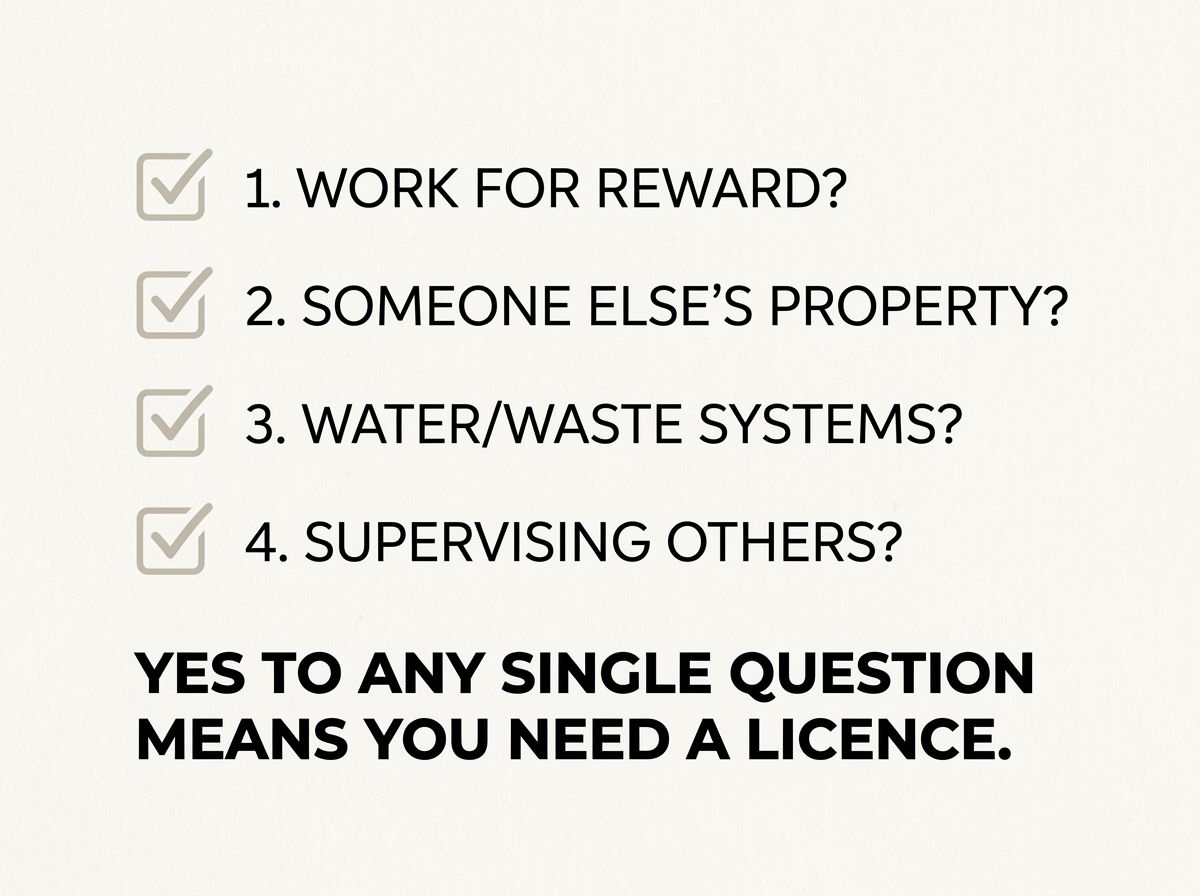
Four questions. Each has a yes or no answer. If you answer yes to any single question, you are in scope for the ACT plumbing licence requirement. You do not need to answer yes to all four; one is enough. Read each question, apply it to your actual work situation, and note your answer before moving on.
Question 1: Are you doing plumbing work for reward?
If you are paid for plumbing work in the ACT, you are doing it for reward. That is the threshold. It does not matter whether the payment is a formal invoice, a cash arrangement, a trade exchange, or a benefit in kind. If something of value changes hands in return for your plumbing work, this trigger applies.
This includes work done as part of your employment. If your employer pays you a wage and plumbing is part of your role, you are performing plumbing work for reward. This applies even if you never invoice a client directly yourself.
The only situation that may sit outside this trigger is work you do on your own property, for your own benefit, with no payment involved. But that exception is narrower than most people assume. It does not apply to investment properties or properties you do not personally occupy. If there is any doubt, treat the answer as yes and confirm your specific situation with Access Canberra.
If you answered yes to Question 1, you are in scope. Continue through the remaining questions to confirm the full picture.
Question 2: Are you working on someone else's property?
Work on a property you do not own and personally occupy is almost always in scope for the licensing requirement. This covers client properties, employer-owned sites, rental properties, commercial premises, and strata buildings.
The property ownership question catches more people than they expect. If you own an investment property and do the plumbing work yourself, that is not the same as working on your own home. The property is yours, but you do not occupy it, and in most licensing frameworks, that distinction matters.
Similarly, work on a family member's property, even if you do it as a favour, may still trigger the licensing requirement if you also receive any form of reward (see Question 1). The two questions work together.
The conservative default is this: if you are not the owner-occupier of the property where the work is being done, treat the answer as yes. If you believe an exemption applies to your specific situation, confirm it directly with Access Canberra before proceeding.
Question 3: Does the work involve water supply, sewerage, or drainage systems?
Not everything that involves pipes requires a plumbing licence. The licensing requirement in the ACT is tied to specific categories of work. If your work falls within these categories, the answer to this question is yes.
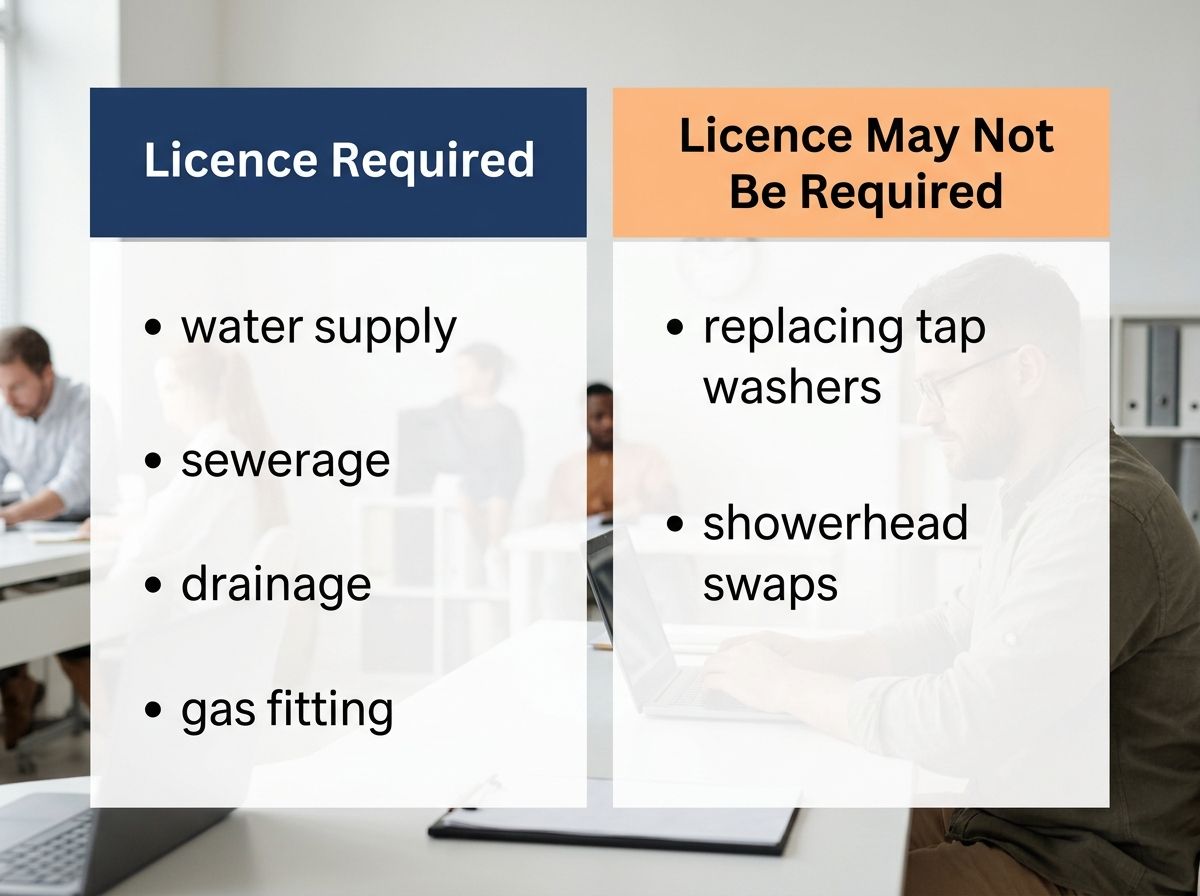
The core categories that generally require a plumbing licence in the ACT include:
- Water supply systems: installation, alteration, repair, or maintenance of pipes and fittings that carry potable water
- Sewage and sanitary drainage systems: work on pipes and fittings that carry waste from fixtures to the sewer
- Stormwater and roof drainage systems: gutters, downpipes, and drainage connected to stormwater infrastructure
- Gas fitting: installation, alteration, or repair of gas supply systems and appliances (note: gas fitting may require a separate or additional licence class; confirm with Access Canberra)
- Hot water systems: installation or replacement of water heaters connected to the water supply or gas system
Work that may not require a plumbing licence includes minor maintenance tasks that do not involve the core systems listed above. For example, you might replace a tap washer or a showerhead on an existing fitting. However, the line between minor maintenance and licensed work is not always obvious, and the consequences of getting it wrong are significant. If you are unsure whether your specific work type requires a licence, confirm with Access Canberra before proceeding.
If your work involves any of the categories listed above, the answer to Question 3 is yes.
Question 4: Are you supervising others who do this work?
This question catches more experienced tradespeople than any other. If you are supervising, directing, or taking responsibility for plumbing work carried out by others, even if you are not personally holding the tools, you may be required to hold a licence.
The licensing obligation in most Australian jurisdictions extends to the person who is responsible for the work, rather than only the person physically performing it. If you are the site supervisor, the business owner, or the senior tradesperson who signs off on the quality and compliance of plumbing work, you are likely in scope, regardless of whether you personally touch the pipes.
This also has implications for business structures. If you operate a plumbing business and employ or subcontract others to do the work, the question of who holds the licence, and whether that satisfies the ACT's requirements for the business as a whole, is one to confirm directly with Access Canberra. The rules vary, and the consequences of getting it wrong fall on the person responsible, not just the person doing the work.
If you are supervising plumbing work and taking responsibility for its quality and compliance, treat the answer to Question 4 as yes and confirm your specific obligations with Access Canberra.
What your answers mean
If you answered yes to any one of these four questions, you need a plumbing licence to work legally in the ACT. That is the conclusion. It is not a maybe, and it is not something that resolves itself over time.
Operating without a required licence in the ACT exposes you to significant financial penalties under ACT licensing law. Beyond the direct penalties, unlicensed work may also affect your insurance coverage. Many public liability policies exclude claims arising from work performed without the required licence. If something goes wrong on a job and you were not licensed, the financial and legal consequences can extend well beyond a fine.
None of this is about your competence. You may be an exceptional plumber. The licensing requirement exists to protect consumers and the public. It is a structural requirement, not a judgement on your skill. The good news is that your skill is exactly what the recognition pathway is designed to assess.
If you need a licence, here is the pathway that recognises what you already know
For experienced plumbers who answered yes to any of the four questions, the ACT plumbing licence pathway through Recognition of Prior Learning (RPL) is worth understanding. RPL is not a training programme. It is an assessment process that evaluates whether you can demonstrate competency against the units that underpin the Certificate III in Plumbing, which is the qualification required to apply for an ACT plumbing licence.
That means your years of on-the-job experience are not irrelevant. They are evidence. The RPL process is designed to assess that evidence through documentation, practical demonstration, and third-party verification, and determine whether it meets the required standard. If it does, the qualification is issued by a registered training organisation. If gaps are identified, structured support is available.
RPL is a rigorous process. It is not a shortcut, and it does not bypass legitimate assessment. What it does is recognise that competency can be built through experience, rather than formal study alone, and it provides a structured pathway to have that competency formally assessed.
The ACT plumbing licence pathway is available for experienced plumbers who are ready to have their competency formally assessed. Your experience is real. The question is whether it has been formally recognised.
Find out more about the ACT plumbing licence pathway through RPL.
Ready to Get Recognised?
Start with a free skills review to find out if RPL is right for you.