End of financial year is your real accounting exam
If you survived a messy EOFY reconciliation, you have already demonstrated diploma-level accounting skills. Here is what that means for your career.

If you have reconciled a complex corporate EOFY, you have already passed the hardest accounting exam. You just did not receive a certificate for it.
The exam nobody told you you were sitting
You know exactly how EOFY feels. The reconciliations that refuse to balance at 11pm. The BAS lodgements that must be flawless. The management reports that have to explain complex financial stories to stakeholders who do not work with numbers daily. The payroll year-end that cannot wait. The tax provisions that must be correct the first time.
This demanding period is a direct, practical demonstration of the exact competencies assessed in a Diploma of Accounting. You completed the work and met the standards, but the system has not yet issued the formal credential.
This highlights a practical reality that many experienced accounting professionals do not realise: the qualification you are told you need to study for is largely a structured assessment of what you already perform daily. EOFY, as the most compressed and demanding period in the Australian accounting calendar, is where this operational competence is most clearly demonstrated.
What a Diploma of Accounting actually tests
Without the classroom framing, a Diploma of Accounting is a competency-based qualification. The assessment does not focus on theoretical knowledge; it tests whether you can perform specific accounting tasks to an industry-standard level. The units cover key professional areas including financial reporting, management accounting, tax compliance, budgeting, and the preparation and lodgement of statutory obligations.
Competency-based assessment does not require classroom attendance. Instead, it requires you to show, through documented evidence, that you can perform the work. This distinction is highly relevant for experienced professionals because the evidence of their competence already exists. It is found in daily spreadsheets, reconciliation files, BAS lodgements, management reports, and year-end workpapers.
The qualification does not test whether you can write essays about accounting theory. It tests whether you can execute the tasks. If you have been doing this work, especially under the pressure of EOFY, the gap between your competence and your credential is a documentation issue rather than a skills deficit.
The EOFY competency map: What you did vs what the diploma requires
The mapping below shows how common EOFY tasks correspond to the competencies assessed in a Diploma of Accounting. Specific unit codes and titles should be verified against the current version of FNS50222 on training.gov.au, as training packages are updated periodically. These descriptions show the general competency areas covered by the qualification.
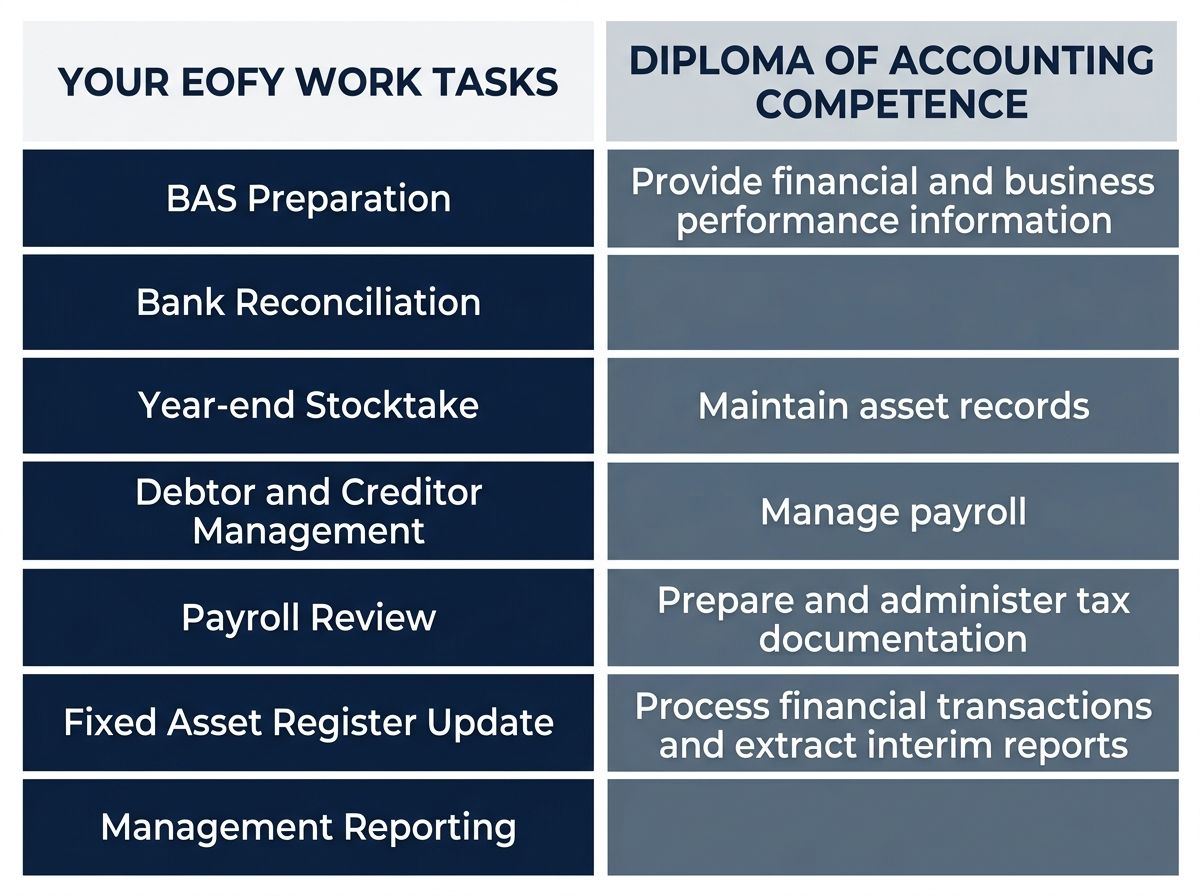
- Preparing and lodging Business Activity Statements (BAS) and Instalment Activity Statements (IAS) → Competency in tax compliance and statutory reporting obligations, including GST, PAYG withholding, and fringe benefits tax
- Preparing end-of-year financial statements (including profit and loss, balance sheet, and cash flow statements) for management and external stakeholders → Competency in financial reporting and the preparation of general-purpose financial statements
- Reconciling accounts across the general ledger, bank accounts, debtors, creditors, and payroll functions → Competency in accounting systems and general ledger reconciliation processes
- Preparing management accounting reports (including variance analysis, budget-to-actual comparisons, and cost centre reporting) for internal decision-making purposes → Competency in management accounting and performance reporting
- Processing payroll year-end, including payment summaries, superannuation reconciliations, and Single Touch Payroll finalisation → Competency in payroll systems and statutory payroll obligations
- Preparing tax provisions and working alongside external tax advisers on corporate income tax compliance → Competency in income tax and business tax obligations
- Reviewing and adjusting journal entries to ensure an accurate period-end financial position → Competency in accounting adjustments and the application of accounting standards
If you performed most of these tasks during your last EOFY as the senior professional responsible for the accuracy and completeness of the output, rather than a junior clerk processing transactions, you have demonstrated the core competencies of a Diploma of Accounting. The primary question is whether those existing skills are formatted in a way that the formal education system can recognise.
Why surviving EOFY is not enough on its own
While your practical experience is real, it exists in a format that is not yet ready for formal recognition. The formal system—including the Australian Qualifications Framework, registered training organisations, and employers—requires objective evidence rather than unsubstantiated claims.
Recognition of Prior Learning (RPL) is the formal assessment pathway that bridges this gap. It is a rigorous, established process under the Australian Qualifications Framework through which a qualified assessor from a registered training organisation evaluates whether your existing skills and knowledge meet the requirements of a qualification. This professional assessment is thorough, and the resulting qualification is nationally recognised across Australia.
RPL translates your practical experience, including reconciliations, BAS lodgements, and financial statements, into formal evidence. Rather than teaching you new skills, it provides a pathway for your current capabilities to be formally acknowledged.
The difference between your EOFY performance and a formal credential is an evidence gap rather than a skills deficit. RPL is the pathway used to close this gap.
What RPL for a Diploma of Accounting actually looks like
The RPL process for a Diploma of Accounting involves several stages. Understanding each step helps you prepare before committing to the process.
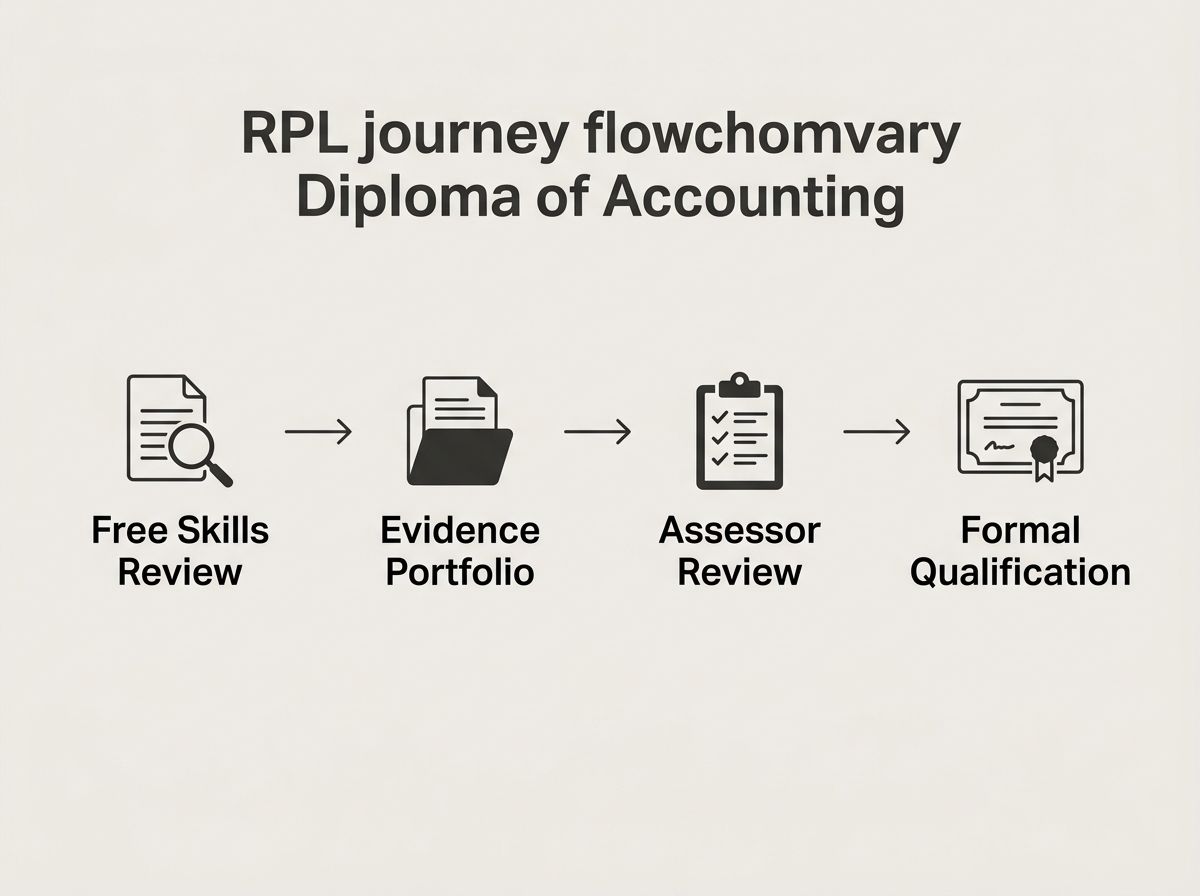
- Free Skills Review: Before starting any formal process, a skills review determines whether your professional experience profile supports an RPL assessment. This initial conversation carries no obligation and provides direct suitability guidance rather than enrolment pressure.
- Evidence Gathering: If the skills review indicates suitability, the next stage involves compiling evidence of your competence. This includes practical work samples such as financial statements, reconciliation files, BAS lodgements, and management reports, which are documents most accounting professionals already use in their roles. A structured portfolio is prepared with guidance from RPL it.
- Assessment by a Qualified Assessor: The evidence portfolio is assessed by a qualified assessor from the delivering registered training organisation (RTO). The assessor determines whether the evidence demonstrates competency against the qualification requirements. This is an independent professional assessment; RPL it guides you through compiling the portfolio, but the final assessment outcome rests with the RTO's assessor.
- Qualification Issued: If the assessor determines competency has been demonstrated, the RTO issues the qualification. If gaps are identified, gap training is provided, usually at no additional cost, to address specific units before the qualification is formally awarded.
The timeframe for an RPL assessment depends on the complexity of the qualification, the completeness of the evidence, and your personal circumstances. It is a structured process rather than an overnight transaction, and reputable providers will be clear about this timeline. RPL offers a pathway that respects your past investment, including your years of work, EOFY delivery, and professional judgement, without requiring you to repeat these subjects in a classroom.
Is your EOFY experience enough to start an RPL assessment?
Not every accounting professional who works through EOFY will be suitable for RPL. Suitability depends on several specific factors beyond simply holding a job in the field.
Strong indicators of RPL suitability for a Diploma of Accounting include: several years of experience managing accounting functions with direct responsibility for final outputs rather than transactional data entry; experience across a broad range of competency areas rather than a narrow specialisation; recent industry experience, as skills from the distant past require more supporting evidence; and the availability of documentary evidence such as work samples, reference letters, and professional records.
If your EOFY experience involved preparing financial statements, managing compliance obligations, and producing management reports, and you have documentation of that work, your experience profile is well-suited for evaluation. If your EOFY role was primarily transactional, or if your experience is concentrated in a single narrow area, the assessment process may be more complex.
Our Free Skills Review is designed to address this uncertainty. This is a no-cost, no-obligation evaluation of your experience profile to determine if RPL is a viable pathway for your specific situation before you commit to the process.
Your experience is real. The question is whether it is ready to be recognised.
Each EOFY cycle you complete, including every reconciliation closed, BAS lodged, and management report delivered under pressure, is practical evidence of competence. The Australian education system covers these exact competencies under the Diploma of Accounting.
The gap between your skills and a formal qualification is a matter of recognition. RPL closes this gap by guiding you through compiling and presenting your existing evidence in a format that assessors can formally evaluate.
We help you translate your practical experience into a recognized qualification. The decision to take the next step is yours.
Ready to Get Recognised?
Start with a free skills review to find out if RPL is right for you.